
Name: Glyceryl Monooleate
CAS No: 9-Octadecenoic acid (Z), monoester with 1,2,3-propanetriol [25496-72-4]
BP: Glycerol Mono-oleate PhEur: Glyceryl Monooleate USP-NF: Glyceryl Monooleate
Aldo MO; Atlas G-695; Capmul GMO; glycerol-1-oleate; glyceroli mono-oleas; glyceryl mono-oleate; HallStar GMO; Imwitor 948; Kessco GMO; Ligalub; monolein; Monomuls 90-O18; mono-olein; a-mono-olein glycerol; Peceol; Priolube 1408; Stepan GMO; Tegin.
9-Octadecenoic acid (Z), monoester with 1,2,3-propanetriol [25496-72-4]
C21H40O4 ,356.55 (for pure material)
Glyceryl monooleate is a polar lipid that swells in water to give several phases with different rheological properties.(1) It is available in both nonemulsifying (n/e) and self-emulsifying (s/e) grades, the self-emulsifying grade containing about 5% of an anionic surfactant. The nonemulsifying grade is used in topical formulations as an emollient and as an emulsifying agent for water-in-oil emulsions. It is also a stabilizer for oil-in-water emulsions. The self-emulsifying grade is used as a primary emulsifier for oil-in-water systems.(2) Glyceryl monooleate gels in excess water, forming a highly ordered cubic phase that can be used to sustain the release of various water-soluble drugs.(3–6) It is also the basis of mucoadhesive drug delivery systems.(7,8) Glyceryl monooleate is reported to enhance transdermal(9) and buccal penetration.
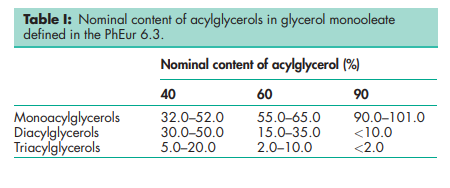
The PhEur 6.3 describes glyceryl monooleate as being a mixture of monoacylglycerols, mainly monooleoylglycerol, together with variable quantities of di- and triacylglycerols. They are defined by the nominal content of monoacylglycerols (see Table I) and obtained by partial glycerolysis of vegetable oils mainly containing triacylglycerols of oleic acid or by esterification of glycerol by oleic acid, this fatty acid being of vegetable or animal origin. A suitable antioxidant may be added. Glyceryl monooleates occur as amber oily liquids, which may be partially solidified at room temperature and have a characteristic odor.
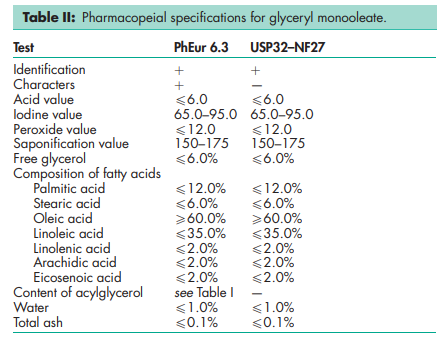
See Table II.
Boiling point 238–2408C Density 0.942 g/cm3 Flash point 2168C HLB value 3.3 (n/e); 4.1 (s/e). Melting point 358C (see also Section 13) Refractive index 1.4626 Solubility Soluble in chloroform, ethanol (95%), ether, mineral oil, and vegetable oils; practically insoluble in water. The selfemulsifying grade is dispersible in water. Viscosity (kinematic) 100 m2 /s (100 cSt) at 408C
Glyceryl monooleate should be stored in an airtight container, protected from light in a cool, dry place.
Glyceryl monooleate is incompatible with strong oxidizing agents. The self-emulsifying grade is incompatible with cationic surfactants.
Glyceryl monooleate is prepared by the esterification of glycerol with fatty acids, chiefly oleic acid. As the fatty acids are not pure substances, but rather a mixture of fatty acids, the product obtained from the esterification will contain a mixture of esters, including stearic and palmitic. Di- and triesters may also be present. The composition and, therefore, the physical properties of glyceryl monooleate may thus vary considerably from manufacturer to manufacturer; e.g. the melting point may vary from 10–358C.
Observe normal precautions appropriate to the circumstances and quantity of material handled.
GRAS listed. Included in the FDA Inactive Ingredients Database (oral capsules, oral powder, oral tablets; creams, controlled-release transdermal films). Included in nonparenteral medicines licensed in the UK. Included in the Canadian List of Acceptable Non-medicinal Ingredients.
Glyceryl monostearate.
A specification for glyceryl monooleate is included in the Food Chemicals Codex (FCC).(11) The EINECS number for glyceryl monooleate is 247-038-6. The PubChem Compound ID (CID) for glyceryl monooleate includes 5283468 and 33022.