
Name: Glyceryl Palmitostearate
CAS No: Octadecanoic acid, 2,3-dihydroxypropyl ester mixed with 3-hydroxy-2-[(1-oxohexadecyl)-oxy] propyl octadecanoate [8067-32-1]
None adopted.
Glycerin palmitostearate; glycerol palmitostearate; 2-[(1-oxohexadecyl)-oxy]-1,3-propanediyl dioctadecanoate and 1,2,3-propane triol; Precirol ATO 5
Octadecanoic acid, 2,3-dihydroxypropyl ester mixed with 3-hydroxy-2-[(1-oxohexadecyl)-oxy] propyl octadecanoate [8067-32-1]
Glyceryl palmitostearate is a mixture of mono-, di-, and triglycerides of C16 and C18 fatty acids.
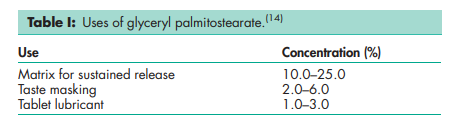
Glyceryl palmitostearate is used in oral solid-dosage pharmaceutical formulations as a lubricant.(1,2) Disintegration times increase(3) and tablet strength decreases(4) with increase in mixing time. It is used as a lipophilic matrix for sustained-release tablet and capsule formulations.(5,6) Tablet formulations may be prepared by either granulation or a hot-melt technique,(7,8) the former producing tablets that have the faster release profile. Release rate decreases with increased glyceryl palmitostearate content.(5) Glyceryl palmitostearate is used to form microspheres, which may be used in capsules or compressed to form tablets,(9,10) pellets,(11) coated beads,(12) and biodegradable gels.(13) It is also used for taste-masking.(14) See Table I.
Glyceryl palmitostearate occurs as a fine white powder with a faint odor
—
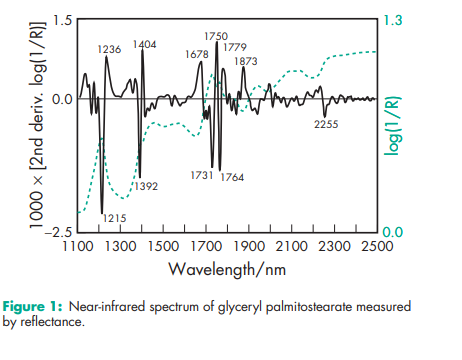
Acid value <6.0 Boiling point 2008C Color <3 (Gardner scale) Free glycerin content <1.0% Heavy metals <10 ppm Hydroxyl value 60–115 Iodine value <3 Melting point 52–558C 1-Monoglycerides content 8.0–17.0% NIR spectra see Figure 1. Peroxide value <3.0 Saponification value 175–195 Solubility Freely soluble in chloroform and dichloromethane; practically insoluble in ethanol (95%), mineral oil, and water. Sulfated ash <0.1% Unsaponifiable matter <1.0% Water content <1.0%
Glyceryl palmitostearate should not be stored at temperatures above 358C. For storage for periods over 1 month, glyceryl palmitostearate should be stored at a temperature of 5–158C in an airtight container, protected from light and moisture.
Glyceryl palmitostearate is incompatible with ketoprofen(15) and naproxen.(16)
Glyceryl palmitostearate is manufactured, without a catalyst, by the direct esterification of palmitic and stearic acids with glycerol.
Glyceryl palmitostearate is used in oral pharmaceutical formulations and is generally regarded as an essentially nontoxic and nonirritant material. LD50 (rat, oral): >6 g/kg(14)
Observe normal handling precautions appropriate to the circumstances and quantity of material handled.
GRAS listed. Included in the FDA Inactive Ingredients Database (oral suspension, oral tablet). Included in nonparenteral preparations licensed in Europe. Included in the Canadian List of Acceptable Non-medicinal Ingredients.
Glyceryl behenate; glyceryl monostearate.
The EINECS number for glyceryl palmitostearate is 232-514-8. The PubChem Compound ID (CID) for glyceryl palmitostearate is 114690.