
Name: Imidurea
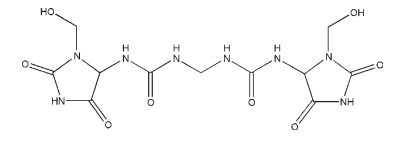
CAS No: N,N00-Methylenebis{N0-[3-(hydroxymethyl), 2,5-dioxo-4-imidazoli dinyl]urea} [39236-46-9]
USP-NF: Imidurea
Biopure 100; Germall 115; imidazolidinyl urea; methanebis[N,N0 (5-ureido-2,4-diketotetrahydroimidazole)-N,N-dimethylol]; 1,10 - methylenebis{3-[3-(hydroxymethyl)-2,5-dioxo-4-imidazolidinyl]urea}; Tri-Stat IU.
N,N00-Methylenebis{N0-[3-(hydroxymethyl), 2,5-dioxo-4-imidazoli dinyl]urea} [39236-46-9]
C11H16N8O8 388.29 (for anhydrous) C11H16N8O8.H2O 406.33 (for monohydrate)
Imidurea is a broad-spectrum antimicrobial preservative used in cosmetics and topical pharmaceutical formulations; typical concentrations used are 0.03–0.5% w/w. It is effective between pH 3–9 and is reported to have synergistic effects when used with parabens;
Imidurea is a white, free-flowing odorless powder.
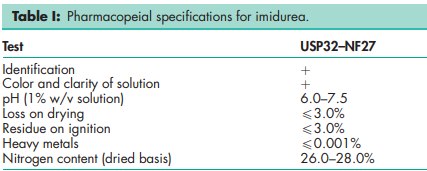
See Table I.
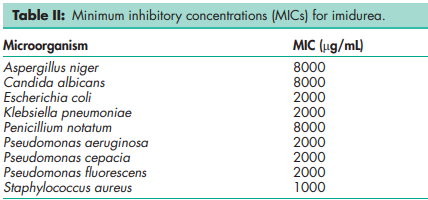
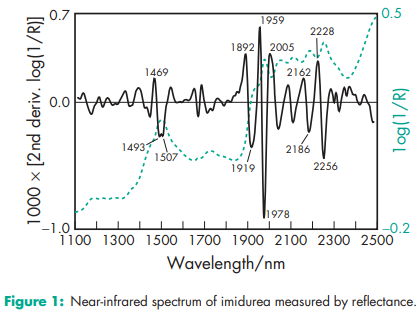
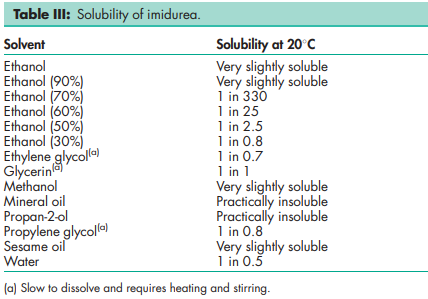
Acidity/alkalinity pH = 6.0–7.5 (1% w/v aqueous solution) Antimicrobial activity Predominantly an antibacterial preservative, imidurea also has some selective antifungal properties. Used at concentrations between 0.03–0.5% w/w it is effective between pH 3–9, although preservative efficacy is best seen in slightly acidic solutions. Synergistic effects have been reported, and preservative activity is considerably enhanced, particularly against fungi, when used in combination with parabens.(1,2) A cosmetic formulation containing 0.5% imidurea, 0.2% methylparaben, and 0.1% propylparaben was effectively preserved against various Pseudomonas species.(3) For reported minimum inhibitory concentrations (MICs), see Table II.(4) NIR spectra see Figure 1. Solubility Soluble in water and in glycerol, but insoluble in almost all organic solvents.(4)
Imidurea is hygroscopic and should be stored in a well-closed container in a cool, dry place.
Imidurea is incompatible with strong oxidants. It is compatible with other preservatives including sorbic acid and quaternary ammonium compounds.(5) It is also compatible with other pharmaceutical and cosmetic excipients including proteins, nonionic surfactants, and lecithin.(6)
Imidurea is produced by the condensation of allantoin with formaldehyde.
Imidurea is widely used in cosmetics and topical pharmaceutical formulations, and is generally regarded as a nontoxic and nonirritant material.(5) However, there have been some reports of contact dermatitis associated with imidurea, although these are relatively few considering its widespread use in cosmetics.(7–12) Although imidurea releases formaldehyde, it does not appear to be associated with cross-sensitization with formaldehyde or other formaldehyde-releasing compounds. LD50 (mouse, oral): 7.2 g/kg(13,14) LD50 (rabbit, skin): > 8 g/kg LD50 (rat, oral): 11.3 g/kg
Observe normal precautions appropriate to the circumstances and quantity of material handled. Imidurea may be irritant to the eyes. Eye protection and gloves are recommended.
Included in the FDA Inactive Ingredients Database (topical preparations). Accepted for use in cosmetics in Europe and the USA. Included in the Canadian List of Acceptable Non-medicinal Ingredients.
Diazolidinyl urea. Diazolidinyl urea Empirical formula C8H14N4O7 Molecular weight 278.23 CAS number [78491-02-8] Synonyms Germall II; N-(hydroxymethyl)-N-(1,3-dihydroxymethyl-2,5-dioxo-4-imidazolidinyl)-N0 -(hydroxymethyl)urea. Appearance White, free-flowing hygroscopic powder, with a faint characteristic odor. Antimicrobial activity Similar to imidurea.(15,16) Diazolidinyl urea is the most active of the imidazolidinyl family of preservatives. Used in concentrations of 0.1–0.5% w/w, at pH 3–9, it has predominantly antibacterial properties. Typical MICs are: Aspergillus niger 4000 mg/mL; Candida albicans 8000 mg/mL; Escherichia coli 1000 mg/mL; Pseudomonas aeruginosa 1000 mg/mL; Staphylococcus aureus 250 mg/mL. Solubility Very soluble in water; insoluble in fats. Safety LD50 (mouse, oral): 3.7 g/kg(17) LD50 (rat, oral): 2.6 g/kg Comments The EINECS number for diazolidinyl urea is 278-928- 2.
Imidurea is the best known of a family of heterocyclic urea derivatives that are effective antimicrobial preservatives. Diazolidinyl urea has the greatest antimicrobial activity. The EINECS number for imidurea is 254-372-6. The PubChem Compound ID (CID) for imidurea is 38258.