Name: Alcohol
CAS No: Ethanol [64-17-5]
BP: Ethanol (96%) JP: Ethanol PhEur: Ethanol (96 per cent) USP: Alcohol
Ethanolum (96 per centum); ethyl alcohol; ethyl hydroxide; grain alcohol; methyl carbinol.
Ethanol [64-17-5]
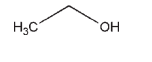
C2H6O 46.07
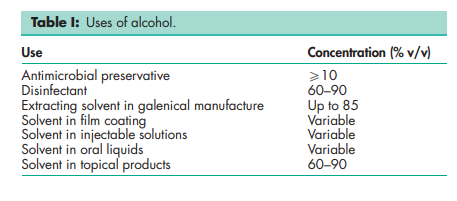
Ethanol and aqueous ethanol solutions of various concentrations (see Sections 8 and 17) are widely used in pharmaceutical formulations and cosmetics; see Table I. Although ethanol is primarily used as a solvent, it is also employed as a disinfectant, and in solutions as an antimicrobial preservative.(1,2) Topical ethanol solutions are used in the development of transdermal drug delivery systems as penetration enhancers.(3–10) Ethanol has also been used in the development of transdermal preparations as a co-surfactant.(11–13)
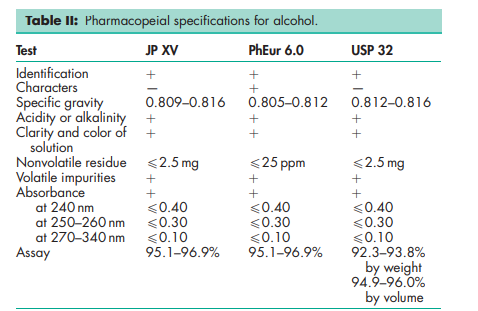
In the BP 2009, the term ‘ethanol’ used without other qualification refers to ethanol containing 599.5% v/v of C2H6O. The term ‘alcohol’, without other qualification, refers to ethanol 95.1–96.9% v/v. Where other strengths are intended, the term ‘alcohol’ or ‘ethanol’ is used, followed by the statement of the strength. In the PhEur 6.0, anhydrous ethanol contains not less than 99.5% v/v of C2H6O at 208C. The term ethanol (96%) is used to describe the material containing water and 95.1–96.9% v/v of C2H6O at 208C.
See Table II. See also Sections 17 and 18.
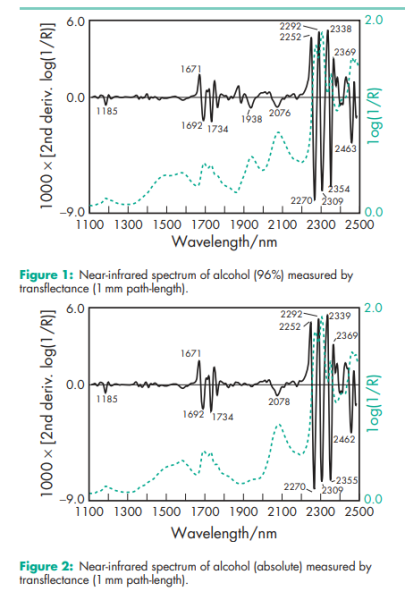
Antimicrobial activity Ethanol is bactericidal in aqueous mixtures at concentrations between 60% and 95% v/v; the optimum concentration is generally considered to be 70% v/v. Antimicrobial activity is enhanced in the presence of edetic acid or edetate salts.(1) Ethanol is inactivated in the presence of nonionic surfactants and is ineffective against bacterial spores. Boiling point 78.158C Flammability Readily flammable, burning with a blue, smokeless flame. Flash point 148C (closed cup) NIR spectra see Figures 1 and 2. Solubility Miscible with chloroform, ether, glycerin, and water (with rise of temperature and contraction of volume). Specific gravity 0.8119–0.8139 at 208C Note The above typical properties are for alcohol (ethanol 95% or 96% v/v). See Section 17 for typical properties of dehydrated alcohol.
Aqueous ethanol solutions may be sterilized by autoclaving or by filtration and should be stored in airtight containers, in a cool place.
In acidic conditions, ethanol solutions may react vigorously with oxidizing materials. Mixtures with alkali may darken in color owing to a reaction with residual amounts of aldehyde. Organic salts or acacia may be precipitated from aqueous solutions or dispersions. Ethanol solutions are also incompatible with aluminum containers and may interact with some drugs.
Ethanol is manufactured by the controlled enzymatic fermentation of starch, sugar, or other carbohydrates. A fermented liquid is produced containing about 15% ethanol; ethanol 95% v/v is then obtained by fractional distillation. Ethanol may also be prepared by a number of synthetic methods.
Ethanol and aqueous ethanol solutions are widely used in a variety of pharmaceutical formulations and cosmetics. It is also consumed in alcoholic beverages. Ethanol is rapidly absorbed from the gastrointestinal tract and the vapor may be absorbed through the lungs; it is metabolized, mainly in the liver, to acetaldehyde, which is further oxidized to acetate. Ethanol is a central nervous system depressant and ingestion of low to moderate quantities can lead to symptoms of intoxication including muscle incoordination, visual impairment, slurred speech, etc. Ingestion of higher concentrations may cause depression of medullary action, lethargy, amnesia, hypothermia, hypoglycemia, stupor, coma, respiratory depression, and cardiovascular collapse. The lethal human blood-alcohol concentration is generally estimated to be 400–500 mg/100 mL.
Observe normal precautions appropriate to the circumstances and quantity of material handled. Ethanol and aqueous ethanol solutions should be handled in a well-ventilated environment. In the UK, the long-term 8-hour TWA workplace exposure limit for ethanol is 1920 mg/m3 (1000 ppm).(17) Ethanol may be irritant to the eyes and mucous membranes, and eye protection and gloves are recommended. Ethanol is flammable and should be heated with care. Fixed storage tanks should be electrically grounded to avoid ignition from electrostatic discharges when ethanol is transferred.
Included in the FDA Inactive Ingredients Database (dental preparations; inhalations; IM, IV, and SC injections; nasal and ophthalmic preparations; oral capsules, solutions, suspensions, syrups, and tablets; rectal, topical, and transdermal preparations). Included in the Canadian List of Acceptable Non-medicinal Ingredients. Included in nonparenteral and parenteral medicines licensed in the UK.
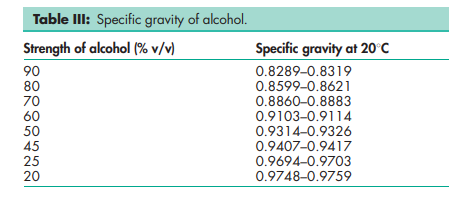
Dehydrated alcohol; denatured alcohol; dilute alcohol; isopropyl alcohol. Dehydrated alcohol Synonyms Absolute alcohol; anhydrous ethanol; ethanol. Autoignition temperature 3658C Boiling point 78.58C Explosive limits 3.5–19.0% v/v in air Flash point 128C (closed cup) Melting point 1128C Moisture content Absorbs water rapidly from the air. Refractive index n D 20 = 1.361 Specific gravity 0.7904–0.7935 at 208C Surface tension 22.75 mN/m at 208C (ethanol/vapor) Vapor density (relative) 1.59 (air = 1 Vapor pressure 5.8 Pa at 208C Viscosity (dynamic) 1.22 mPa s (1.22 cP) at 208C Comments Dehydrated alcohol is ethanol 599.5% v/v. See Section 8. Dehydrated alcohol is one of the materials that have been selected for harmonization by the Pharmacopeial Discussion Group. For further information see the General Information Chapter <1196> in the USP32–NF27, the General Chapter 5.8 in PhEur 6.0, along with the ‘State of Work’ document on the PhEur EDQM website, and also the General Information Chapter 8 in the JP XV. Denatured alcohol Synonyms Industrial methylated spirit; surgical spirit. Comments Denatured alcohol is alcohol intended for external use only. It has been rendered unfit for human consumption by the addition of a denaturing agent such as methanol or methyl isobutyl ketone. Dilute alcohol Synonyms Dilute ethanol. Specific gravity see Table III. Comments The term ‘dilute alcohol’ refers to a mixture of ethanol and water of stated concentration. The USP32–NF27 lists diluted alcohol. The BP 2009 lists eight strengths of dilute alcohol ( dilute ethanol) containing 90%, 80%, 70%, 60%, 50%, 45%, 25%, and 20% v/v respectively of ethanol.
Alcohol is one of the materials that have been selected for harmonization by the Pharmacopeial Discussion Group. For further information see the General Information Chapter <1196> in the USP32–NF27, the General Chapter 5.8 in PhEur 6.0, along with the ‘State of Work’ document on the PhEur EDQM website, and also the General Information Chapter 8 in the JP XV. Possession and use of nondenatured alcohols are usually subject to close control by excise authorities. A specification for alcohol is contained in the Food Chemicals Codex (FCC).(18) The EINECS number for alcohol is 200-578-6. The PubChem Compound ID (CID) for alcohol is 702.