
Name: Benzethonium Chloride
CAS No: N,N-Dimethyl-N-[2-[2-[4-(1,1,3,3-tetramethylbutyl), phenoxy]ethoxy], ethyl]benzene-methanaminium chloride [121-54-0]
BP: Benzethonium Chloride JP: Benzethonium Chloride PhEur: Benzethonium Chloride USP: Benzethonium Chloride
Benzethonii chloridum; benzyldimethyl-[2-[2-(p-1,1,3,3-tetramethylbutylphenoxy) ethoxy]ethyl]ammonium chloride; BZT; diisobutylphenoxyethoxyethyl dimethyl benzyl ammonium chloride; Hyamine 1622.
N,N-Dimethyl-N-[2-[2-[4-(1,1,3,3-tetramethylbutyl), phenoxy]ethoxy], ethyl]benzene-methanaminium chloride [121-54-0]
C27H42ClNO2 448.10
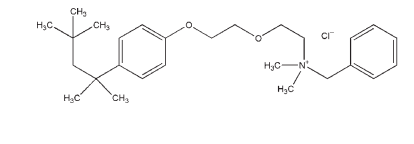
Benzethonium chloride is a quaternary ammonium compound used in pharmaceutical formulations as an antimicrobial preservative. Typically, it is used for this purpose in injections, ophthalmic and otic preparations at concentrations 0.01–0.02% w/v. Benzethonium chloride may also be used as a wetting and solubilizing agent, and as a topical disinfectant.(1,2) In cosmetics such as deodorants, benzethonium chloride may be used as an antimicrobial preservative in concentrations up to 0.5% w/v. The physical properties and applications of benzethonium chloride are similar to those of other cationic surfactants such as cetrimide.
Benzethonium chloride occurs as a white crystalline material with a mild odor and very bitter taste.
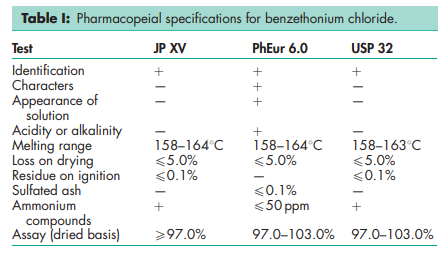
See Table I.
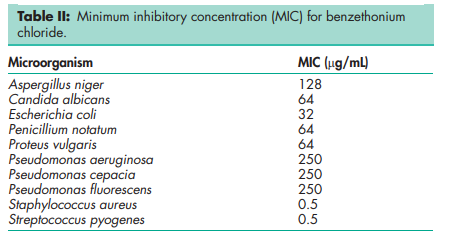
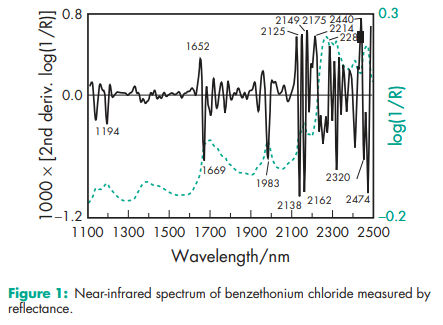
Acidity/alkalinity pH = 4.8–5.5 for a 1% w/v aqueous solution. Antimicrobial activity Optimum antimicrobial activity occurs between pH 4–10. Preservative efficacy is enhanced by ethanol and reduced by soaps and other anionic surfactants. For typical minimum inhibitory concentrations (MICs) see Table II.(3) NIR spectra see Figure 1. Solubility Soluble 1 in less than 1 of acetone, chloroform, ethanol (95%), and water; soluble 1 in 6000 of ether. Dissolves in water to produce a foamy, soapy solution.
Benzethonium chloride is stable. Aqueous solutions may be sterilized by autoclaving. The bulk material should be stored in an airtight container protected from light, in a cool, dry place.
Benzethonium chloride is incompatible with soaps and other anionic surfactants and may be precipitated from solutions greater than 2% w/v concentration by the addition of mineral acids and some salt solutions.
p-Diisobutylphenol is condensed in the presence of a basic catalyst with b,b0 -dichlorodiethyl ether to yield 2-[2-[4-(1,1,3,3-tetramethylbutyl)phenoxy]ethoxy]ethyl chloride. Alkaline dimethylamination then produces the corresponding tertiary amine which, after purification by distillation, is dissolved in a suitable organic solvent and treated with benzyl chloride to precipitate benzethonium chloride.(4)
Benzethonium chloride is readily absorbed and is generally regarded as a toxic substance when administered orally. Ingestion may cause vomiting, collapse, convulsions, and coma. The probable lethal human oral dose is estimated to be 50–500 mg/kg bodyweight. The topical use of solutions containing greater than 5% w/v benzethonium chloride can cause irritation although benzethonium chloride is not regarded as a sensitizer. The use of 0.5% w/v benzethonium chloride in cosmetics is associated with few adverse effects. A maximum concentration of 0.02% w/v benzethonium chloride is recommended for use in cosmetics used in the eye area and this is also the maximum concentration generally used in pharmaceutical formulations such as injections and ophthalmic preparations.(5) See also Benzalkonium Chloride. LD50 (mouse, IP): 15.5 mg/kg(6) LD50 (mouse, IV): 30 mg/kg LD50 (mouse, oral): 338 mg/kg LD50 (rat, IP): 16.5 mg/kg LD50 (rat, IV): 19 mg/kg LD50 (rat, oral): 368 mg/kg LD50 (rat, SC): 119 mg/kg
Observe normal precautions appropriate to the circumstances and quantity of material handled. Eye protection and gloves are recommended.
Included in the FDA Inactive Ingredients Database (IM and IV injections; nasal, ophthalmic and otic preparations). Included in the Canadian List of Acceptable Non-medicinal Ingredients.
Benzalkonium chloride; cetrimide.
Benzethonium chloride has been used therapeutically as a disinfectant and topical anti-infective agent. However, its use in these applications has largely been superseded by other more effective antimicrobials and it is now largely used solely as a preservative in a limited number of pharmaceutical and cosmetic formulations. The EINECS number for benzethonium chloride is 204-479-9. The PubChem Compound ID (CID) for benethonium chloride includes 8478 and 547429.