
Name: Lactose, Monohydrate and Microcrystalline Cellulose
CAS No: See Section 8.
None adopted.
MicroceLac 100.
See Section 8.
See Section 8.
Lactose monohydrate and microcrystalline cellulose can be used in tablets for direct compression
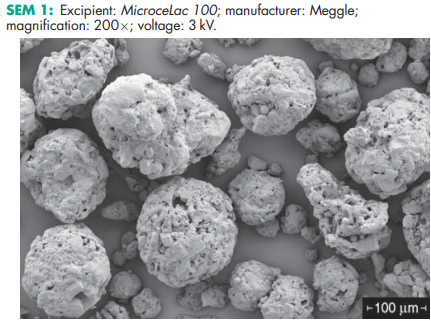
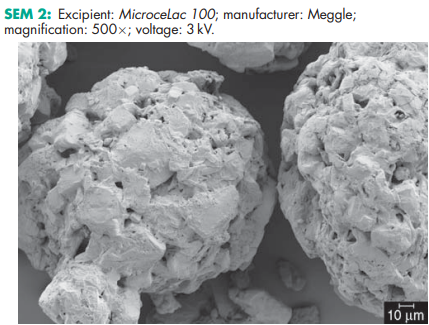
Lactose monohydrate and microcrystalline cellulose occurs as a white or almost white odorless powder containing 73–77% of lactose monohydrate and 23–27% of microcrystalline cellulose.
Both lactose monohydrate and microcrystalline cellulose are listed as separate monographs in the JP, PhEur, and USP–NF, but the combination is not listed. See Lactose, Monohydrate, and Cellulose, Microcrystalline.
Acidity/alkalinity pH = 4.0–7.0 for MicroceLac 100 Angle of repose 348 for MicroceLac 100 Density (bulk) 0.5 g/cm3 for MicroceLac 100 Density (tapped) 0.61 g/cm3 for MicroceLac 100 Hausner ratio 1.16 for MicroceLac 100 Heavy metals 45 ppm for MicroceLac 100 Loss on drying 41.5% for MicroceLac 100 Microbial content Total viable aerobic count 4100 cfu/g, molds 410 cfu/g, yeasts 410 cfu/g (Escherichia coli and Salmonella species absent) for MicroceLac 100 Particle size distribution 415% <32 mm, 45–70% <160 mm, 590% <250 mm for MicroceLac 100 Solubility Partially soluble in water for MicroceLac 100 Sulfated ash 40.1% for MicroceLac 100 Water content 4–6% for MicroceLac 100
Store at room temperature in well-closed containers under dry and odor-free conditions.
See Lactose, Monohydrate, and Cellulose, Microcrystalline
Lactose monohydrate and microcrystalline cellulose is prepared by spray-drying a mixture of the two ingredients.
See Lactose, Monohydrate, and Cellulose, Microcrystalline.
Observe normal precautions appropriate to the circumstances and quantity of material handled.
Lactose monohydrate and microcrystalline cellulose is a mixture of two materials both of which are generally regarded as nontoxic: Lactose monohydrate GRAS listed. Included in the FDA Inactive Ingredients Database (IM, IV, and SC: powder for injections; oral: capsules and tablets; inhalation preparations; vaginal preparations). Included in nonparenteral and parenteral medicines licensed in the UK. Included in the Canadian List of Acceptable Non-medicinal Ingredients. Microcrystalline cellulose GRAS listed. Accepted for use as a food additive in Europe. Included in the FDA Inactive Ingredients Database (inhalations; oral capsules, powders, suspensions, syrups, and tablets; topical and vaginal preparations). Included in nonparenteral medicines licensed in the UK. Included in the Canadian List of Acceptable Non-medicinal Ingredients.
Cellulose, microcrystalline; lactose, monohydrate.
Lactose monohydrate and microcrystalline cellulose are two of the materials that have been selected for harmonization by the Pharmacopeial Discussion Group. For further information see the General Information Chapter <1196> in the USP32–NF27, the General Chapter 5.8 in PhEur 6.0, along with the ‘State of Work’ document on the PhEur EDQM website, and also the General Information Chapter 8 in the JP XV. MicroceLac 100 has been designed for formulating high-dose small tablets with a poorly flowable active ingredient. It showed superior flow and binding properties compared to simple mixtures of its components.(1,2) Differences between MicroceLac 100 and Cellactose 80 have recently been evaluated.(3) A specification for lactose and microcrystalline cellulose spheres is contained in the Japanese Pharmaceutical Excipients (JPE);