
Name: Lanolin
CAS No: Anhydrous lanolin [8006-54-0]
BP: Wool Fat JP: Purified Lanolin PhEur: Wool Fat USP: Lanolin
Adeps lanae; cera lanae; E913; lanolina; lanolin anhydrous; Protalan anhydrous; purified lanolin; refined wool fat.
Anhydrous lanolin [8006-54-0]
The USP 32 describes lanolin as the purified wax-like substance obtained from the wool of the sheep, Ovis aries Linne´ (Fam. Bovidae), that has been cleaned, decolorized, and deodorized. It contains not more than 0.25% w/w of water and may contain up to 0.02% w/w of a suitable antioxidant; the PhEur 6.0 specifies up to 200 ppm of butylated hydroxytoluene as an antioxidant
See Section 4.
Lanolin is widely used in topical pharmaceutical formulations and cosmetics. Lanolin may be used as a hydrophobic vehicle and in the preparation of water-in-oil creams and ointments. When mixed with suitable vegetable oils or with soft paraffin, it produces emollient creams that penetrate the skin and hence facilitate the absorption of drugs. Lanolin mixes with about twice its own weight of water, without separation, to produce stable emulsions that do not readily become rancid on storage.
Lanolin is a pale yellow-colored, unctuous, waxy substance with a faint, characteristic odor. Melted lanolin is a clear or almost clear, yellow liquid.
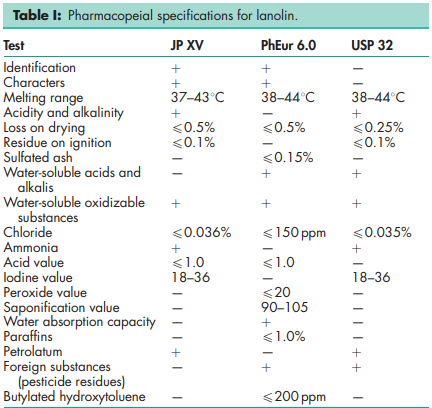
See Table I.
Autoignition temperature 4458C Density 0.932–0.945 g/cm3 at 158C Flash point 2388C Refractive index nD 40 = 1.478–1.482 Solubility Freely soluble in benzene, chloroform, ether, and petroleum spirit; sparingly soluble in cold ethanol (95%), more soluble in boiling ethanol (95%); practically insoluble in water.
Lanolin may gradually undergo autoxidation during storage. To inhibit this process, the inclusion of butylated hydroxytoluene is permitted as an antioxidant. Exposure to excessive or prolonged heating may cause anhydrous lanolin to darken in color and develop a strong rancidlike odor. However, lanolin may be sterilized by dry heat at 1508C. Ophthalmic ointments containing lanolin may be sterilized by filtration or by exposure to gamma irradiation.(1)Lanolin should be stored in a well-filled, well-closed container protected from light, in a cool, dry place. Normal storage life is 2 years.
Lanolin may contain prooxidants, which may affect the stability of certain active drugs.
Lanolin is a naturally occurring wax-like material obtained from the wool of sheep, Ovis aries Linne´ (Fam. Bovidae). Crude lanolin is saponified with a weak alkali and the resultant saponified fat emulsion is centrifuged to remove the aqueous phase. The aqueous phase contains a soap solution from which, on standing, a layer of partially purified lanolin separates. This material is then further refined by treatment with calcium chloride, followed by fusion with unslaked lime to dehydrate the lanolin. The lanolin is finally extracted with acetone and the solvent is removed by distillation.
Lanolin is widely used in cosmetics and a variety of topical pharmaceutical formulations. Although generally regarded as a nontoxic and nonirritant material, lanolin and lanolin derivatives are associated with skin hypersensitivity reactions, and the use of lanolin in subjects with known sensitivity should be avoided.(2,3) Other reports suggest that ‘sensitivity’ arises from false positives in patch testing.(4) However, skin hypersensitivity is relatively uncommon;(5) the incidence of hypersensitivity to lanolin in the general population is estimated to be around 5 per million.(6) Sensitivity is thought to be associated with the content of free fatty alcohols present in lanolin products rather than the total alcohol content.(7) The safety of pesticide residues in lanolin products has also been of concern.(8,9) However, highly refined ‘hypoallergenic’ grades of lanolin and grades with low pesticide residues are commercially available.
Observe normal precautions appropriate to the circumstances and quantity of material handled.
Included in the FDA Inactive Ingredients Database (ophthalmic, otic, topical, and vaginal preparations). Included in nonparenteral medicines licensed in the UK. Included in the Canadian List of Acceptable Non-medicinal Ingredients.
Cholesterol; hydrogenated lanolin; lanolin, hydrous; lanolin alcohols; modified lanolin. See also Section 18. Hydrogenated lanolin Synonyms Adeps lanae hydrogenatus; hydrogenated wool fat. Acid value 41.0 Hydroxyl value 140–180 Melting point 45–558C Saponification value 48.0 Water 43.0% Comments Some pharmacopeias, such as the PhEur 6.0, contain a monograph for hydrogenated lanolin. This material is a mixture of higher aliphatic alcohols and sterols obtained from the direct, high-pressure, high-temperature hydrogenation of lanolin during which the esters and acids present are reduced to the corresponding alcohols. Hydrogenated lanolin may contain a suitable antioxidant; the PhEur 6.0 specifies not more than 200 ppm of butylated hydroxytoluene. Modified lanolin Comments Some pharmacopeias, such as the USP 32, contain a monograph for modified lanolin. This material is lanolin that has been processed to reduce the contents of free lanolin alcohols and detergent and pesticide residues. It contains not more than 0.25% w/w of water. The USP 32 specifies that it may contain not more than 0.02% w/w of a suitable antioxidant
Lanolin (the anhydrous material) may be confused in some instances with hydrous lanolin since the USP formerly contained monographs for ‘lanolin’ and ‘anhydrous lanolin’ in which the name ‘lanolin’ referred to the material containing 25–30% w/w of purified water. However, in the USP 32 the former lanolin monograph (hydrous lanolin) is deleted and the monograph for anhydrous lanolin is renamed ‘lanolin’. Since lanolin is a natural product obtained from various geographical sources, its physical characteristics such as color, consistency, iodine value, saponification value, and hydroxyl value may vary for the products from different sources. Consequently, formulations containing lanolin from different sources may also have different physical properties. A wide range of grades of lanolin are commercially available that have been refined to different extents in order to produce hypoallergenic grades or grades with low pesticide contents. Many lanolin derivatives are also commercially available that have properties similar to those of the parent material and include: acetylated lanolin; ethoxylated or polyoxyl lanolin ( water-soluble); hydrogenated lanolin; isopropyl lanolate; lanolin oil; lanolin wax; liquid lanolin; and water-soluble lanolin. A specification for anhydrous lanolin is contained in the Food Chemicals Codex (FCC),(11) where it is described as being used as a masticatory substance in chewing gum base. The EINECS number for lanolin is 232-348-6.