
Name: Hexetidine
CAS No: 1,3-bis(2-Ethylhexyl)-5-methylhexahydro-5-pyrimidinamine [141-94-6]
BP: Hexetidine PhEur: Hexetidine
5-Amino-1,3-bis(2-ethylhexyl)hexahydro-5-methylpyrimidine; 5-amino-1,3-di(b-ethylhexyl)hexahydro-5-methylpyrimidine; 1,3-bis(2-ethylhexyl)-5-methylhexahydropyrimidin-5-ylamine; 1,3-bis(b-ethylhexyl)-5-methyl-5-aminohexahydropyrimidine; Glypesin; hexetidinum; Hexigel; Hexocil; Hexoral; Hextril; Oraldene; Sterisil; Steri/Sol.
1,3-bis(2-Ethylhexyl)-5-methylhexahydro-5-pyrimidinamine [141-94-6]
C21H45N3 339.61
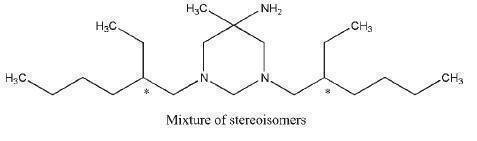
Hexetidine is used as an antimicrobial preservative in cosmetics and nonparenteral pharmaceutical formulations. Therapeutically, hexetidine is mainly used as a 0.1% w/v solution in mouthwash formulations for the prevention and treatment of minor local infections, gingivitis, and mouth ulcers.
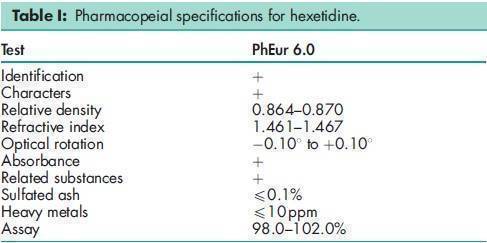
Hexetidine is a colorless or faint yellow-colored oily liquid with a characteristic amine odor.
See Table I.
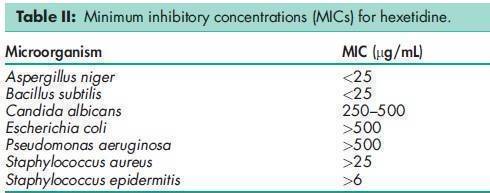
Antimicrobial activity Hexetidine is a nonantibiotic antimicrobial agent that possesses broad-spectrum antimicrobial activity against Gram-positive and Gram-negative bacteria and fungi such as Candida albicans.(1–4) Several studies have identified the antiplaque activity of hexetidine.(3–8) Hexetidine has been shown to be effective against isolates of Staphylococcus aureus and Pseudomonas aeruginosa in planktonic form and against biofilms of the same microorganisms on PVC.(1) Hexetidine has also been reported to reduce the adherence of Candida albicans to human buccal epithelial cells in vitro.(9) Hexetidine has been shown to be a promising candidate antimalarial agent, with IC50 values being comparable with those of quinine chlorohydrate and chloroquine sulfate.(10) See also Table II. Boiling point 172–1768C Dissociation constant pKa = 8.3 Density 0.864–0.870 at 208C Refractive index n D 20 = 1.463–1.467 Solubility Soluble in acetone, benzene, chloroform, dichloromethane, ethanol (95%), n-hexane, methanol, mineral acids, petroleum ether, and propylene glycol; very slightly soluble in water.
Hexetidine is stable and should be stored in a well-closed container in a cool, dry place. Brass and copper equipment should not be used for the handling or storage of hexetidine.
Hexetidine is incompatible with strong oxidizing agents. Salts are formed with mineral and organic acids; strong acids cause opening of the hexahydropyrimidine ring, releasing formaldehyde.
Hexetidine is prepared by hydrogenation under pressure of 1,3-bis(2-ethylhexyl)-5-methyl-4-nitrohexahydropyriminine at 1008C using Raney nickel as a catalyst.
Hexetidine is mainly used in mouthwashes as a bactericidal and fungicidal antiseptic. It is also used as an antimicrobial preservative and is generally regarded as a relatively nontoxic and nonirritant material at concentrations up to 0.1% w/v. Allergic contact dermatitis and altered olfactory and taste perception have occasionally been reported. Hexetidine is toxic when administered intravenously. Solutions of hexetidine in oil at concentrations of 5–10% w/v cause strong primary irritations without sensitization in humans. Long-term toxicological studies of up to 0.1% w/w of hexetidine in food for 1 year do not show any toxic effect. Fetotoxicity, embryotoxicity, and teratogenicity studies in rats of doses up to 50 mg/kg/day exhibit no sign of toxicity. LD100 (cat, IV): 5–20 mg/kg LD50 (dog, oral): 1.60 g/kg LD50 (mouse, IP): 0.142 g/kg LD50 (mouse, oral): 1.52 g/kg LD50 (rat, oral): 0.61–1.43 g/kg
Observe normal precautions appropriate to the circumstances and quantity of material handled. Hexetidine may be harmful upon inhalation or on contact with the skin or eyes. Eye protection and gloves are recommended. When significant quantities are being handled, the use of a respirator with an appropriate gas filter is recommended.
Included in nonparenteral formulations licensed in Europe.
—
Hexetidine has been quantitatively determined in both commercial formulations and saliva using a reversed-phase HPLC method,(11) with determination being possible at concentrations below the published minimum inhibitory concentrations for a selection of microorganisms. The EINECS number for hexetidine is 205-513-5.