Name: BP: Leucine JP: L-Leucine PhEur: Leucine USP: Leucine
CAS No: L-Leucine [61-90-5]
BP: Leucine JP: L-Leucine PhEur: Leucine USP: Leucine
a-Aminoisocaproic acid; L-a-aminoisocaproic acid; 2-amino-4- methylpentanoic acid; 2-amino-4-methylvaleric acid; a-amino-gmethylvaleric acid; 1,2-amino-4-methylvaleric acid; D L-leucine; Lleucine; leu; leucinum; 4-methylnorvaline.
L-Leucine [61-90-5]
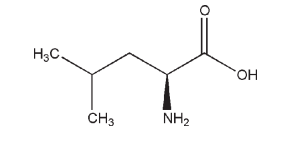
C6H13NO2 131.17
Leucine is used in pharmaceutical formulations as a flavoring agent.(1) It has been used experimentally as an antiadherent to improve the deagglomeration of disodium cromoglycate micro-particles and other compounds in inhalation preparations;(2) and as a tablet lubricant.(3) Leucine copolymers have been shown to successfully produce stable drug nanocrystals in water.(4)
Leucine occurs as a white or almost off-white crystalline powder or shiny flakes.
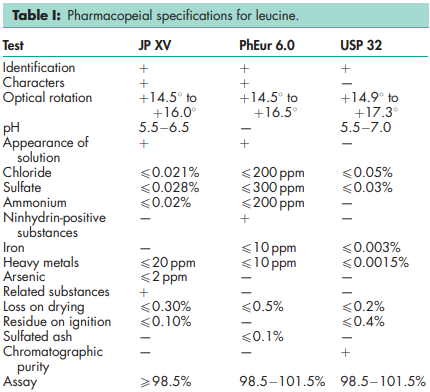
See Table I
Density 1.293 g/cm3 Dissociation constant pKa1 = 2.35 at 138C; pKa2 = 9.60. Isoelectric point 6.04 Melting point Decomposes at 2932958C; sublimes at 1451488C. Solubility Soluble in acetic acid, ethanol (99%) and water. Practically insoluble in ether.
Leucine is sensitive to light and moisture, and should be stored in an airtight container in a cool, dark, dry place.
Leucine is incompatible with strong oxidizing agents
Leucine is produced microbially by incubating an amino-acidproducing microorganism including but not exclusive to Pseudomonas, Escherichia, Bacillus, or Staphylococcus in the presence of oxygen and a hydrocarbon. The nutrient medium should contain an inhibitory amount of a growth inhibitor that is a chemically similar derivative of leucine (e.g. methylallylglycine, a-hydrozinoisocaproic acid, or b-cyclopentanealanine) to inhibit the growth of the organism except for at least one mutant that is resistant to the inhibitory effect. The resistant mutant is then isolated and grown in the presence of oxygen and the hydrocarbon in the absence of the inhibitor. The mutant cells are then harvested and a nutrient medium is formed that includes a hydrocarbon as the sole source of carbon. Finally, the harvested cells are incubated in the medium in the presence of oxygen.(5)
Leucine is an essential amino acid and is consumed as part of a normal diet. It is generally regarded as a nontoxic and nonirritant material. It is moderately toxic by the subcutaneous route. LD50 (rat, IP): 5.379 g/kg(6)
Observe normal precautions appropriate to the circumstances and quantity of the material handled.
Included in the FDA Inactive Ingredients Database (IV infusion; oral tablets). Included in nonparenteral medicines licensed in the UK.
DL-Leucine DL-Leucine Empirical formula C6H13NO2 Molecular weight 131.20 Appearance White leaflets. Dissociation constant pKa1 = 2.36; pKa2 = 9.60. Solubility Soluble in ethanol (90%) and water. Practically insoluble in ether.
A specification for leucine is included in the Food Chemicals Codex (FCC).(7) The EINECS number for leucine is 200-522-0.