
Name: Alginic Acid
CAS No: Alginic acid [9005-32-7]
BP: Alginic Acid PhEur: Alginic Acid USP-NF: Alginic Acid
Acidum alginicum; E400; Kelacid; L-gulo-D-mannoglycuronan; polymannuronic acid; Protacid; Satialgine H8.
Alginic acid [9005-32-7]
Alginic acid is a linear glycuronan polymer consisting of a mixture of b-(1!4)-D-mannosyluronic acid and a-(1!4)-L-gulosyluronic acid residues, of general formula (C6H8O)n. The molecular weight is typically 20 000–240 000.
The PhEur 6.3 describes alginic acid as a mixture of polyuronic acids [(C6H8O6)n] composed of residues of D-mannuronic and Lglucuronic acid, and obtained mainly from algae belonging to the Phaeophyceae. A small proportion of the carboxyl groups may be neutralized. See also Section 4.
Alginic acid is used in a variety of oral and topical pharmaceutical formulations. In tablet and capsule formulations, alginic acid is used as both a binder and disintegrating agent at concentrations of 1–5% w/w.(1,2) Alginic acid is widely used as a thickening and suspending agent in a variety of pastes, creams, and gels; and as a stabilizing agent for oil-in-water emulsions. Alginic acid has been used to improve the stability of levosimendan.(3) Therapeutically, alginic acid has been used as an antacid.(4) In combination with an H2-receptor antagonist, it has also been utilized for the management of gastroesophageal reflux.(5)
Alginic acid is a tasteless, practically odorless, white to yellowishwhite, fibrous powder.
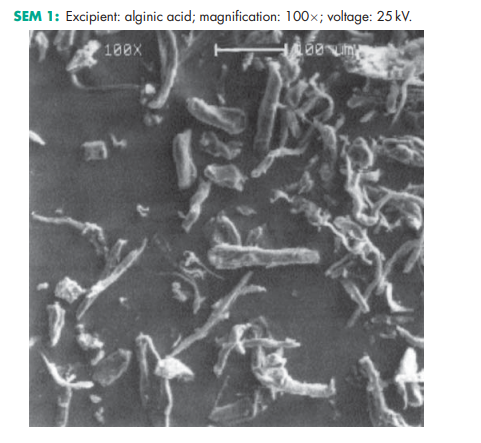
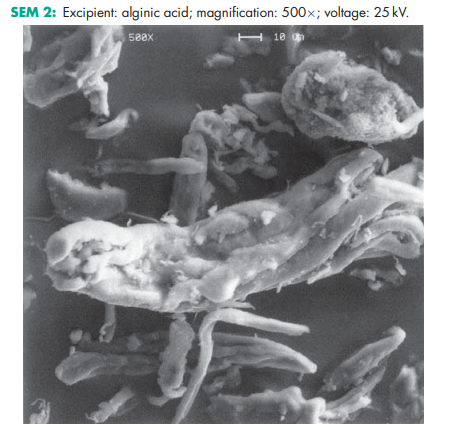
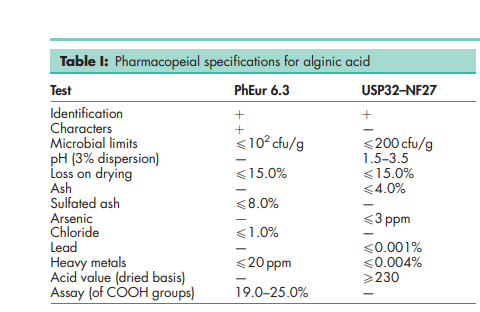
See Table I.
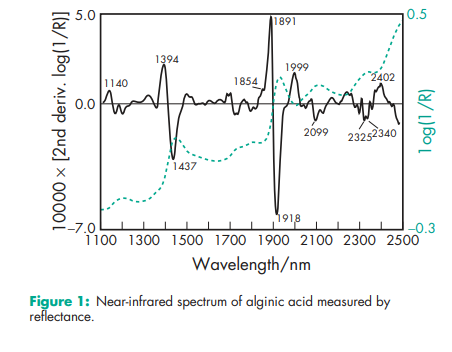
Acidity/alkalinity pH = 1.5–3.5 for a 3% w/v aqueous dispersion. Crosslinking Addition of a calcium salt, such as calcium citrate or calcium chloride, causes crosslinking of the alginic acid polymerv resulting in an apparent increase in molecular weight. Films crosslinked with triphosphate (tripolyphosphate) and calcium chloride were found to be insoluble but permeable to water vapor. Drug permeability varies with pH and the extent of crosslinking.(6) Density (true) 1.601 g/cm3 Moisture content 7.01% NIR spectra see Figure 1. Solubility Soluble in alkali hydroxides, producing viscous solutions; very slightly soluble or practically insoluble in ethanol (95%) and other organic solvents. Alginic acid swells in water but does not dissolve; it is capable of absorbing 200–300 times its own weight of water. Viscosity (dynamic) Various grades of alginic acid are commercially available that vary in their molecular weight and hence viscosity. Viscosity increases considerably with increasing concentration; typically a 0.5% w/w aqueous dispersion will have a viscosity of approximately 20 mPa s, while a 2.0% w/w aqueous dispersion will have a viscosity of approximately 2000 mPa s. The viscosity of dispersions decreases with increasing temperature. As a general rule, a 18C increase in temperature results in a 2.5% reduction in viscosity. At low concentrations, the viscosity of an alginic acid dispersion may be increased by the addition of a calcium salt, such as calcium citrate. See also Sections 11 and 18.
Alginic acid hydrolyzes slowly at warm temperatures producing a material with a lower molecular weight and lower dispersion viscosity
Incompatible with strong oxidizing agents; alginic acid forms insoluble salts in the presence of alkaline earth metals and group III metals with the exception of magnesium.
Alginic acid is a hydrophilic colloid carbohydrate that occurs naturally in the cell walls and intercellular spaces of various species of brown seaweed (Phaeophyceae). The seaweed occurs widely throughout the world and is harvested, crushed, and treated with dilute alkali to extract the alginic acid.
Alginic acid is widely used in food products and topical and oral pharmaceutical formulations. It is generally regarded as a nontoxic and nonirritant material, although excessive oral consumption may be harmful. Inhalation of alginate dust may be an irritant and has been associated with industrially related asthma in workers involved in alginate production. However, it appears that the cases of asthma were linked to exposure to unprocessed seaweed dust rather than pure alginate dust.(8) An acceptable daily intake of alginic acid and its ammonium, calcium, potassium, and sodium salts was not set by the WHO because the quantities used, and the background levels in food, did not represent a hazard to health.(9) LD50 (rat, IP): 1.6 g/kg(10)
Observe normal precautions appropriate to the circumstances and quantity of material handled. Alginic acid may be irritant to the eyes or respiratory system if inhaled as dust; see Section 14. Eye protection, gloves, and a dust respirator are recommended. Alginic acid should be handled in a well-ventilated environment.
GRAS listed. Accepted in Europe for use as a food additive. Included in the FDA Inactive Ingredients Database (ophthalmic preparations, oral capsules, and tablets). Included in the Canadian List of Acceptable Non-medicinal Ingredients. Included in nonparenteral medicines licensed in the UK.
Ammonium alginate; calcium alginate; potassium alginate; propylene glycol alginate; sodium alginate.
Alginic acid has been investigated for use in an ocular formulation of carteolol.(11) In the area of controlled release, the preparation of indomethacin sustained-release microparticles from alginic acid (alginate)–gelatin hydrocolloid coacervate systems has been investigated.(12) In addition, as controlled-release systems for liposome-associated macromolecules, microspheres have been produced encapsulating liposomes coated with alginic acid and poly-L-lysine membranes.(13) Alginate gel beads capable of floating in the gastric cavity have been prepared, the release properties of which were reported to be applicable for sustained release of drugs, and for targeting the gastric mucosa.(14) Mechanical properties, water uptake, and permeability properties of a sodium salt of alginic acid have been characterized for controlled-release applications.(6) In addition, sodium alginate has been incorporated into an ophthalmic drug delivery system for pilocarpine nitrate.(15) Sodium alginate has been used to improve pelletization due to polyelectrolyte complex formation between cationic polymers such as chitosan.(16) Alginic acid has also been shown to be beneficial in the development of alginate gelencapsulated, chitosan-coated nanocores, where the alginates act as a protective agent for sensitive macromolecules such as proteins and peptides for prolonged release.(17) In addition, the crosslinking of dehydrated paracetamol sodium alginate pellets has been shown to successfully mask the drug’s unpleasant taste by an extrusion/ spheronization technique.(18) It has also been reported that associated chains of alginic acid complexed with cations can bind to cell surfaces and exert pharmacological effects, which depend on the cell type and the complexed cation. These complexes can be used to treat rheumatic disorders, diseases associated with atopic diathesis and liver diseases.(19) An alginic oligosaccharide, obtained from a natural edible polysaccharide, has been shown to suppress Th2 responses and IgE production by inducing IL-12 production, and was found to be a useful approach for preventing allergic disorders.(20) Chemically modified alginic acid derivatives have also been researched for their anti-inflammatory, antiviral, and antitumor activities.(21) Alginate/ antacid antireflux preparations have been reported to provide symptomatic relief by forming a physical barrier on top of the stomach contents in the form of a raft.(22) Alginic acid dispersions are best prepared by pouring the alginic acid slowly and steadily into vigorously stirred water. Dispersions should be stirred for approximately 30 minutes. Premixing the alginic acid with another powder, such as sugar, or a water-miscible liquid such as ethanol (95%) or glycerin, aids dispersion. When using alginic acid in tablet formulations, the alginic acid is best incorporated or blended using a dry granulation process. Alginic acid gels for use in drug delivery systems may be prepared by adding D-glucono-D-lactone, which hydrolyzes in the presence of water to produce gluconic acid with a continuous lowering of pH.(23) A specification for alginic acid is contained in the Food Chemicals Codex (FCC).(24) The EINECS number for alginic acid is 232-680-1.