
Name: Aliphatic Polyesters
CAS No: See Table I.
None adopted.
See Table I.
See Table I.
Aliphatic polyesters are synthetic homopolymers or copolymers of lactic acid, glycolic acid, lactide, glycolide and e-hydroxycaproic acid. Typically, the molecular weights of homopolymers and copolymers range from 2000 to >100 000 Da.
Owing to their reputation as safe materials and their biodegradability, aliphatic polyesters are primarily used as biocompatible and biodegradable carriers in many types of implantable or injectable drug-delivery systems for both human and veterinary use. Examples of implantable drug delivery systems include rods,(1) cylinders, tubing, films,(2) fibers, pellets, and beads.(3) Examples of injectable drug-delivery systems include microcapsules,(4) microspheres,(5) nanoparticles, and liquid injectable controlled-release systems such as gel formulations.(6)
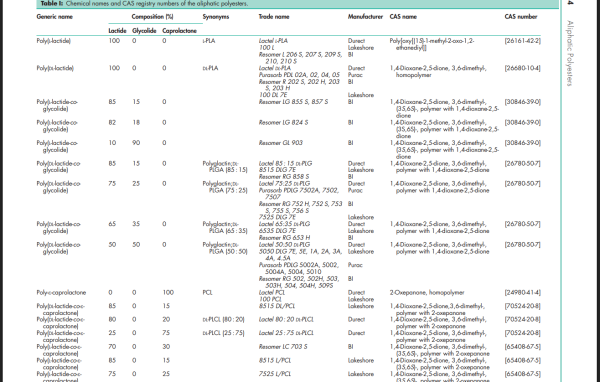
Aliphatic polyesters are a group of synthesized homopolymers or copolymers. They are nontoxic and can easily be fabricated into a variety of novel devices, such as rods, screws, nails, and cylinders. The polymers are commercially available in varying molecular weights as both homopolymers and copolymers. Molecular weights of polyesters range from 2000 Da to greater than 100 000 Da. Co-monomer ratios of lactic acid and glycolic acid (or lactide and glycolide) for poly(DL-lactide-co-glycolide) range from 85 : 15 to 50 : 50. Table I shows the chemical and trade names of different commercially available aliphatic polyesters.
—
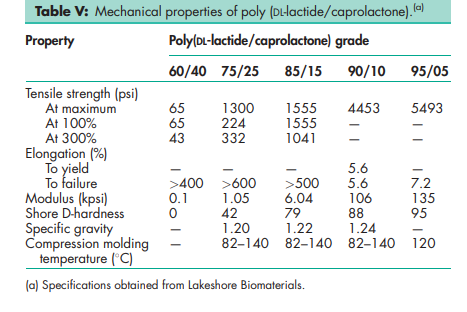
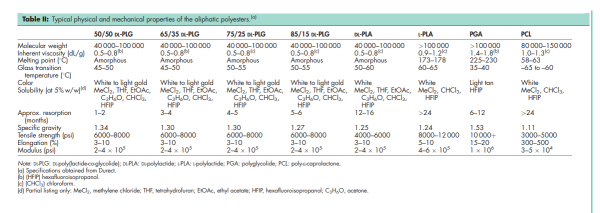
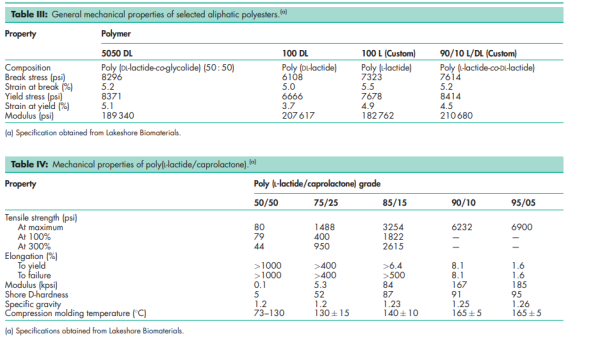
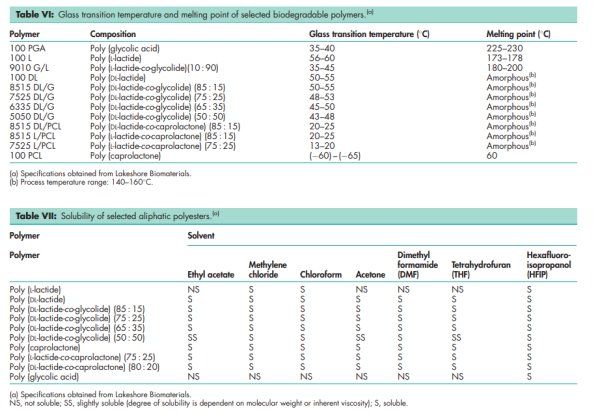
For typical physical and mechanical properties of the aliphatic polyesters, see Tables II, III, IV, V, VI, and VII. Polymer composition and crystallinity play important roles in the solubility of these aliphatic polyesters. The crystalline homopolymers of glycolide or glycolic acid are soluble only in strong solvents, such as hexafluoroisopropanol. The crystalline homopolymers of lactide or lactic acid also do not have good solubility in most organic solvents. However, amorphous polymers of DL-lactide or DL-lactic acid and copolymers of lactide or lactic acid with a low glycolide or glycolic acid content are soluble in many organic solvents (Table II). Aliphatic polyesters are slightly soluble or
The aliphatic polyesters are easily susceptible to hydrolysis in the presence of moisture. Hence, they should be packaged under highpurity dry nitrogen and properly stored in airtight containers, preferably refrigerated at below 08C. It is necessary to allow the polymers to reach room temperature in a dry environment before opening the container. After the original package has been opened, it is recommended to re-purge the package with high-purity dry nitrogen prior to resealing.
—
Generally, aliphatic polyesters can be synthesized via polycondensation of hydroxycarboxylic acids and catalytic ring-opening polymerization of lactones. Ring-opening polymerization is preferred because polyesters with high molecular weights can be produced. Moreover, the dehydration of hydroxycarboxylic acids to form lactones does not have to be carried to a high degree of completion. Lactones can easily be purified owing to the differences of their physical and chemical properties from those of the corresponding hydroxycarboxylic acid. The esterification of the carboxylic acid end group makes polymers more hydrophobic, which decreases the hydrolytic degradation rate of the polymers in the presence of water or moisture.
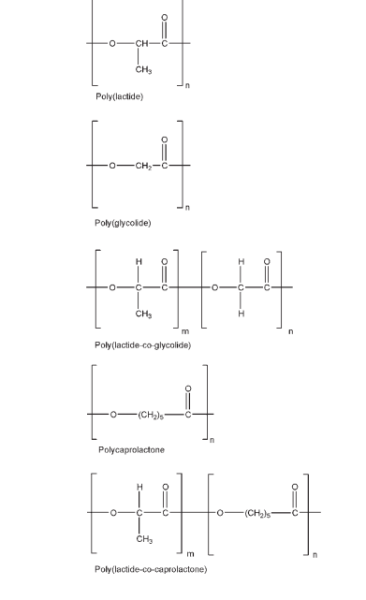
Poly(lactic acide) or poly(lactide), poly(glycolic acid) or poly(glycolide), poly (lactic-co-glycolic acid) or poly(lactide-co-glycolide), and polycaprolactone are used in parenteral pharmaceutical formulations and are regarded as biodegradable, biocompatible, and bioabsorbable materials. Their biodegradation products are nontoxic, noncarcinogenic, and nonteratogenic. In general, these polyesters exhibit very little hazard.
Observe normal precautions appropriate to the circumstances and quantity of material handled. Contact with eyes, skin, and clothing, and breathing the dust of the polymers should be avoided. Aliphatic polyesters produce acid materials such as hydroxyacetic and/or lactic acid in the presence of moisture; thus, contact with materials that will react with acids, especially in moist conditions, should be avoided.
GRAS listed. Included in the Canadian List of Acceptable Nonmedicinal Ingredients. Poly(lactide) and poly(lactide-co-glycolide) have been used in medical products and medical devices approved by the FDA.
Lactic acid.
Aliphatic polyesters are a group of synthesized, nontoxic, biodegradable polymers. In an aqueous environment, the polymer backbone undergoes hydrolytic degradation, through cleavage of the ester linkages, into nontoxic hydroxycarboxylic acids. Aliphatic polyesters are eventually metabolized to carbon dioxide and water, via the citric acid cycle. The rate of biodegradation and drug-release characteristics from injectable drug-delivery systems formulated with the aliphatic polyesters can be controlled by changing the physicochemical properties of the polymers, such as crystallinity, hydrophobicity, monomer stereochemistry, copolymer ratio, end group, and polymer molecular weight or by changing the porosity and geometry of the formulation. Due to their ability to form complexes with heavy metal ions, aliphatic polyesters are added to skin-protective ointments.