
Name: Hydroxyethylmethyl Cellulose
CAS No: Hydroxyethylmethylcellulose [9032-42-2]
BP: Hydroxyethylmethylcellulose PhEur: Methylhydroxyethylcellulose
Cellulose, 2-hydroxyethyl methyl ester; Culminal MHEC; HEMC; hydroxyethyl methylcellulose; hymetellose; MHEC; methylhydroxyethylcellulosum; Tylopur MH; Tylopur MHB; Tylose MB; Tylose MH; Tylose MHB.
Hydroxyethylmethylcellulose [9032-42-2]
The PhEur 6.0 describes hydroxyethylmethyl cellulose as a partly O-methylated and O-(2-hydroxyethylated) cellulose. Various different grades are available, which are distinguished by appending a number indicative of the apparent viscosity in millipascal seconds (mPa s) of a 2% w/v solution measured at 208C.
Hydroxyethylmethyl cellulose is used as an excipient in a wide range of pharmaceutical products, including oral tablets and suspensions, and topical gel preparations.(1) It has similar properties to methylcellulose, but the hydroxyethyl groups make it more readily soluble in water and solutions are more tolerant of salts and have a higher coagulation temperature.
A white, yellowish-white or grayish-white powder or granules, hygroscopic after drying.
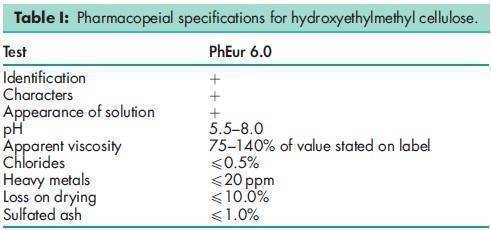
See Table I.
Acidity/alkalinity pH = 5.5–8.0 (2% w/v aqueous solution) Moisture content 410% Solubility Hydroxyethylmethyl cellulose is practically insoluble in hot water (above 608C), acetone, ethanol (95%), ether, and toluene. It dissolves in cold water to form a colloidal solution. Viscosity (dynamic) 8.5–11.5 mPa s (8.5–11.5 cP) for Culminal MHEC 8000 2% w/v aqueous solution at 208C.
Hydroxyethylmethyl cellulose is hygroscopic and should therefore be stored under dry conditions away from heat.
—
—
Hydroxyethylmethyl cellulose is used as an excipient in various oral and topical pharmaceutical preparations, and is generally regarded as an essentially nontoxic and nonirritant material. See Hypromellose for further information.
Observe normal precautions appropriate to the circumstances and quantity of the material handled. Eye protection and gloves are recommended.
GRAS listed. Included in nonparenteral medicines licensed in Europe (oral suspensions, tablets, and topical preparations).
Ethylcellulose; hydroxyethyl cellulose; hypromellose; methylcellulose.
—