
Name: Wax, Carnauba
CAS No: Carnauba wax [8015-86-9]
BP: Carnauba Wax JP: Carnauba Wax PhEur: Carnauba Wax USP-NF: Carnauba Wax
Brazil wax; caranda wax; cera carnauba; E903.
Carnauba wax [8015-86-9]
Carnauba wax consists primarily of a complex mixture of esters of acids and hydroxy acids, mainly aliphatic esters, o-hydroxy esters, p-methoxycinnamic aliphatic esters, and p-hydroxycinnamic aliphatic diesters composed of several chain lengths, in which C26 and C32 alcohols are the most prevalent.(1) Also present are acids, oxypolyhydric alcohols, hydrocarbons, resinous matter, and water.
Carnauba wax is widely used in cosmetics, certain foods, and pharmaceutical formulations. Cosmetically, carnauba wax is commonly used in lip balms.(2) Carnauba wax is the hardest and highest-melting of the waxes commonly used in pharmaceutical formulations and is used primarily as a 10% w/v aqueous emulsion to polish sugar-coated tablets. Aqueous emulsions may be prepared by mixing carnauba wax with an ethanolamine compound and oleic acid. The carnauba wax coating produces tablets of good luster without rubbing. Carnauba wax may also be used in powder form to polish sugarcoated tablets. Carnauba wax (10–50% w/w) is also used alone or with other excipients such as hypromellose, hydroxypropyl cellulose, alginate/ pectin-gelatin, Eudragit, and stearyl alcohol to produce sustainedrelease solid-dosage formulations.(3–10) Carnauba wax has been experimentally investigated for use in producing microparticles in a novel hot air coating (HAC) process developed as an alternative to conventional spray-congealing techniques.(11) In addition, carnauba wax has been used to produce gel beads for intragastric floating drug delivery(12) and has been investigated for use in nanoparticulate sunscreen formulations.(1
Carnauba wax occurs as a light brown- to pale yellow-colored powder, flakes, or irregular lumps of a hard, brittle wax. It has a characteristic bland odor and practically no taste. It is free from rancidity. Various types and grades are available commercially.
See Table I.
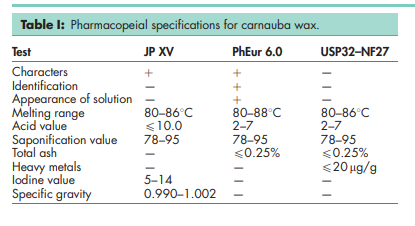
Flash point 270–3308C NIR spectra see Figure 1. Refractive index nD 90 = 1.450 Solubility Soluble in warm chloroform and in warm toluene; slightly soluble in boiling ethanol (95%); practically insoluble in water. Specific gravity 0.990–0.999 at 258C Unsaponified matter 50–55%
Carnauba wax is stable and should be stored in a well-closed container, in a cool, dry place.
—
Carnauba wax is obtained from the leaf buds and leaves of the Brazilian carnauba palm, Copernicia cerifera. The leaves are dried and shredded, and the wax is then removed by the addition of hot water
Carnauba wax is widely used in oral pharmaceutical formulations, cosmetics, and certain food products. It is generally regarded as an essentially nontoxic and nonirritant material.(14-16) However, there have been reports of allergic contact dermatitis from carnauba wax in mascara.(17) The WHO has established an acceptable daily intake of up to 7 mg/kg body-weight for carnauba wax.(18)
Observe normal precautions appropriate to the circumstances and quantity of material handled.
GRAS listed. Accepted for use as a food additive in Europe. Included in the FDA Inactive Ingredients Database (oral capsules and tablets). Included in nonparenteral medicines licensed in the UK. Included in the Canadian List of Acceptable Non-medicinal Ingredients.
—
In cosmetics, carnauba wax is mainly used to increase the stiffness of formulations, e.g. lipsticks and mascaras. The EINECS number for carnauba wax is 232-399-4.