
Name: Acacia
CAS No: Acacia [9000-01-5]
BP:Acacia JP:Acacia PhEur:Acacia USP-NF:Acacia
Acaciaegummi;acaciagum;arabicgum;E414;gumacacia;gummi africanum; gumarabic; gummiarabicum;gummimimosae; talha gum.
Acacia [9000-01-5]
Acaciaisacomplex, looseaggregateofsugarsandhemicelluloses withamolecularweightofapproximately240000–580000.The aggregateconsistsessentiallyofanarabicacidnucleustowhichare connected calcium, magnesium, and potassiumalongwith the sugarsarabinose,galactose,andrhamnose.
SeeSection4.
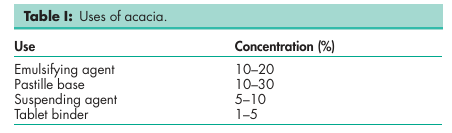
Acaciaismainlyusedinoralandtopicalpharmaceutical formula tionsasasuspendingandemulsifyingagent,oftenincombination withtragacanth. It isalsousedinthepreparationofpastillesand lozenges,andasatabletbinder,althoughifusedincautiouslyitcan produce tabletswithaprolongeddisintegrationtime.Acaciahas alsobeenevaluatedasabioadhesive;(1)andhasbeenusedinnovel tabletformulations,(2)andmodifiedreleasetablets.(3)SeeTableI. Acaciaisalsousedincosmetics, confectionery, foodproducts, andspray-driedflavors.(4) SeealsoSection18.
Acacia is available as white or yellowish-white thin flakes, spheroidal tears, granules, powder, or spray-driedpowder. It is odorlessandhasablandtaste.
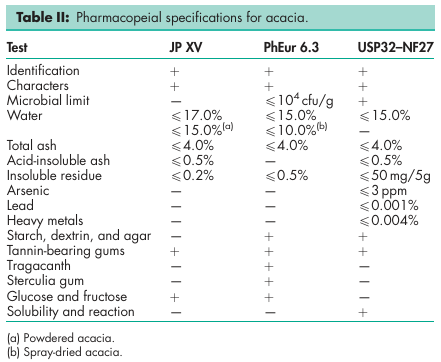
ThePhEur6.3providesmonographsonacaciaandspray-dried acacia, while the USP32–NF27 describes acacia in a single monographthatencompasses tears, flakes,granules,powder,and spray-driedpowder.TheUSP32–NF27alsohasamonographon acaciasyrup.TheJPXVhasmonographsonacaciaandpowdered acacia.SeeTableII.
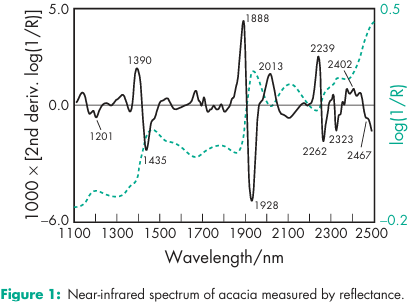
Acidity/alkalinity pH=4.5–5.0(5%w/vaqueoussolution) Acidvalue 2.5 Hygroscopicity Atrelativehumiditiesof25–65%,theequilibrium moisturecontentofpowderedacaciaat258Cis8–13%w/w,but at relativehumiditiesaboveabout70%itabsorbs substantial amountsofwater. NIRspectra seeFigure1. Solubility Soluble1in20ofglycerin,1in20ofpropyleneglycol, 1 in2.7ofwater; practically insoluble inethanol (95%). In water,acaciadissolvesveryslowly,althoughalmostcompletely aftertwohours, intwicethemassofwater leavingonlyavery small residueofpowder.Thesolutioniscolorlessoryellowish, viscous,adhesive,andtranslucent.Spray-driedacaciadissolves morerapidly, inabout20minutes. Specificgravity 1.35–1.49 Viscosity(dynamic) 100mPas (100cP) fora30%w/vaqueous solution at 208C. The viscosity of aqueous acacia solutions variesdependinguponthe sourceof thematerial, processing, storage conditions, pH, and the presence of salts. Viscosity increases slowly up to about 25%w/v concentration and exhibitsNewtonianbehavior.Abovethisconcentration,viscos ity increases rapidly (non-Newtonian rheology). Increasing temperature or prolonged heating of solutions results in a decrease of viscosity owing to depolymerization or particle agglomeration.SeealsoSection12.
Aqueous solutions are subject to bacterial or enzymatic degradation but may be preserved by initially boiling the solution for a short time to inactivate any enzymes present; microwave irradiation can also be used.(5) Aqueous solutions may also be preserved by the addition of an antimicrobial preservative such as 0.1% w/v benzoic acid, 0.1% w/v sodium benzoate, or a mixture of 0.17% w/v methylparaben and 0.03%propylparaben. Powdered acacia should be stored in an airtight container in a cool, dry place
Acacia is incompatible with a number of substances including amidopyrine, apomorphine, cresol, ethanol (95%), ferric salts, morphine, phenol, physostigmine, tannins, thymol, and vanillin. An oxidizing enzyme present in acacia may affect preparations containing easily oxidizable substances. However, the enzyme may be inactivated by heating at 1008C for a short time; see Section 11. Many salts reduce the viscosity of aqueous acacia solutions, while trivalent salts may initiate coagulation. Aqueous solutions carry a negative charge and will form coacervates with gelatin and other substances. In the preparation of emulsions, solutions of acacia are incompatible with soaps
Acacia is the dried gummy exudate obtained from the stems and branches of Acacia senegal (Linne´) Willdenow or other related species of Acacia (Fam. Leguminosae) that grow mainly in the Sudan and Senegal regions of Africa. The bark of the tree is incised and the exudate allowed to dry on the bark. The dried exudate is then collected, processed to remove bark, sand, and other particulate matter, and graded. Various acacia grades differing in particle size and other physical properties are thus obtained. A spray-dried powder is also commercially available.
Acacia is used in cosmetics, foods, and oral and topical pharmaceutical formulations. Although it is generally regarded as an essentially nontoxic material, there have been a limited number of reports of hypersensitivity to acacia after inhalation or ingestion.(6,7) Severe anaphylactic reactions have occurred follow ing the parenteral administration of acacia and it is now no longer used for this purpose.(6) The WHOhas not set an acceptable daily intake for acacia as a food additive because the levels necessary to achieve a desired effect were not considered to represent a hazard to health.(8) LD50 (hamster, oral): >18g/kg(9) LD50 (mouse, oral): >16g/kg LD50 (rabbit, oral): 8.0g/kg LD50 (rat, oral): >16g/kg
Observe normal precautions appropriate to the circumstances and quantity of material handled. Acacia can be irritant to the eyes and skin and upon inhalation. Gloves, eye protection, and a dust respirator are recommended.
GRAS listed. Accepted for use in Europe as a food additive. Included in the FDA Inactive Ingredients Database (oral prepara tions and buccal or sublingual tablets). Included in the Canadian List of Acceptable Non-medicinal Ingredients. Included in nonpar enteral medicines licensed in the UK
Ceratonia; guar gum; tragacanth
Concentrated aqueous solutions are used to prepare pastilles since on drying they form solid rubbery or glasslike masses depending upon the concentration used. Foreign policy changes and politically unstable conditions in Sudan, which is the principal supplier of acacia, has created a need to find a suitable replacement.(10) Poloxamer 188 (12–15% w/w) can be used to make an oil/water emulsion with similar rheological characteristics to acacia. Other natural by-products of foods can also be used.(11) Acacia is also used in the food industry as an emulsifier, stabilizer, and thickener. A specification for acacia is contained in the Food Chemicals Codex (FCC).(12) The EINECS number for acacia is 232-519-5.