Name: Wax, Nonionic Emulsifying
CAS No:
BP: Cetomacrogol Emulsifying Wax USP-NF: Emulsifying Wax
Collone NI; Crodex N; Emulgade 1000NI; Esterwax NF; Lipowax P; Masurf Emulsifying Wax NF; Permulgin D; Polawax; Ritachol 2000; T-Wax
The USP32–NF27 designates nonionic emulsifying wax as emulsifying wax that is prepared from cetostearyl alcohol and contains a polyoxyethylene derivative of a fatty acid ester of sorbitan. However, the BP 2009 describes nonionic emulsifying wax as cetomacrogol emulsifying wax prepared from cetostearyl alcohol and macrogol cetostearyl ether (22) (cetomacrogol 1000). The UK and US materials are therefore constitutionally different. See also Section 18.
Nonionic emulsifying wax is used as an emulsifying agent in the production of oil-in-water emulsions that are unaffected by moderate concentrations of electrolytes and are stable over a wide pH range. The concentration of wax used alters the consistency of a product owing to its ‘self-bodying action’; at concentrations up to about 5% a product is pourable. Concentrations of about 15% of nonionic emulsifying wax are commonly used in creams, but concentrations as high as 25% may be employed, e.g. in chlorhexidine cream BP. Nonionic emulsifying wax is particularly recommended for use with salts of polyvalent metals and medicaments based on nitrogenous compounds. Creams are susceptible to microbial spoilage and should be adequately preserved. Nonionic emulsifying wax is also used in nonaqueous ointment bases, such as cetomacrogol emulsifying ointment BP, and in barrier creams.
Nonionic emulsifying wax is a white or off-white waxy solid or flakes which melt when heated to give a clear, almost colorless liquid. Nonionic emulsifying wax has a faint odor characteristic of cetostearyl alcohol.
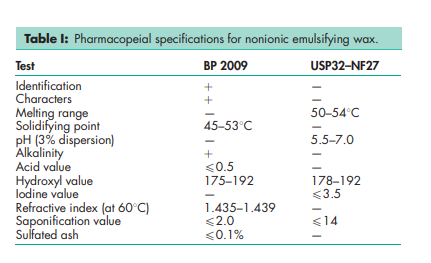
See Table I.
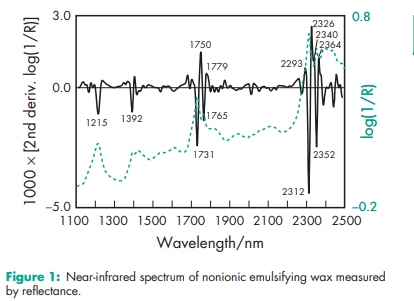
Density 0.94 g/cm3 Flash point >1508C for Masurf Emulsifying Wax NF NIR spectra see Figure 1. Solubility The BP 2009 specifies that cetomagrocol emulsifying wax is practically insoluble in water (forms an emulsion), moderately soluble in in ethanol (96%), and partly soluble in ether. The USP32–NF27 specifies that emulsifying wax is insoluble in water, soluble in alcohol and freely soluble in ether, chloroform, most hydrocarbon solvents, and aerosol propellants
Nonionic emulsifying wax is stable and should be stored in a wellclosed container in a cool, dry place.
Nonionic emulsifying wax is incompatible with tannin, phenol and phenolic materials, resorcinol, and benzocaine. It may reduce the antibacterial efficacy of quaternary ammonium compounds.
The BP 2009 specifies that cetomacrogol emulsifying wax (nonionic emulsifying wax) may be prepared by melting and mixing together 800 g of cetostearyl alcohol and 200 g of macrogol cetostearyl ether (22) (cetomacrogol 1000). The mixture is then stirred until cold. The USP32–NF27 formula for nonionic emulsifying wax is a mixture of unstated proportions of cetostearyl alcohol and a polyoxyethylene derivative of a fatty acid ester of sorbitan.
Nonionic emulsifying wax is used in cosmetics and topical pharmaceutical formulations, and is generally regarded as a nontoxic and nonirritant material.
Observe normal precautions appropriate to the circumstances and quantity of material handled. Eye protection is recommended.
Included in the FDA Inactive Ingredients Database (rectal emulsions and aerosol foams; topical aerosols, emulsions, creams, lotions, and ointments). Included in nonparenteral medicines licensed in the UK. Included in the Canadian List of Acceptable Non-medicinal Ingredients.
Cationic emulsifying wax; cetostearyl alcohol; polyoxyethylene alkyl ethers; wax, anionic emulsifying. It should be noted that there are many similar nonionic emulsifying waxes composed of different nonionic surfactants and fatty alcohols. Cationic emulsifying wax Synonyms cetrimide emulsifying wax; Crodex C. Method of manufacture Cetrimide emulsifying wax is prepared similarly to nonionic emulsifying wax and contains 90 g of cetostearyl alcohol and 10 g of cetrimide. Comments Cationic emulsifying wax is claimed to be of particular value in cosmetic and pharmaceutical formulations when cationic characteristics are important. Thus it can be used in medicated creams, germicidal creams, ointments and lotions, hair conditioners, baby creams, and skin care products in which cationic compounds are included. Cationic emulsifying wax is compatible with cationic and nonionic materials, but is incompatible with anionic surfactants and drugs. Additional antimicrobial preservatives should be included in creams. Cetrimide may cause irritation to the eye; see Cetrimide.
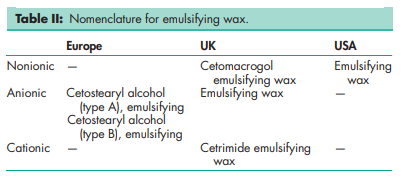
The nomenclature for emulsifying wax is confusing since there are three groups of emulsifying waxes with different titles in Europe, the UK, and USA; see Table II.