
Name: Hydroxypropyl Cellulose, Low-substituted
CAS No: Cellulose, 2-hydroxypropyl ether (low-substituted) [9004-64-2]
JP: Low Substituted Hydroxypropylcellulose USP-NF: Low-Substituted Hydroxypropyl Cellulose
Cellulose, 2-hydroxypropyl ether; 2-hydroxypropyl ether (low-substituted) cellulose; hyprolose, low-substituted; L-HPC; oxypropylated cellulose.
Cellulose, 2-hydroxypropyl ether (low-substituted) [9004-64-2]
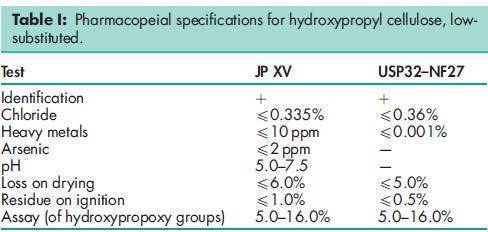
The USP32–NF27 describes low-substituted hydroxypropyl cellulose as a low-substituted hydroxypropyl ether of cellulose. Compared to hydroxypropyl cellulose, low-substituted hydroxypropyl cellulose has only a small proportion of the three free hydroxyl groups per glucose subunit converted to a hydroxypropyl ether.(1) When dried at 1058C for 1 hour, it contains not less than 5.0% and not more than 16.0% of hydroxypropoxy groups (— OCH2CHOHCH3). Low-substituted hydroxypropyl cellulose is commercially available in a number of different grades that have different particle sizes and substitution levels.
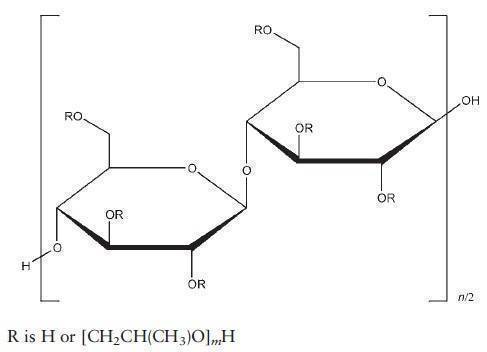
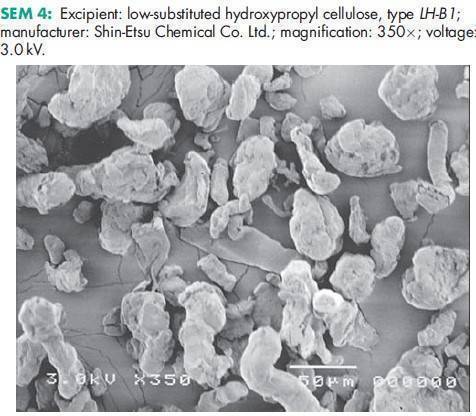
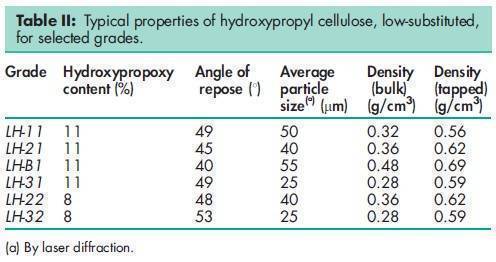
Low-substituted hydroxypropyl cellulose is widely used in oral solid-dosage forms. It is primarily used as a disintegrant, and as a binder for tablets and granules in wet or dry granulation.(1) It has been used in the preparation of rapidly disintegrating tablets produced by direct compression methods.(2–4) In addition, low substituted hydroxypropyl cellulose has been used as a binder/ disintegrant included in the powder layering process on spherical cores and to prepare pellets by extrusion/spheronization.(1,6,7) A low particle size and high hydroxypropyl content is recommended to produce round spheres and rapid dissolution.(1,5) There are a number of grades that have different particle sizes and substitution levels. LH-11 has the longest fibrous particles, and is typically used as an anticapping agent and disintegrant for direct compression. LH-21 is less fibrous and is used as a binder and disintegrant for tablets through the wet-granulation process. LH-31 is a small-particle grade used especially for extrusion to produce granules, as it has a small particle size that is better for passing a screen. LH-B1 is the nonfibrous, high-density grade designed for fluid-bed granulation, and can be used for direct compression and/ or formulations with a high low-substituted hydroxypropyl cellulose loading. Lower substitution grades LH-22 and LH-32 can be used for better disintegration capability, depending on the characteristics of the active ingredients. The typical content of low-substituted hydroxypropyl cellulose in a formulation is approximately 5–50%.
Low-substituted hydroxypropyl cellulose occurs as a white to yellowish white powder or granules. It is odorless or has a slight, characteristic odor, and it is tasteless.
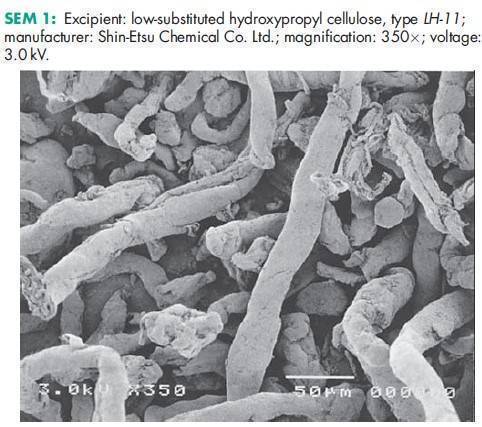
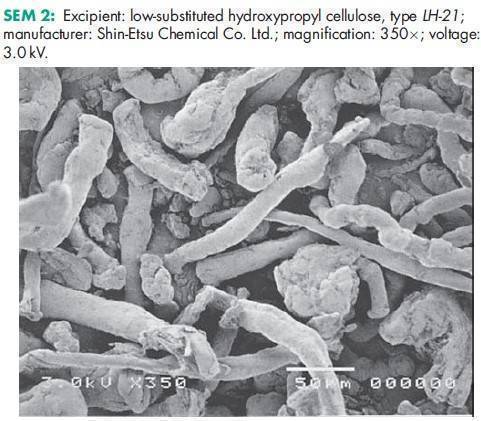
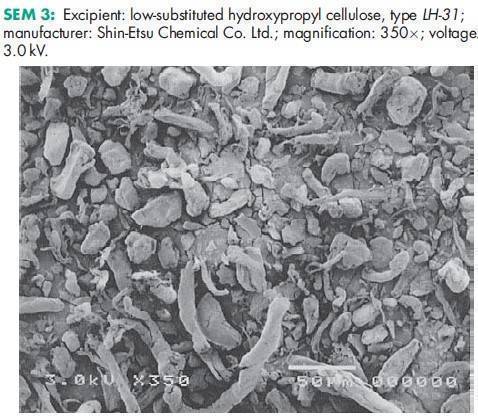
See Table I.
Acidity/alkalinity pH = 5.0–7.5 for 1% w/v aqueous suspension. Angle of repose see Table II. Ash 0.5% Density (bulk) see Table II. Density (tapped) see Table II. Density (true) 1.3 g/cm3 Melting point Decomposition at 2908C. Moisture content 8% at 33% relative humidity; 38% at 95% relative humidity. Particle size distribution LH-11: average size 50 mm; not more than 2% larger than 150 mm; LH-21 and LH-22: average size 40 mm; not more than 10% larger than 75 mm; LH-31 and LH-32: average size 25 mm; not more than 50% larger than 45 mm. Solubility Practically insoluble in ethanol (95%) and in ether. Dissolves in a solution of sodium hydroxide (1 in 10) and produces a viscous solution. Insoluble, but swells in water. Specific surface area 0.756m2/g for LH-21; 0.469m2/g for LH-B1.
Low-substituted hydroxypropyl cellulose is a stable, though hygroscopic, material. The powder should be stored in a well closed container.
Alkaline substances may interact. If a tablet formulation contains such a material, the disintegration time may be extended after storage.
Low-substituted hydroxypropyl cellulose is manufactured by reacting alkaline cellulose with propylene oxide at elevated temperature. Following the reaction, the product is recrystallized by neutralization, washed, and milled.
Low-substituted hydroxypropyl cellulose is generally regarded as a nontoxic and nonirritant material. Animal toxicity studies showed no adverse effects in rats fed orally 6 g/kg/day over 6 months. No teratogenic effects were noted in rabbits and rats fed 5 g/kg/day.(8–11) LD50 (rat, oral): >15 g/kg(8)
Observe normal precautions appropriate to the circumstances and quantity of material handled. Excessive dust generation should be avoided to minimize the risk of explosions.
Included in the FDA Inactive Ingredients Database (oral capsules, tablets, pellets). Approved for use in pharmaceuticals in Europe, Japan, USA, and other countries. Included in the Canadian List of Acceptable Non-medicinal Ingredients.
Hydroxyethylmethyl cellulose; hydroxypropyl cellulose; methylcellulose.
Low-substituted hydroxypropyl cellulose is one of the materials that have been selected for harmonization by the Pharmacopeial Discussion Group. For further information see the General Information Chapter <1196> in the USP32–NF27, the General Chapter 5.8 in PhEur 6.0, along with the ‘State of Work’ document on the PhEur EDQM website, and also the General Information Chapter 8 in the JP XV.