
Name: Sesame Oil
CAS No: Sesame oil [8008-74-0]
BP: Refined Sesame Oil JP: Sesame Oil PhEur: Sesame Oil, Refined USP-NF: Sesame Oil
Benne oil; gingelly oil; gingili oil; jinjili oil; Lipovol SES; sesami oleum raffinatum; teel oil.
Sesame oil [8008-74-0]
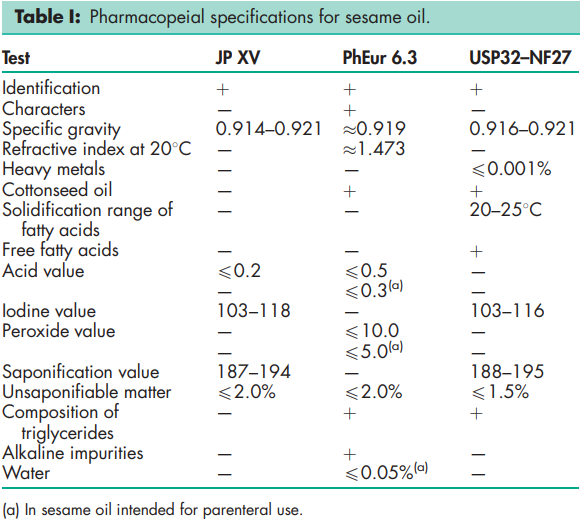
A typical analysis of refined sesame oil indicates the composition of the acids, present as glycerides, to be: arachidic acid 0.8%; linoleic acid 40.4%; oleic acid 45.4%; palmitic acid 9.1%; and stearic acid 4.3%. Sesamin, a complex cyclic ether, and sesamolin, a glycoside, are also present in small amounts. Note that other reported analyses may vary slightly from that above.(1) The monographs for Sesame Oil in the USP32–NF27 and Refined Sesame Oil in the PhEur 6.3 specify the acceptable range of eight triglycerides found in sesame oil.
See Section 4.
The major use of sesame oil in pharmaceutical formulations is as a solvent in the preparation of sustained-release intramuscular injections of steroids, such as estradiol valerate, hydroxyprogesterone caproate, testosterone enanthate, and nandrolone decanoate,(2) or other oil-soluble drug substances, such as the decanoates or enanthate esters of fluphenazine. The disappearance of sesame oil from the injection site, following subcutaneous or intramuscular administration to pigs, has been reported to have a half-life of about 23 days.(3) The in vitro drug release rates from oily depot formulations containing sesame oil intended for intra-articular administration have been reported.(4) Sesame oil may be used as a solvent in the preparation of subcutaneous injections,(5) oral capsules,(6,7) rectal suppositories,(8) and ophthalmic preparations;(9) it may also be used in the formulation of suspensions(10) and emulsions.(10–12) Multipleemulsion formulations, in which sesame oil was one of the oil phases incorporated, have been investigated as a prolonged-release system for rifampicin;(13) microemulsions containing sesame oil have been prepared for the transdermal delivery of ketoprofen.(14) Sesame oil has also been included in self-microemulsifying drug delivery systems,(15) and fast-disintegrating lyophilized dry emulsion tablets(16) for oral administration. It has also been used in the preparation of liniments, pastes, ointments, and soaps. A sesame paste (tahini), composed of crushed sesame seeds in sesame oil, has been investigated as a novel suspending agent.(17) Sesame oil is additionally used as an edible oil and in the preparation of oleomargarine.
Refined sesame oil is a clear, pale-yellow colored liquid with a slight, pleasant odor and a bland taste. It solidifies to a soft mass at about 48C.
See Table I.
Density 0.916–0.920 g/cm3 Flash point 3388C (open cup) Freezing point 58C Refractive index nD 40 = 1.4650–1.4665 Solubility Insoluble in water; practically insoluble in ethanol (95%); miscible with carbon disulfide, chloroform, ether, hexane, and light petroleum. Specific rotation [a]D 25 = þ18 to þ98 Viscosity (dynamic) 43 mPa s (43 cP)
Sesame oil is more stable than most other fixed oils and does not readily become rancid; this has been attributed to the antioxidant effect of some of its characteristic constituents. The PhEur 6.3 permits the addition of a suitable antioxidant to sesame oil. Sesame oil may be sterilized by aseptic filtration or dry heat. It has been reported that suitable conditions for the sterilization of injections containing sesame oil are a temperature of 1708C for 2 hours; it has been suggested that 1508C for 1 hour is inadequate.(18) However, it has been demonstrated that dry heat sterilization of sesame oil at 1508C for 1 hour was sufficient to kill all added Bacillus subtilis spores.(19) Sesame oil should be stored in a well-filled, airtight, lightresistant container, at a temperature not exceeding 408C. Sesame oil intended for use in the manufacture of parenteral dosage forms should be stored under an inert gas in an airtight glass container.
Sesame oil may be saponified by alkali hydroxides.
Sesame oil is obtained from the ripe seeds of one or more cultivated varieties of Sesamum indicum Linne´ (Fam. Pedaliaceae) by expression in a hydraulic press or by solvent extraction. The crude oil thus obtained is refined to obtain an oil suitable for food or pharmaceutical use. Improved color and odor may be obtained by further refining
Sesame oil is mainly used in intramuscular and subcutaneous injections; it should not be administered intravenously. It is also used in topical pharmaceutical formulations and consumed as an edible oil. Although it is generally regarded as an essentially nontoxic and nonirritant material,(20) there have been rare reports of hypersensitivity to sesame oil, with sesamin suspected as being the primary allergen.(21–24) Anaphylactic reactions to sesame seeds have also been reported. However, it is thought that the allergens in the seeds may be inactivated or destroyed by heating as heat-extracted sesame seed oil or baked sesame seeds do not cause anaphylactic reactions in sesame seed-allergic individuals.(25) LD50 (rabbit, IV): 678 mg/kg(26)
Observe normal precautions appropriate to the circumstances and quantity of material handled. Spillages of sesame oil are slippery and should be covered with an inert absorbent material prior to disposal.
Included in the FDA Inactive Ingredients Database (IM and SC injections; oral capsules, emulsions, and tablets; also topical preparations). Included in parenteral (IM injections) and nonparenteral (oral capsules) medicines licensed in the UK. Included in the Canadian List of Acceptable Non-medicinal Ingredients.
Almond oil; canola oil; corn oil; cottonseed oil; peanut oil; soybean oil; sunflower oil.