
Name: Bronopol
CAS No: 2-Bromo-2-nitropropane-1,3-diol [52-51-7]
BP: Bronopol
2-Bromo-2-nitro-1,3-propanediol; b-bromo-b-nitrotrimethyleneglycol; Myacide.
2-Bromo-2-nitropropane-1,3-diol [52-51-7]
C3H6BrNO4 200.00

Bronopol 0.01–0.1% w/v is used as an antimicrobial preservative either alone or in combination with other preservatives in topical pharmaceutical formulations, cosmetics, and toiletries; the usual concentration is 0.02% w/v.
Bronopol is a white or almost white crystalline powder; odorless or with a faint characteristic odor.
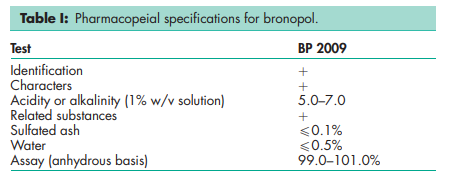
See Table I.
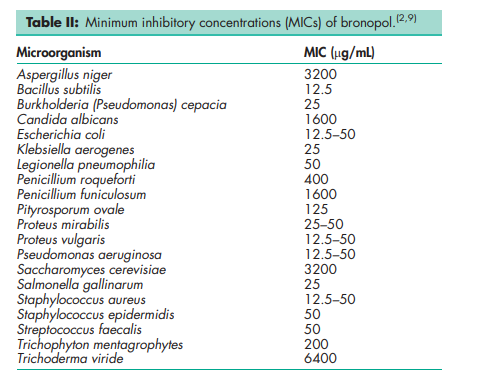
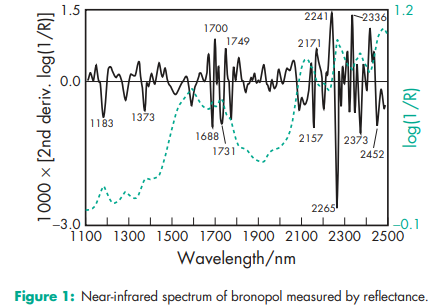
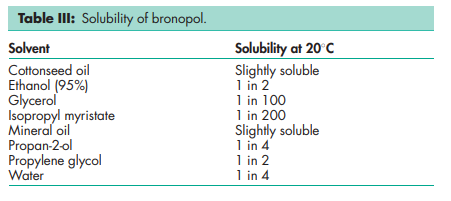
Antimicrobial activity Bronopol is active against both Grampositive and Gram-negative bacteria including Pseudomonas aeruginosa, with typical minimum inhibitory concentrations (MICs) between 10–50 mg/mL;(1–8) see also Table II. At room temperature, a 0.08% w/v aqueous solution may reduce the viability of culture collection strains of Escherichia coli and Pseudomonas aeruginosa by 100-fold or more in 15 minutes. Antimicrobial activity is not markedly influenced by pH in the range 5.0–8.0, nor by common anionic and nonionic surfactants, lecithin, or proteins.(2,5,6) Bronopol is less active against yeasts and molds, with typical MICs of 50–400 mg/mL or more, and has little or no useful activity against bacterial spores. See also Section 12. Melting point 128–1328C NIR spectra see Figure 1. Partition coefficients Mineral oil : water = 0.043 at 22–248C; Peanut oil : water = 0.11 at 22–248C. Solubility see Table III.
Bronopol is stable and its antimicrobial activity is practically unaffected when stored as a solid at room temperature and ambient relative humidity for up to 2 years.(3) The pH of a 1.0% w/v aqueous solution is 5.0–6.0 and falls slowly during storage; solutions are more stable in acid conditions. Half-lives of bronopol in buffered aqueous solutions at 0.03% w/v are shown in Table IV.(9) Microbiological assay results indicate longer half-lives than those obtained by HPLC and thus suggest that degradation products may contribute to antimicrobial activity. Formaldehyde and nitrites are among the decomposition products, but formaldehyde arises in such low concentrations that its antimicrobial effect is not likely to be significant. On exposure to light, especially under alkaline conditions, solutions become yellow or brown-colored but the degree of discoloration does not directly correlate with loss of antimicrobial activity. The bulk material should be stored in a well-closed, nonaluminum container protected from light, in a cool, dry place.
Sulfhydryl compounds cause significant reductions in the activity of bronopol, and cysteine hydrochloride may be used as the deactivating agent in preservative efficacy tests; lecithin/polysorbate combinations are unsuitable for this purpose.(5) Bronopol is incompatible with sodium thiosulfate, with sodium metabisulfite, and with amine oxide or protein hydrolysate surfactants. Owing to an incompatibility with aluminum, the use of aluminum in the packaging of products that contain bronopol should be avoided.
Bronopol is synthesized by the reaction of nitromethane with paraformaldehyde in an alkaline environment, followed by bromination. After crystallization, bronopol powder may be milled to produce a powder of the required fineness.
Bronopol is used widely in topical pharmaceutical formulations and cosmetics as an antimicrobial preservative. Although bronopol has been reported to cause both irritant and hypersensitivity adverse reactions following topical use,(10–13) it is generally regarded as a nonirritant and nonsensitizing material at concentrations up to 0.1% w/v. At a concentration of 0.02% w/v, bronopol is frequently used as a preservative in ‘hypoallergenic’ formulations. Animal toxicity studies have shown no evidence of phototoxicity or tumor occurrence when bronopol is applied to rodents topically or administered orally; and there is no in vitro or in vivo evidence of mutagenicity;(1) this is despite the demonstrated potential of bronopol to liberate nitrite on decomposition, which in the presence of certain amines may generate nitrosamines. Formation of nitrosamines in formulations containing amines may be reduced by limiting the concentration of bronopol to 0.01% w/v and including an antioxidant such as 0.2% w/v alpha tocopherol or 0.05% w/v butylated hydroxytoluene;(14) other inhibitor systems may also be appropriate.(15) LD50 (dog, oral): 250 mg/kg (16) LD50 (mouse, IP): 15.5 mg/kg LD50 (mouse, IV): 48 mg/kg LD50 (mouse, oral): 270 mg/kg LD50 (mouse, SC): 116 mg/kg LD50 (mouse, skin): 4.75 g/kg LD50 (rat, IP): 26 mg/kg LD50 (rat, IV): 37.4 mg/kg LD50 (rat, oral): 180 mg/kg LD50 (rat, SC): 170 mg/kg LD50 (rat, skin): 1.6 g/kg
Observe normal precautions appropriate to the circumstances and quantity of material handled. Bronopol may be harmful upon inhalation and the solid or concentrated solutions can be irritant to the skin and eyes. Eye protection, gloves, and dust respirator are recommended. Bronopol burns to produce toxic fumes.
Included in topical pharmaceutical formulations licensed in Europe. Included in the Canadian List of Acceptable Non-medicinal Ingredients.
Bronopol owes its usefulness as a preservative largely to its activity against Pseudomonas aeruginosa, and its affinity for polar solvents, which prevents the loss of preservative into the oil phase of emulsions that is seen with some other preservatives. Other advantages include a low incidence of microbial resistance; low concentration exponent;(17) and good compatibility with most surfactants, other excipients, and preservatives, with which it can therefore be used in combination. The major disadvantages of bronopol are relatively poor activity against yeasts and molds, instability at alkaline pH, and the production of formaldehyde and nitrite on decomposition, although there is no evidence of serious toxicity problems associated with bronopol that are attributable to these compounds. The EINECS number for bronopol is200-143-0. The PubChem Compound ID (CID) for bronopol is 2450.