Name: Wax, Yellow
CAS No: Yellow beeswax [8012-89-3]
BP: Yellow Beeswax JP: Yellow Beeswax PhEur: Beeswax, Yellow USP-NF: Yellow Wax
Apifil; cera flava; E901; refined wax.
Yellow beeswax [8012-89-3]
Yellow wax is naturally obtained beeswax; see Section 13. Beeswax consists of 70–75% of a mixture of various esters of straight-chain monohydric alcohols with even-numbered carbon chains from C24 to C36 esterified with straight-chain acids. These straight-chain acids also have even numbers of carbon atoms up to C36 together with some C18 hydroxy acids. The chief ester is myricyl palmitate. Also present are free acids (about 14%) and carbohydrates (about 12%) as well as approximately 1% free wax alcohols and stearic esters of fatty acids.
Yellow wax is used in food, cosmetics, and confectionery products. Its main use is in topical pharmaceutical formulations, where it is used at a concentration of 5–20%, as a stiffening agent in ointments and creams. Yellow wax is also employed in emulsions because it enables water to be incorporated into water-in-oil emulsions. In some oral formulations yellow wax is used as a polishing agent for sugar-coated tablets. It is also used in sustained-release formulations. Yellow wax coatings can be used to affect the release rate of drug from ion-exchange resin beads,(1) and yellow wax has also been used in multiparticulate controlled-release dosage forms of chlorphenamine maleate.(2) Yellow wax forms a soap with borax.
Yellow or light brown pieces or plates with a fine-grained matt, noncrystalline fracture and a faint characteristic odor. The wax becomes soft and pliable when warmed. The PhEur 6.0 describes yellow wax as the wax obtained by melting the walls of the honeycomb made by the honeybee, Apis mellifera, with hot water and removing foreign matter.
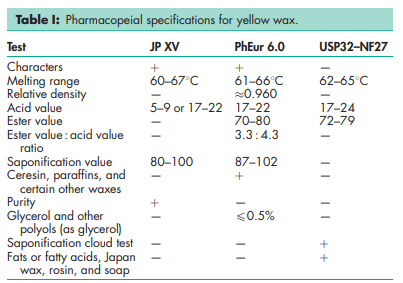
See Table I.
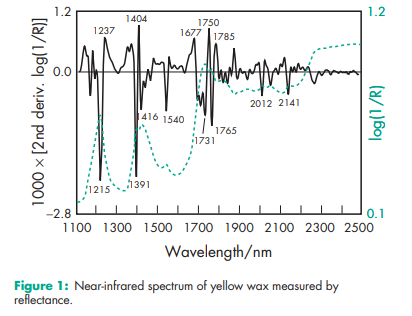
Acid value 20 Arsenic 43 ppm Density 0.95–0.96 g/cm3 Flash point 245–2588C Heavy metals 40.004% Iodine number 8–11 Lead 410 ppm Melting point 61–658C NIR spectra see Figure 1. Peroxide value 48 Solubility Soluble in chloroform, ether, fixed oils, volatile oils, and warm carbon disulfide; sparingly soluble in ethanol (95%); practically insoluble in water. Unsaponified matter 52–55% Viscosity (kinematic) 1470 mm2 /s (1470 cSt) at 998C
When the wax is heated above 1508C esterification occurs with a consequent lowering of acid value and elevation of melting point. Yellow wax is stable when stored in a well-closed container, protected from light
Incompatible with oxidizing agents.
Yellow wax is a natural secretion of bees (Apis mellifera Linne´ (Fam. Apidae)) and is obtained commercially from honeycombs. Honey is abstracted from combs either by draining or centrifugation, and water is added to the remaining wax to remove soluble impurities. Hot water is then added to form a floating melt, which is strained to remove foreign matter. The wax is then poured into flat dishes or molds to cool and harden.
Yellow wax is generally regarded as an essentially nontoxic and nonirritant material, and is used in both topical and oral formulations. However, hypersensitivity reactions attributed to contaminants in the wax, although rare, have been reported.(3,4
Observe normal precautions appropriate to the circumstances and quantity of material handled.
GRAS listed. Accepted for use as a food additive in Europe. Included in the FDA Inactive Ingredients Database (oral capsules and tablets, and topical preparations). Included in nonparenteral medicines licensed in the UK. Included in the Canadian List of Acceptable Non-medicinal Ingredients.
Paraffin; wax, microcrystalline; wax, white.
Studies have shown that yellow wax, when added to suppository formulations, increased the melting point of the preparation significantly and decreased the rate of release of the active substance.(5)