Name: Shellac
CAS No: Shellac [9000-59-3]
BP: Shellac JP: Purified Shellac, JP: White Shellac PhEur: Shellac USP-NF: Shellac
Blonde; Bulls Eye Shellac; CertiSeal FC 300A; Crystalac; E904; Excelacs 3-Circles; Excelacs 3-Stars; Gifu Shellac GBN-PH; Gifu Shellac Pearl-811; lac; lacca; Mantrolac R-49; Mantrolac R-52; Marcoat 125; Opaglos R; Sepifilm SN; SSB Aquagold; SSB 55 Pharma; SSB 56 Pharma; SSB 57 Pharma; Swanlac.
Shellac [9000-59-3]
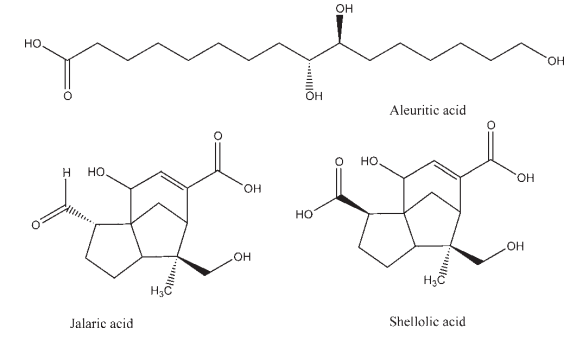
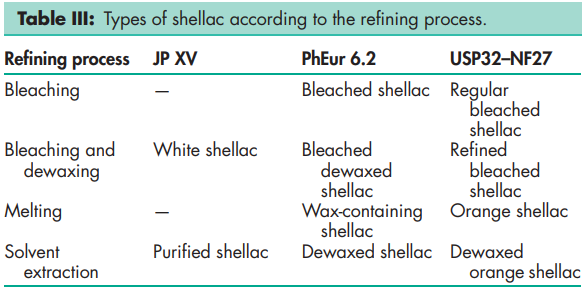
Shellac is the general term for the refined form of lac, a natural polyester resin secreted by insects. PhEur 6.2 and USP32–NF27 define four types of shellac depending on the refining method, and JP XV mentions only two types; pes; see Section 13. Elementary analysis reveals that shellac contains carbon, hydrogen, oxygen, and a negligible amount of ash. Orange shellac contains approx. 68% carbon, 9% hydrogen and 23% oxygen, and with a molecular weight of 1006 (bleached shellac is 949) the empirical formula for the average shellac molecule is C60H90O15. Even with this relatively low molecular weight, shellac has excellent film-forming properties. Lac is a complex mixture of aliphatic and alicyclic acids. The major components are aleuritic, jalaric and shellolic acids, as well as butolic and kerrolic acids. Seed lac and orange shellac contain approximately 5–6% wax and two coloring components, the water soluble laccaic acid and the water insoluble erythrolaccin.
Shellac is widely used as a moisture barrier coating for tablets and pellets due to its low water vapor and oxygen permeability. It has usually been applied in the form of alcoholic or aqueous solutions (pharmaceutical glazes). However, due to stability problems with alcoholic shellac solutions, it has had limited use in the pharmaceutical industry for modified-release or enteric coatings; see also Section 18. Shellac, particularly novel aqueous shellac solutions, is mainly used in food products and nutritional supplements. Recent research results indicate good application properties and chemical stability of shellac films from aqueous shellac solutions.(1,2) Aqueous ammonium shellac solutions, based on dewaxed orange shellac, do not show the problems exhibited by alcoholic shellac solutions and are used as an enteric coating for pellets, tablets, soft and hard gelatine capsules, primarily in nutritional supplements.(3) Shellac is a primary ingredient of pharmaceutical printing inks for capsules and tablets, and can be applied as a 40% w/v alcoholic solution. It has also been used to apply one or two sealing coats to tablet cores to protect them from moisture before being film- or sugar-coated. Other applications of shellac are the coating or encapsulation of powders or granules, e.g. in probiotics. Prior to the introduction of film coating, a combination of shellac, cetostearyl alcohol and stearic acid was used as an enteric coating. In cosmetics, shellac is used in hairsprays, mascara and lipstick formulations.(4) Aqueous shellac solutions are also used for colonic drug delivery.(5)
Shellac is a natural resin that may be obtained in a variety of colors ranging from light yellow to dark red in the form of hard, brittle flakes with or without wax, depending on the refining process; see Sections 4 and 13. The different types of shellac include bleached shellac, bleached dewaxed shellac, dewaxed and decolorized shellac, dewaxed flake shellac, dewaxed orange shellac, dewaxed shellac, orange shellac, purified shellac, refined bleached shellac, regular bleached shellac, regular waxy shellac, wax-containing shellac, and white shellac. The flakes may be crushed or milled to a coarse or fine powder. Bleached shellac is supplied as a coarse offwhite powder. Shellac is tasteless and may have a faint odor. The typical odor of shellac is the result of a complex fragrance system.(6)
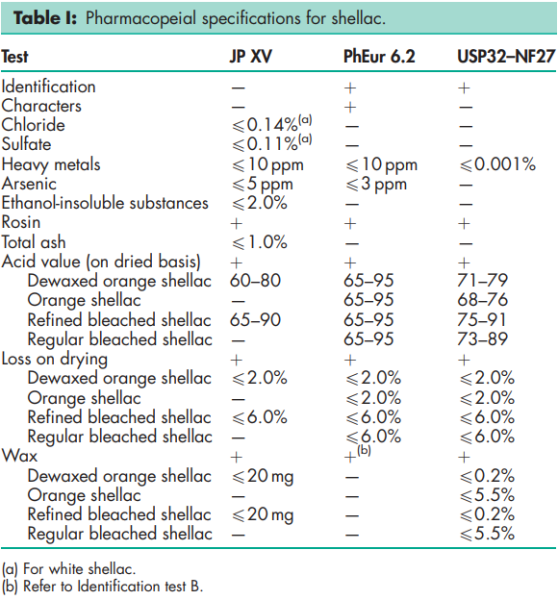
See Table I.
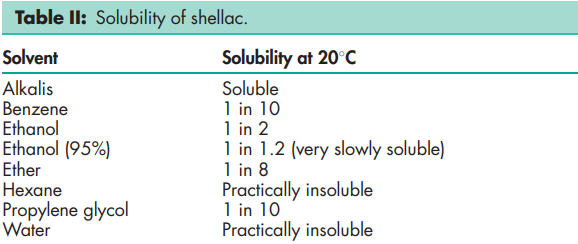
The properties of shellac depend on the insect strain and host tree as well as the method used for refining the crude lac (seed lac). Density 1.035–1.140 g/cm3 Dissociation constant pKa value = 5.60–6.59(7) Glass transition temperature 33–528C;(7) the wide range in temperature is a result of the process used in refining and the type of seed lac used as a starting material. Hydroxyl value 230–280 Iodine number 10–18 Melting point 77–908C Refractive index nD 20 = 1.514–1.524 Saponification value 185–260 Solubility
After long periods of storage, shellac becomes less readily soluble in alcohol, less fluid on heating, and darker in color; see also Section 18. Shellac should be stored in a well-closed container at temperatures below 158C. Wax-containing grades should be mixed before use to ensure uniform distribution of the wax. Orange and dewaxed orange shellac have a shelf-life of 1 to 2 years. The shelf-life of bleached shellac is approximately 6 months.
Shellac is chemically reactive with aqueous alkalis, organic bases, alcohols, and agents that esterify carboxyl groups. Therefore, shellac should be used with caution in the presence of such compounds.
Shellac or lac is cultivated and refined from lacca, a resinous secretion produced by the tiny insect Kerria lacca (Kerr) Lindinger (Coccideae), formerly Laccifer lacca (Kerr). The insects are parasitic on certain trees, mainly in India. In Thailand and South China, the resin is secreted by another species, Laccifer chinensis (Madihassan) on different trees.(7,8) The insects pierce through the bark of the tree and transform the sap into a natural polyester resin, called stick lac which is secreted through the surface of their body. The resin forms thick encrustations on the smaller branches and twigs, which are then scraped off the twigs and further processed to produce seed lac, as it is known at this stage. Seed lac is then refined to become shellac. The chemical composition, properties and the color of shellac depend on the insect or insect strain, and thus the host tree, as well as the process used for refining.(7) Three very different processes are used for refining the seed lac to shellac (bleaching, melting, and solvent extraction),(7–9) resulting in products with different characteristics and properties. Bleaching process Refined bleached or white shellac is obtained by dissolving seed lac in an aqueous alkaline solution, which is then filtered, dewaxed, and bleached with sodium hypochlorite to completely remove the color. However, changes in the molecular structure and the addition of chlorine substituents may lead to self-crosslinking and polymerization. Melting process After melting the seed lac, the highly viscous molten lac is pressed through a filter and drawn to a thin film. Once cooled, the film breaks into thin flakes. The shellac wax is not removed by this process and the color depends on the type of seed lac used. Solvent extraction process Solvent extraction is a very gentle process for refining shellac. The seed lac is dissolved in ethanol, and wax and impurities are removed by filtration. Activated carbon is used to produce light-colored grades. After a further filtration step and the removal of ethanol, the resin is drawn to a thin film, which breaks into flakes after cooling. The properties of the final product depend on the type of seed lac used and are influenced by the processing parameters and the grade of activated carbon. PhEur 6.2 and USP32–NF27 define four types of shellac depending on the refining method, and the JP XV mentions two types; The use of the term ‘pharmaceutical grade’ as well as the quality of the shellac depends on the manufacturer. Seed lac is mainly produced in India, Thailand and China. Orange shellac, refined by the melting process, is manufactured by several companies in India, Thailand and South-East Asia. Bleached shellac is produced in the USA, Canada, Japan, India, Thailand and South China. Dewaxed orange shellac is refined by the solvent extraction process in Germany, Japan and India.
Shellac is used in oral pharmaceutical formulations, food products, and cosmetics. It is generally regarded as an essentially nonirritant and nontoxic material at the levels employed as an excipient
Observe normal precautions appropriate to the circumstances and quantity of material handled. Shellac can be irritating to the eyes, and to the respiratory system if inhaled as dust. Eye protection,gloves, and a dust respirator are recommended. Shellac should be handled in a well-ventilated environment.
Accepted as a food additive in the USA, Europe, and Japan. Included in the FDA Inactive Ingredients Database (oral capsules and tablets). Included in nonparenteral medicines (oral tablets and capsules, often in printing ink formulations) licensed in the UK. Included in the Canadian List of Acceptable Non-medicinal Ingredients
Aleuritic acid; aqueous shellac solution; laccaic acid B; pharmaceutical glaze. Aleuritic acid Empirical formula C16H32O5 Molecular weight 304.42 CAS number [533-87-9] Synonyms DL-erythro-9,10,16,-Trihydroxyhexadecanoic acid; 9,10,16-trihydroxypalmitic acid; 8,9,15-trihydroxypentadecane-1-carboxylic acid. Melting point 100–1018C Solubility Soluble in hot water and lower alcohols. Comments Main component of shellac. Isolated by saponification, and the starting material for the synthesis of macrocyclic musk compounds for fragrances and pheromones.(10) The EINECS number for aleuritic acid is 208-578-8. Aqueous shellac solution CAS number [68308-35-0] Synonyms Shellac ammonium salt Comments Aqueous solution of shellac with 20-25 % solids at a pH of 7–7.5. The EINECS number is 269-647-6. Used as a coating material for granules, pellets, tablets, hard and soft gelatine capsules. Suitable for sustained-release and enteric coatings, as moisture barrier and as encapsulation agent.(3,8,9) Laccaic acid B Empirical formula C24H16O12 Molecular weight 496 Synonyms Lac dye; natural red 25; 9,10-dihydro-3,5,6,8-tetrahydroxy-7-[2-hydroxy-5-(2-hydroxyethyl)phenyl]-9,10-dioxo1,2-anthracenedicarboxylic acid. CAS number [17249-00-2] Solubility Water soluble Comments Laccaic acid consists of 5 compounds, laccaic acid A, B, C, D and E. Laccaic acid B is used as a food color in Japan. The color is pH dependent: orange at pH 3 to reddish purple at above pH 7. Pharmaceutical glaze Synonyms Confectionary glaze, alcoholic shellac solution Comments Pharmaceutical glaze is a specially denatured alcoholic solution of shellac containing between 20% and 57% of shellac. It may be prepared using either ethanol or ethanol (95%), and may contain waxes and titanium dioxide as an opacifying agent.
Under the general term shellac, many grades are available. The pharmacopeial specifications are very narrow with regard to purity; however, they allow a wide range for the acid value. Shellac in the form of its alcoholic solution (pharmaceutical glaze) has been used for many years as an enteric coating for pharmaceutical applications. However, due to significant problems with delayed disintegration and changes in release profiles of the coated dosage forms after storage, alcoholic shellac solutions have limited use as enteric coatings in the pharmaceutical industry today.(3,11,12) Problems are due to an esterification of the carboxyl groups of shellac with alcohol and a polymerization due to trapped alcohol residues in the dry film. The use of bleached shellac, where the molecular structure is partly changed by the treatment with sodium hypochlorite, increases the polymerization problems. Shellac films from ammoniated aqueous shellac solutions using dewaxed orange shellac do not have these problems and have very stable release characteristics even after extended storage times. Furthermore, they can be formulated in combination with other polymers such as HPMC or modified starch together with plasticizers to meet the disintegration requirements of the USP, PhEur and JP.(2,3,8,9) A specification for bleached shellac is contained in the Food Chemicals Codex (FCC).(13) The EINECS number for shellac is 232- 549-9.