Name: Thaumatin
CAS No: Thaumatin [53850-34-3]
None adopted.
E957; katemfe; Talin; taumatin; taumatina; thalin; thaumatine; thaumatins; thaumatins protein.
Thaumatin [53850-34-3]
Thaumatin is a mixture of five thaumatin proteins: thaumatins I, II, III, and a and b, where thaumatins I and II predominate. Thaumatins I and II consist of almost identical sequences of amino acids. There are no unusual side-chains or peptide linkages, and there are no end-group substitutions.
Thaumatin is a naturally occurring intense sweetening agent approximately 2000–3000 times as sweet as sucrose. It has a delayed-onset taste profile and long (up to one hour) licorice-like aftertaste. It is used extensively in food applications as a sweetening agent and flavor enhancer, and has potential for use in pharmaceutical applications such as oral suspensions.(1) The typical level used in foods is 0.5–3 ppm, although higher levels are used in certain applications such as chewing gum. Synergistic effects with other intense sweeteners such as acesulfame K and saccharin occur. The extensive disulfide crosslinking within thaumatin maintains the tertiary structure of the polypeptide: cleavage of just one disulfide bridge has been shown to result in the loss of the sweet taste of thaumatin.(2)
Thaumatin occurs as a pale-brown colored, odorless, hygroscopic powder with an intensely sweet taste.
—
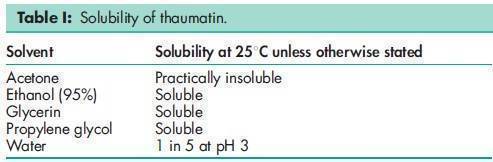
Solubility see Table I.
Thaumatin is stable in aqueous solutions at pH 2–8. It is also heatstable at less than pH 5.5 (e.g. during baking, canning, pasteurizing, or UHT processes).
—
Thaumatin is a naturally occurring intense sweetener isolated from the fruit of the African plant Thaumatococcus daniellii (Benth).(3) Commercially, thaumatin is produced by aqueous extraction under reduced pH conditions followed by other physical processes such as reverse osmosis.
Thaumatin is accepted for use in food products either as a sweetener or as a flavor modifier in a number of areas including Europe and Australia. It is also used in oral hygiene products such as mouthwashes and toothpastes, and has been proposed for use in oral pharmaceutical formulations. Thaumatin is generally regarded as a relatively nontoxic and nonirritant material when used as an excipient. In Europe, because of its lack of toxicity, an ADI has been set of ‘not specified’.(4,5) LD50 (mouse, oral): >20 g/kg(5) LD50 (rat, oral): >20 g/kg
Observe normal precautions appropriate to the circumstances and quantity of material handled.
GRAS listed. Accepted for use as a food additive in Europe. Included in nonparenteral medicines licensed in the UK.
—
As thaumatin is a protein it has some calorific value; however, in food products and pharmaceutical formulations the quantities used are so small that the calorific value is insignificant. The EINECS number for thaumatin is 258-822-2.