
Name: Almond Oil
CAS No: Almond oil [8007-69-0]
BP: Virgin Almond Oil PhEur: Almond Oil, Virgin USP-NF: Almond Oil
Almond oil, bitter; amygdalae oleum virginale; artificial almond oil; bitter almond oil; expressed almond oil; huile d’amande; oleo de ameˆndoas; olio di mandorla; sweet almond oil; virgin almond oil.
Almond oil [8007-69-0]
Almond oil consists chiefly of glycerides of oleic acid, with smaller amounts of linoleic and palmitic acids. The PhEur 6.0 describes almond oil as the fatty oil obtained by cold expression from the ripe seeds of Prunus dulcis (Miller) DAWebb var. dulcis or Prunus dulcis (Miller) DA Webb var. amara (DC) Buchheim or a mixture of both varieties. A suitable antioxidant may be added. The USP32–NF27 describes almond oil as the fixed oil obtained by expression from the kernels of varieties of Prunus dulcis (Miller) D.A. Webb (formerly known as Prunus amygdalus Batsch) (Fam. Rosaceae) except for Prunus dolcii (Miller) D.A. Webb var. amara (De (Andolle) Focke).
See Section 4.
Almond oil is used therapeutically as an emollient(1) and to soften ear wax. As a pharmaceutical excipient it is employed as a vehicle in parenteral preparations,(2) such as oily phenol injection. It is also used in nasal spray,(3) and topical preparations.(4)Almond oil is also consumed as a food substance; see Section 18.
A clear, colorless, or pale-yellow colored oil with a bland, nutty taste.
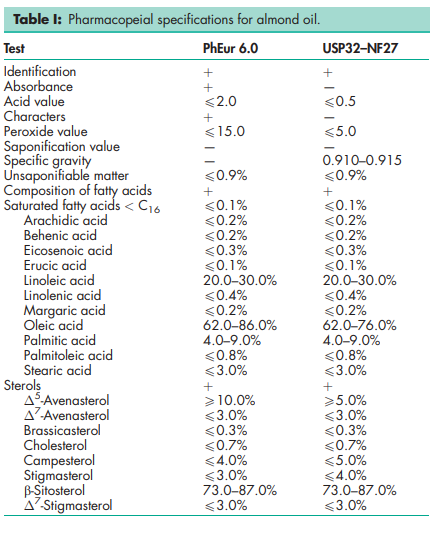
See Table I.
Flash point 3208C Melting point 188C Refractive index n D 40 = 1.4630–1.4650 Smoke point 2208C Solubility Miscible with chloroform, and ether; slightly soluble in ethanol (95%).
Almond oil should be stored in a well-closed container in a cool, dry place away from direct sunlight and odors. It may be sterilized by heating at 1508C for 1 hour. Almond oil does not easily turn rancid.
—
Almond oil is expressed from the seeds of the bitter or sweet almond, Prunus dulcis (Prunus amygdalus; Amygdalus communis) var. amara or var. dulcis (Rosaceae).(5) See also Section 4.
Almond oil is widely consumed as a food and is used both therapeutically and as an excipient in topical and parenteral pharmaceutical formulations, where it is generally regarded as a nontoxic and nonirritant material. However, there has been a single case reported of a 5-month-old child developing allergic dermatitis attributed to the application of almond oil for 2 months to the cheeks and buttocks.(6)
Observe normal precautions appropriate to the circumstances and quantity of material handled.
Included in nonparenteral and parenteral medicines licensed in the UK. Widely used as an edible oil.
Canola oil; corn oil; cottonseed oil; peanut oil; refined almond oil; sesame oil; soybean oil. Refined almond oil Synonyms Amygdalae oleum raffinatum. Comments Refined almond oil is defined in some pharmacopeias such as the PhEur 6.0. Refined almond oil is a clear, pale yellow colored oil with virtually no taste or odor. It is obtained by expression of almond seeds followed by subsequent refining. It may contain a suitable antioxidant.
A 100 g quantity of almond oil has a nutritional energy value of 3700 kJ (900 kcal) and contains 100 g of fat of which 28% is polyunsaturated, 64% is monounsaturated and 8% is saturated fat. Studies have suggested that almond consumption is associated with health benefits, including a decreased risk of colon cancer.(7) A specification for bitter almond oil is contained in the Food Chemicals Codex (FCC).(8)