
Name: Vegetable Oil, Hydrogenated
CAS No: Hydrogenated vegetable oil [68334-00-9] Hydrogenated soybean oil [8016-70-4]
BP: Hydrogenated Vegetable Oil JP: Hydrogenated Oil USP-NF: Hydrogenated Vegetable Oil
Some trade names for materials derived from stated vegetable oils are shown below: Hydrogenated cottonseed oil: Akofine; Lubritab; Sterotex. Hydrogenated palm oil: Softisan 154. Hydrogenated soybean oil: Lipovol HS-K; Sterotex HM
Hydrogenated vegetable oil [68334-00-9] Hydrogenated soybean oil [8016-70-4]
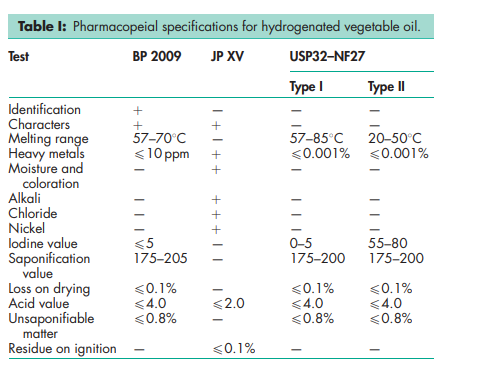
The USP32–NF27 defines two types of hydrogenated vegetable oil, type I and type II, which differ in their physical properties and applications.
R1 COOCH2—CH(OOCR2 )—CH2OOCR3 where R1 , R2 , and R3 are mainly C15 and C17.
Hydrogenated vegetable oil type I may be used as a lubricant in tablet and capsule formulations.(1,2) In this application it is used at concentrations of 1–6% w/w, usually in combination with talc, silica or a silicate to prevent sticking to tablet punch faces. It may also be used as an auxiliary binder in tablet formulations. Hydrogenated vegetable oil type I is additionally used as the matrix-forming material in lipophilic-based controlled-release formulations;(3–6) it may also be used as a coating aid in controlled-release formulations. It has also been investigated in hydrophobic melt agglomeration.(7) Other uses of hydrogenated vegetable oil type I include use as a viscosity modifier in the preparation of oil-based liquid and semisolid formulations; in the preparation of suppositories, to reduce the sedimentation of suspended components and to improve the solidification process; and in the formulation of liquid and semisolid fills for hard gelatin capsules.(8) Fully hydrogenated vegetable oil products may also be used as alternatives to hard waxes in cosmetics and topical pharmaceutical formulations
Hydrogenated vegetable oil is a mixture of triglycerides of fatty acids. The two types that are defined in the USP32–NF27 are characterized by their physical properties; see Section 9. Hydrogenated vegetable oil type I occurs in various forms, e.g. fine powder, flakes, or pellets. The color of the material depends on the manufacturing process and the form. In general, the material is white to yellowish-white with the powder grades appearing more white-colored than the coarser grades.
See Table I
Density (tapped) 0.57 g/cm3 for Lubritab Melting point 61–668C for Lubritab Particle size distribution 85% < 177 mm, 25% < 74 mm in size for Lubritab. Average particle size is 104 mm. Solubility Soluble in chloroform, petroleum spirit, and hot propan-2-ol; practically insoluble in water.
Hydrogenated vegetable oil type I is a stable material; typically it is assigned a 2-year shelf-life. The bulk material should be stored in a well-closed container in a cool, dry place.
Incompatible with strong oxidizing agents
Hydrogenated vegetable oil type I is prepared from refined vegetable oils, which are hydrogenated using a catalyst.
Hydrogenated vegetable oil type I is used in food products and oral pharmaceutical formulations, and is generally regarded as a nontoxic and nonirritant excipient.
Observe normal precautions appropriate to the circumstances and quantity of material handled. Gloves, eye protection, and a dust mask are recommended when handling fine powder grades.
GRAS listed. Included in the FDA Inactive Ingredients Database (oral capsules and tablets; rectal and vaginal suppositories and topical preparations). Included in nonparenteral medicines licensed in the UK. Included in the Canadian List of Acceptable Nonmedicinal Ingredients.
Castor oil, hydrogenated; hydrogenated vegetable oil, type II; medium-chain triglycerides; suppository bases. Hydrogenated vegetable oil, type II Comments Hydrogenated vegetable oil type II includes partially hydrogenated vegetable oils from different sources that have a wide range of applications. In general, type II materials have lower melting ranges and higher iodine values than type I materials. Many type II materials are prepared to meet specific customer requirements for use in cosmetics. Type II materials may also be used in the manufacture of suppositories
Products from different manufacturers may vary owing to differences in the source of the vegetable oil used for hydrogenation. Certain materials are made from mixed hydrogenated oils, e.g. hydrogenated soybean oil and hydrogenated castor oil (Sterotex K).