
Name: Octyldodecanol
CAS No: Octyldodecanol [5333-42-6]
BP: Octyldodecanol PhEur: Octyldodecanol USP-NF: Octyldodecanol
Eutanol G PH; isoarachidyl alcohol; Jarcol 1-20; Jeecol ODD; octildodecanol; octyldodecanolum; 2-octyldodecyl alcohol; 2-octyl1-dodecanol; 2-octyldodecanol; Standamul G.
Octyldodecanol [5333-42-6]
C20H42O ,298.62
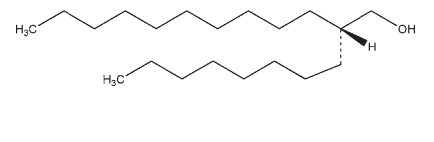
Octyldodecanol is widely used in cosmetics and pharmaceutical applications as an emulsifying and opacifying agent. It is primarily used in topical applications because of its lubricating and emollient properties. Octyldodecanol has been used in the preparation of oil/water microemulsions investigated as the vehicle for the dermal administration of drugs having no or low skin penetration.(1) Octyldodecanol has also been evaluated as a solvent for naproxen when applied topically.(2) Studies of estimated permeability coefficient suggest that octyldodecanol could be a potential dermal permeation enhancer.(3)
Octyldodecanol occurs as a clear, colorless, or yellowish, oily liquid.
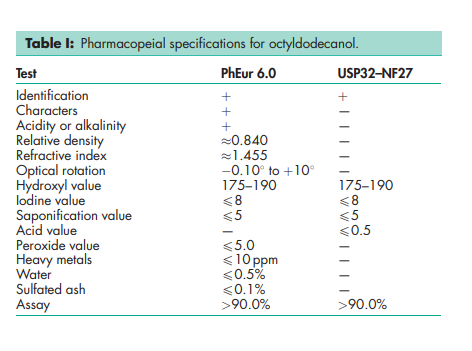
See Table I.
10 Typical Properties Flash point 1808C2008C Melting point <208C Refractive index nD 20 = 1.45–1.46 Solubility Miscible with ethanol (95%); practically insoluble in water. Specific gravity 0.83–0.85 at 208C Viscosity (dynamic) 58–64 mPa s (58–64 cP) at 208C
The bulk material should be stored in a well-closed container in a cool, dry place, protected from light. In the original unopened container, octyldodecanol can be stored for 2 years protected from moisture at below 308C.
Octyldodecanol is generally compatible with most materials encountered in cosmetic and pharmaceutical formulations.
Octyldodecanol is produced by the condensation of two molecules of decyl alcohol. It also occurs naturally in small quantities in plants.
Octyldodecanol is widely used in cosmetics and topical pharmaceutical formulations, and is generally regarded as nontoxic and nonirritant at the levels employed as an excipient. In acute oral toxicity studies in rats fed 5 g/kg of undiluted octyldodecanol, no deaths were observed.(4) In an acute dermal toxicity study, intact and abraded skin sites of guinea pigs were treated with 3 g/kg of undiluted octyldodecanol under occlusive patches; no deaths occurred and no gross skin lesions were observed.(4) Octyldodecanol caused either no ocular irritation or minimal, transient irritation in the eyes of rabbits.(4) However, some sources describe undiluted octyldodecanol as an eye and severe skin irritant
Observe normal precautions appropriate to the circumstances and quantity of material handled. When heated to decomposition, octyldodecanol emits acrid smoke and irritating fumes.
Included in the FDA Inactive Ingredients Database (topical, transdermal, and vaginal preparations). Included in nonparenteral medicines licensed in the UK. Included in the Canadian List of Acceptable Non-medicinal Ingredients.
—
A specification for octyldodecanol is included in Japanese Pharmaceutical Excipients (JPE).(5) The EINECS number for octyldodecanol is 226-242-9. The PubChem Compound ID (CID) for octyldodecanol includes 21414 and 11983377.