Name: Oleyl Alcohol
CAS No: (Z)-9-Octadecen-1-ol [143-28-2]
BP: Oleyl Alcohol PhEur: Oleyl Alcohol USP-NF: Oleyl Alcohol
Alcohol oleicus; HD-Eutanol V PH; Novol; Ocenol; cis-9- octadecen-1-ol; oleic alcohol; oleo alcohol; oleol.
(Z)-9-Octadecen-1-ol [143-28-2]
C18H36O ,268.48

Oleyl alcohol is mainly used in topical pharmaceutical formulations and has been used in transdermal delivery formulations.(1–7) It has been utilized in the development of biodegradable injectable thermoplastic oligomers,(8) and in aerosol formulations of insulin(9) and albuterol.(10) Therapeutically, it has been suggested that oleyl alcohol may exhibit antitumor properties via transmembrane permeation.(1)
Oleyl alcohol occurs as a pale yellow oily liquid that gives off acrid fumes when heated
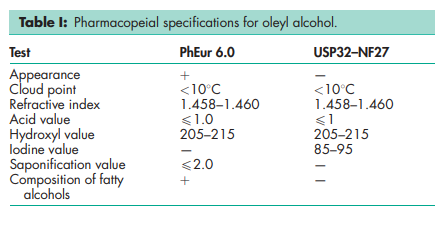
See Table I
Boiling point 182–1848C at 0.152 mPa (1.5 atm) Density 0.850 g/cm3 at 208C Flash point 1708C Melting point 13–198C Partition coefficient Log P (octanol : water) = 7.50. Refractive index nD 25 = 1.4582 Solubility Soluble in ethanol (95%), and ether; practically insoluble in water.
The bulk material should be stored in a well-closed container in a cool, dry, place.
—
Oleyl alcohol occurs naturally in fish oils. Synthetically, it can be prepared from butyl oleate by a Bouveault–Blanc reduction with sodium and butyl alcohol. An alternative method of manufacture is by the hydrogenation of triolein in the presence of zinc chromite.
Oleyl alcohol is mainly used in topical pharmaceutical formulations and is generally regarded as a nontoxic and nonirritant material at the levels employed as an excipient. However, contact dermatitis due to oleyl alcohol has been reported.(12–14) The results of acute oral toxicity and percutaneous studies in animals with products containing 8% oleyl alcohol indicate a very low toxicity.(15) Formulations containing 8% or 20% oleyl alcohol administered by gastric intubation, at doses up to 10 g/kg bodyweight, caused no deaths and no toxic effects in rats.(15)
Observe normal precautions appropriate to the circumstances and quantity of material handled.
Included in the FDA Inactive Ingredients Database (topical emulsions and ointments). Included in nonparenteral medicines licensed in the UK. Included in the Canadian List of Acceptable Non-medicinal Ingredients.
Oleic acid; oleyl oleate. Oleyl oleate Empirical formula C36H68O2 Molecular weight 532.9 CAS number [3687-45-4] Refractive index nD 25 = 1.464–1.468 Specific gravity 0.860–0.884 Solubility Miscible with chloroform and with diethyl ether; slightly soluble in ethanol.
Oleyl alcohol is a mixture of unsaturated and staturated long-chain fatty alcohols consisting mainly of octadec-9-enol (oleyl alcohol and elaidyl alcohol). It may be of animal or vegetable origin. A specification for oleyl alcohol is included in the Japanese Pharmaceutical Excipients (JPE).(16) The EINECS number for oleyl alcohol is 205-597-3. The PubChem Compound ID (CID) for oleyl alcohol is 5284499.