
Name: Olive Oil
CAS No: Olive oil [8001-25-00]
BP: Refined Olive Oil JP: Olive Oil PhEur: Olive Oil, Refined USP-NF: Olive Oil
Gomenoleo oil; olivae oleum raffinatum; pure olive oil; olea europaea oil; oleum olivae
Olive oil [8001-25-00]
Olive oil is a mixture of fatty acid glycerides. Analysis of olive oil shows a high proportion of unsaturated fatty acids, and a typical analysis shows that the composition of the fatty acids is as follows: Myristic acid (14 : 0), 40.5% Palmitic acid (16 : 0), 7.5–20.0% Palmitoleic acid (16 : 1), 0.3–5.0% Hepatodecenoic acid (17 : 1), 40.3% Stearic acid (18 : 0), 0.5–5.0% Oleic acid (18 : 1), 55.0–83.0% Linoleic acid (18 : 2), 3.5–21.0% Linoleic acid (18 : 3), 40.9% Arachidic acid (20 : 0), 40.6% Eicosaenoic acid (20 : 1), 40.4% Behenic acid (22 : 0), 40.2% Lignoceric acid (24 : 0), 41.0% Sterols are also present.
Olive oil has been used in enemas, liniments, ointments, plasters, and soap. It has also been used in oral capsules and solutions, and as a vehicle for oily injections including targeted delivery systems.(1) It has been used in topically applied lipogels of methyl nicotinate.(2) It has also been used to soften ear wax.(3) Olive oil has been used in combination with soybean oil to prepare lipid emulsion for use in pre-term infants.(4) Olive oil is used widely in the food industry as a cooking oil and for preparing salad dressings. In cosmetics, olive oil is used as a solvent, and also as a skin and hair conditioner. Types of products containing olive oil include shampoos and hair conditioners, cleansing products, topical creams and lotions, and sun-tan products.
Olive oil is the fixed oil obtained by cold expression or other suitable mechanical means from the ripe drupes of Olea europaea. It occurs as a clear, colorless or yellow, transparent oily liquid. It may contain suitable antioxidants. Refined olive oil is obtained by refining crude olive oil such that the glyceride content of the oil is unchanged. A suitable antioxidant may be added.
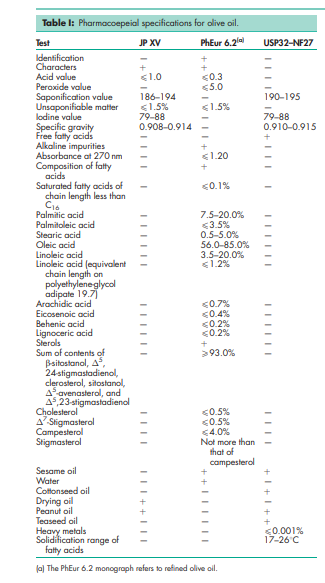
The regulation of olive oil is different in different countries. The pharmacopeia specifications are also different, and may refer to different materials. In the USP32–NF27 and JP XV the monographs cover either mixtures of refined olive oil and virgin olive oil or just refined olive oil. In the PhEur 6.2, the monograph is specific for refined olive oil. See Table I.
Flash point 2258C Refractive index nD 25 = 1.4657–1.4893 Smoke point 160–1888C Solubility Slightly soluble in ethanol (95%); miscible with ether, chloroform, light petroleum (50–708C), and carbon disulfide.
When cooled, olive oil becomes cloudy at approximately 108C, and becomes a butterlike mass at 08C. Olive oil should be stored in a cool, dry place in a tight, wellfilled container, protected from light. For refined oil intended for use in the manufacture of parenteral dosage forms, the PhEur 6.2 requires that the bulk oil be stored under an inert gas.
Olive oil may be saponified by alkali hydroxides. As it contains a high proportion of unsaturated fatty acids, olive oil is prone to oxidation and is incompatible with oxidizing agents.
Virgin olive oil is produced by crushing olives (the fruit of Olea europaea), typically using an edge runner mill. The oil is then expressed from the crushed mass solely by mechanical or other physical methods under conditions that do not cause deterioration of the oil. Any further treatment that the oil undergoes is limited to washing, decantation, centrifugation, and filtration. Refined olive oil is obtained from virgin olive oil by refining methods that do not alter the initial glyceride content of the oil.
Olive oil is used widely as an edible oil and in food preparations and products such as cooking oils and salad dressings. It is used in cosmetics and topical pharmaceutical formulations. Olive oil is generally regarded as a relatively nonirritant and nontoxic material when used as an excipient. Olive oil is a demulcent and has mild laxative properties when taken orally. It has been used in topical formulations as an emollient and to sooth inflamed skin; to soften the skin and crusts in eczema; in massage oils; and to soften earwax.(3) There have been isolated reports that olive oil may cause a reaction in hypersensitive individuals. However, these incidences are relatively uncommon.(5–7) Olive oil is an infrequent sensitizer and does not appear to be a significant allergen in the USA, possibly due to the development of oral tolerance
Observe normal precautions appropriate to the circumstances and quantity of material handled. Olive oil spills are slippery and an inert oil absorbent should be used to cover the oil, which can then be disposed of according to the appropriate legal regulations.
Olive oil is an edible oil. Included in the FDA Inactive Ingredients Database (oral capsules and solution; topical solutions). Included in nonparenteral medicines licensed in Europe. Included in the Canadian List of Acceptable Non-medicinal Ingredients. For nontopical uses, refined olive oil is generally preferred.
Crude olive-pomace oil; extra virgin olive oil; fine virgin olive oil; lampante virgin olive oil; olive-pomace oil; refined olive-pomace oil; virgin olive oil. Crude olive-pomace oil Comments Crude olive-pomace oil is olive-pomace oil that is intended for refining prior to its use in food for human consumption, or that is intended for technical purposes. Extra virgin olive oil Comments Extra virgin oil is a virgin oil that has an organoleptic rating of not less than 6.5, and a free acidity (as oleic acid) of not more than 1.0 g per 100 g. Fine virgin olive oil Comments Fine virgin oil has an organoleptic rating of not less than 5.5, and a free acidity (as oleic acid) of not more than 1.5 g per 100 g. Lampante virgin olive oil Comments Lampante virgin olive oil is virgin olive oil that is not fit for consumption unless it is further processed. This grade of oil is intended for refining or technical purposes. Olive-pomace oil Comments Olive-pomace oil is the oil obtained from the solvent extraction of olive pomace, but does not include oils obtained by reesterification processes or any mixture with oils of any kind. Olive-pomace oil of commerce is a blend of refined olive-pomace oil and virgin olive oil that is fit for human consumption. See also Section 18. Refined olive-pomace oil Comments Refined olive-pomace oil is obtained from crude olivepomace oil by refining methods that do not alter the initial glyceride structure. It is intended for consumption, or blended with virgin olive oil. Virgin olive oil Comments Virgin olive oil has an organoleptic rating of not less than 3.5, and a free acidity (as oleic acid) of not more than 3.3 g per 100 g. The PhEur 6.2 contains a monograph on virgin olive oil as well as refined olive oil.
Olive oil is available in a variety of different grades; see Section 17. All olive oils are graded according to the degree of acidity. The flavor, color, and fragrance of olive oils may vary, depending on the region where the olives are grown, the condition of the crops, and the type of olive used. Olive-pomace oil is obtained from the olive pomace by solvent extraction. The use of solvent extraction causes small changes in the typical fatty acid composition of the oil, and changes in organoleptic properties and impurities. Other oils can be prepared by reesterification of the appropriate combination of fatty acids with glycerol. Olive-pomace oils or reesterified oils cannot be called olive oil.