
Name: Neohesperidin Dihydrochalcone
CAS No: 1-[4-[[2-O-(6-Deoxy-a-L-mannopyranosyl)-b-D-glucopyranosyl] oxy]-2,6-dihydroxyphenyl]-3-(3-hydroxy-4-methoxyphenyl)propan-1-one [20702-77-6]
BP: Neohesperidin Dihydrochalcone PhEur: Neohesperidin Dihydrochalcone
Citrosa; 3,5-dihydroxy-4-(3-hydroxy-4-methoxyhydrocinnamoyl)- phenyl-2-O-(6-deoxy-a-L-mannopyranosyl)-b-D-glucopyranoside; 3,5-dihydroxy-4-[3-(3-hydroxy-4-methoxyphenyl)propionyl]phenyl-2-O-(6-deoxy-a-L-mannopyranosyl)-b-D-glucopyranoside; E959; neohesperidin DC; neohesperidin DHC; neohesperidin dihydrochalconum; neohesperidine dihydrochalcone; NHDC; 1- propanone; 1-[4-[[2-O-6-deoxy-a-L-mannopyranosyl)-b-D-glycopyranosyl]oxy]-2,6-dihydroxyphenyl]-3-(3-hydroxy-4-methoxyphenyl); Sukor.
1-[4-[[2-O-(6-Deoxy-a-L-mannopyranosyl)-b-D-glucopyranosyl] oxy]-2,6-dihydroxyphenyl]-3-(3-hydroxy-4-methoxyphenyl)propan-1-one [20702-77-6]
C28H36O15, 612.58
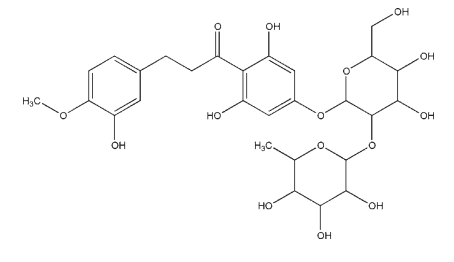
Neohesperidin dihydrochalcone is a synthetic intense sweetening agent approximately 1500–1800 times sweeter than sucrose and 20 times sweeter than saccharin. Structurally it is an analogue of neohesperidin, a flavanone that occurs naturally in Seville oranges (Citrus aurantium). Neohesperidin dihydrochalcone is used in pharmaceutical and food applications as a sweetening agent and flavor enhancer. The sweetness profile is characterized by a lingering sweet/menthol-like aftertaste.(1) The typical level used in foods is 1–5 ppm although much higher levels may be used in certain applications such as chewing gum. Synergistic effects occur with other intense and bulk sweeteners such as acesulfame K, aspartame, polyols, and saccharin.(2) In pharmaceutical applications, neohesperidin dihydrochalcone is useful in masking the unpleasant bitter taste of a number of drugs such as antacids, antibiotics, and vitamins. In antacid preparations, levels of 10–30 ppm result in improved palatability.
Neohesperidin dihydrochalcone occurs as a white or yellowishwhite powder with an intensely sweet taste.
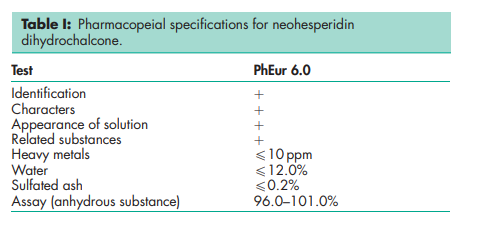
See Table I.
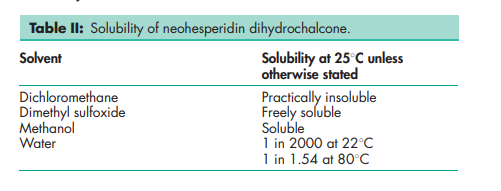
Hygroscopicity Slightly hygroscopic; absorbs up to 15% of water. Melting point 156–1588C Solubility see Table II.
Neohesperidin dihydrochalcone is stable for over three years when stored at room temperature.(1) Accelerated stability studies on aqueous solutions stored at 30–608C and pH 1–7 for 140 days indicate that neohesperidin dihydrochalcone solutions are likely to be stable for 12 months at room temperature and pH 2–6.(3) Solutions formulated with some or all of the water replaced by solvents with a lower dielectric constant are reported to have longer shelf-lives.(4) The bulk material should be stored in a cool, dry, place protected from light
—
Neohesperidin dihydrochalcone is synthesized commercially from either of the bitter-flavanones neohesperidin or naringin by catalytic hydrogenation under alkaline conditions in a process first described in the 1960s, in which neohesperidin is purified by recrystallization from water solutions.(5) Neohesperidin dihydrochalcone is obtained by the alkaline hydrogenation of neohesperidin.(6
Neohesperidin dihydrochalcone is accepted for use in food products either as a sweetener or flavor modifier in a number of areas including Europe, USA, Australia, New Zealand, and several countries in Africa and Asia. It is also used in a number of oral pharmaceutical formulations. Animal toxicity studies suggest that neohesperidin dihydrochalcone is a nontoxic, nonteratogenic, and noncarcinogenic material at the levels used in foods and pharmaceuticals.(7,8) In Europe, an acceptable daily intake of 0–5 mg/kg body-weight has been established.(9,10
Observe normal precautions appropriate to the circumstances and quantity of material handled.
GRAS listed. Accepted for use as a food additive in Europe.
Hesperidin. Hesperidin Empirical formula C28H34O15 Molecular weight 610.56 CAS number [520-26-3] Synonyms (2S)-7-[[6-O-(6-Deoxy-a-L-mannopyranosyl)-b-D-glucopyranosyl]oxy]-2,3-dihydro-5-hydroxy-2-(3-hydroxy-4- methoxyphenyl)-4H-1-benzopyran-4-one; hesperitin 7-rhamnoglucoside; hesperetin-7-rutinoside. Melting point 258–2628C Solubility Freely soluble in diluted alkalis and pyridines; soluble in formamide; slightly soluble in methanol and hot glacial acetic acid. Comments Hesperedin is the predominant flavonoid in lemons and sweet oranges (Citrus sinensis).
Neohesperidin dihydrochalcone is sufficiently soluble in aqueous solutions for most pharmaceutical and food applications; however, solubility may be improved by dissolving in ethanol, glycerin, propylene glycol, or aqueous mixtures of these solvents.(10) Solubility may also be improved by mixing with other intense or bulk sweeteners.(2) Neohesperidin dihydrochalcone in weak concentrations has been shown not to enhance the taste of aqueous sucrose solutions.(6) The EINECS number for neohesperidin dihydrochalcone is 243- 978-6. The PubChem Compound ID (CID) for neohesperidin dihydrochalcone is 30231.