
Name: Neotame
CAS No: (3R)-3-(3,3-Dimethylbutylamino)-4-[[(2R)-1-methoxy-1-oxo-3- phenylpropan-2-yl]amino]-4-oxobutanoic acid [165450-17-9]
USP-NF: Neotame
3-(3,3-Dimethylbutylamino)-N-(a-carboxyphenethyl)succinamic acid methyl ester; N-[N-(3,3-dimethylbutyl)-L-a-aspartyl]-L-phenylalanine 1-methyl ester; L-phenlalanine, N-[N-(3,3-dimethylbutyl)- L-a-aspartyl]-1-methyl ester.
(3R)-3-(3,3-Dimethylbutylamino)-4-[[(2R)-1-methoxy-1-oxo-3- phenylpropan-2-yl]amino]-4-oxobutanoic acid [165450-17-9]
C20H30N2O5 ,378.47
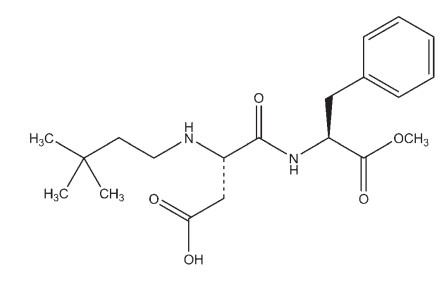
Neotame is a water-soluble, nonnutritive, intense sweetening agent used in beverages and foods. It is structurally related to aspartame and is about 7000–13 000 times sweeter than sucrose, and about 30–60 times sweeter than aspartame, making it the sweetest artificial sweetener available. Neotame is said to have a ‘clean’ sweet taste in contrast to the bitter, metallic aftertaste associated with saccharin. Although neotame has approximately the same caloric value as sucrose (1.2 kJ/g) the small quantities used to achieve a desired level of sweetness in a formulation mean that it is essentially nonnutritive. Neotame may be used in sub-sweetening quantities as a flavor enhancer, e.g. with mint or strawberry flavor.
Neotame occurs as an odorless, white to off-white powder. It has an intense sweet taste 7000–13 000 times sweeter than sucrose depending on the matrix.
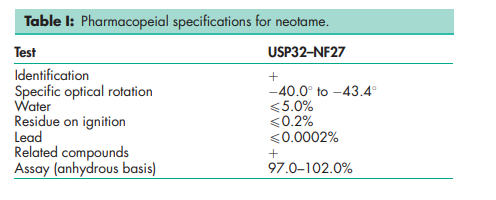
See Table I.
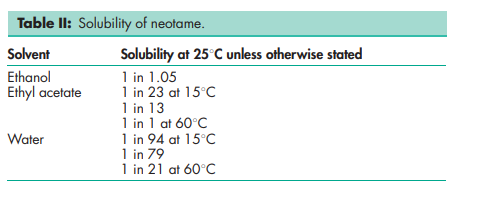
Acidity/alkalinity pH = 5.0–7.0 (0.5% w/v aqueous solution) Dissociation constant pKa1 = 3.01; pKa2 = 8.02. Melting point 80–838C Solubility see Table II.
Neotame stability is affected by moisture, pH, and temperature. Neotame is stable in bakery products and pasteurized dairy products. The bulk material should be stored in a well-closed container, in a cool, dry place; it is stable for up to 5 years at room temperature.
—
Neotame is manufactured by the reaction of aspartame and 3,3- dimethylbutyraldehyde, followed by purification, drying, and milling.(1–3)
Neotame is a nonnutritive intense sweetening agent used in beverages and foods. Studies in animals and humans have shown that neotame is a relatively nontoxic, nonteratogenic, and noncarcinogenic substance. It is reported as safe for use during pregnancy and lactation, and by children and persons with diabetes. At least 30% of ingested neotame is rapidly absorbed. Neotame is metabolized to de-esterified neotame and methanol, with practically all neotame being eliminated from the body in the urine and feces. Peak plasma concentrations of neotame are observed at approximately 30–60 minutes after ingestion. Human studies in healthy and diabetic patients suggest that neotame is well-tolerated at doses up to 1.5 mg/kg body-weight daily (the highest dose studied). Following reviews of over 100 animal and human toxicity studies the European Food Safety Authority and WHO have established an acceptable daily intake for neotame at up to 2 mg/kg body-weight.(4,5
Observe normal precautions appropriate to the circumstances and quantity of the material handled. Eye protection is recommended.
Accepted for use as a food additive in several countries including the USA, Mexico, Australia, and New Zealand. Approved for use in India in pharmaceutical preparations.(6)
Aspartame.
Neotame does not degrade to diketopiperazine and does not require special labeling for phenylketonuria. The PubChem Compound ID (CID) for neotame is 3081923.