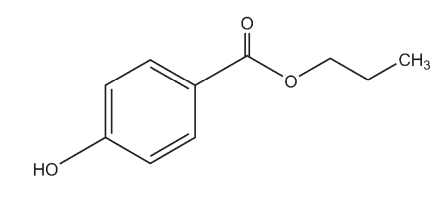
Name: Propylparaben
CAS No: Propyl 4-hydroxybenzoate [94-13-3]
BP: Propyl Hydroxybenzoate JP: Propyl Parahydroxybenzoate PhEur: Propyl Parahydroxybenzoate USP-NF: Propylparaben
Aseptoform P; CoSept P; E216; 4-hydroxybenzoic acid propyl ester; Nipagin P; Nipasol M; propagin; Propyl Aseptoform; propyl butex; Propyl Chemosept; propylis parahydroxybenzoas; propyl phydroxybenzoate; Propyl Parasept; Solbrol P; Tegosept P; Uniphen P-23
Propyl 4-hydroxybenzoate [94-13-3]
C10H12O3 ,180.20
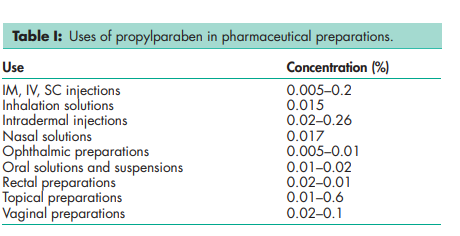
Propylparaben is widely used as an antimicrobial preservative in cosmetics, food products, and pharmaceutical formulations; see Table I. It may be used alone, in combination with other paraben esters, or with other antimicrobial agents. It is one of the most frequently used preservatives in cosmetics.(1) The parabens are effective over a wide pH range and have a broad spectrum of antimicrobial activity, although they are most effective against yeasts and molds; see Section 10. Owing to the poor solubility of the parabens, the paraben salts, particularly the sodium salt, are frequently used in formulations. This may cause the pH of poorly buffered formulations to become more alkaline. Propylparaben (0.02% w/v) together with methylparaben (0.18% w/v) has been used for the preservation of various parenteral pharmaceutical formulations; see Section 14. See Methylparaben for further information.
Propylparaben occurs as a white, crystalline, odorless, and tasteless powder.
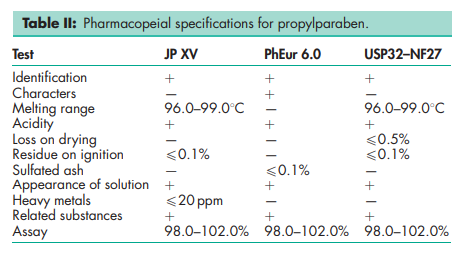
See Table II.
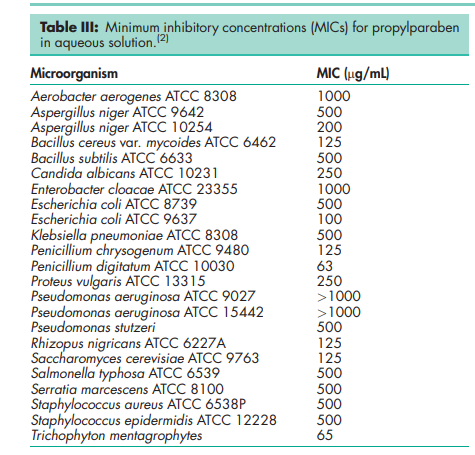
Antimicrobial activity Propylparaben exhibits antimicrobial activity between pH 4–8. Preservative efficacy decreases with increasing pH owing to the formation of the phenolate anion. Parabens are more active against yeasts and molds than against bacteria. They are also more active against Gram-positive than against Gram-negative bacteria. The activity of the parabens increases with increasing chain length of the alkyl moiety; however, solubility decreases. Activity may be improved by using combinations of parabens, as additive effects occur. Propylparaben has been used with methylparaben in parenteral preparations, and is used in combination with other parabens in topical and oral formulations. Activity has also been reported to be improved by the addition of other excipients; see Methylparaben. Reported minimum inhibitory concentrations (MICs) for propylparaben are provided in Table III.(2) Boiling point 2958C Density (bulk) 0.426 g/cm3 Density (tapped) 0.706 g/cm3 Density(true) 1.288 g/cm3 Dissociation constant pKa = 8.4 at 228C Flash point 1408C
Aqueous propylparaben solutions at pH 3–6 can be sterilized by autoclaving, without decomposition.(4) At pH 3–6, aqueous solutions are stable (less than 10% decomposition) for up to about 4 years at room temperature, while solutions at pH 8 or above are subject to rapid hydrolysis (10% or more after about 60 days at room temperature).(5) See Table VI, for the predicted rate constants and half-lives at 258C for propylparaben.(5) Propylparaben should be stored in a well-closed container in a cool, dry place
The antimicrobial activity of propylparaben is reduced considerably in the presence of nonionic surfactants as a result of micellization.(6) Absorption of propylparaben by plastics has been reported, with the amount absorbed dependent upon the type of plastic and the vehicle.(7) Magnesium aluminum silicate, magnesium trisilicate, yellow iron oxide, and ultramarine blue have also been reported to absorb propylparaben, thereby reducing preservative efficacy.(8,9) Propylparaben is discolored in the presence of iron and is subject to hydrolysis by weak alkalis and strong acids. See also Methylparaben.
Propylparaben is prepared by the esterification of p-hydroxybenzoic acid with n-propanol.
Propylparaben and other parabens are widely used as antimicrobial preservatives in cosmetics, food products, and oral and topical pharmaceutical formulations. Propylparaben and methylparaben have been used as preservatives in injections and ophthalmic preparations; however, they are now generally regarded as being unsuitable for these types of formulations owing to the irritant potential of the parabens. Systemically, no adverse reactions to parabens have been reported, although they have been associated with hypersensitivity reactions. The WHO has set an estimated acceptable total daily intake for methyl, ethyl, and propyl parabens at up to 10 mg/kg body-weight.(10) LD50 (mouse, IP): 0.2 g/kg(11) LD50 (mouse, oral): 6.33 g/kg LD50 (mouse, SC): 1.65 g/kg
Observe normal precautions appropriate to the circumstances and quantity of material handled. Propylparaben may be irritant to the skin, eyes, and mucous membranes, and should be handled in a well-ventilated environment. Eye protection, gloves, and a dust mask or respirator are recommended
Propylparaben and methylparaben are affirmed GRAS direct food substances in the USA at levels up to 0.1%. All esters except the benzyl ester are allowed for injection in Japan. In cosmetics, the EU and Brazil allow use of each paraben at 0.4%, but the total of all parabens may not exceed 0.8%. The upper limit in Japan is 1.0%. Accepted as a food additive in Europe. Included in the FDA Inactive Ingredients Database (IM, IV, and SC injections; inhalations; ophthalmic preparations; oral capsules, solutions, suspensions, and tablets; otic, rectal, topical, and vaginal preparations). Included in parenteral and nonparenteral medicines licensed in the UK. Included in the Canadian List of Acceptable Non-medicinal Ingredients.
Butylparaben; ethylparaben; methylparaben; propylparaben potassium; propylparaben sodium. Propylparaben potassium Empirical formula C10H11KO3 Molecular weight 218.30 CAS number [84930-16-5] Synonyms Potassium propyl hydroxybenzoate; propyl 4-hydroxybenzoate potassium salt.
Propylparaben is one of the materials that have been selected for harmonization by the Pharmacopeial Discussion Group. For further information see the General Information Chapter <1196> in the USP32-NF27, the General Chapter 5.8 in PhEur 6.0, along with the ‘State of Work’ document on the PhEur EDQM website, and also the General Information Chapter 8 in the JP XV. A specification for propylparaben is contained in the Food Chemicals Codex (FCC)(12). The EINECS number for propylparaben is 202-307-7. The PubChem Compound ID (CID) for propylparaben is 7175. See Methylparaben for further information and references.