
Name: Petrolatum
CAS No: Petrolatum [8009-03-8]
BP: Yellow Soft Paraffin JP: Yellow Petrolatum PhEur: Paraffin, Yellow Soft USP: Petrolatum
Merkur; mineral jelly; petroleum jelly; Silkolene; Snow White; Soft White; vaselinum flavum; yellow petrolatum; yellow petroleum jelly.
Petrolatum [8009-03-8]
Petrolatum is a purified mixture of semisolid saturated hydrocarbons having the general formula CnH2nþ2, and is obtained from petroleum. The hydrocarbons consist mainly of branched and unbranched chains although some cyclic alkanes and aromatic molecules with paraffin side chains may also be present. The USP 32 and PhEur 6.2 material may contain a suitable stabilizer (antioxidant) that must be stated on the label. The inclusion of a stabilizer is not discussed in the JP XV monograph.
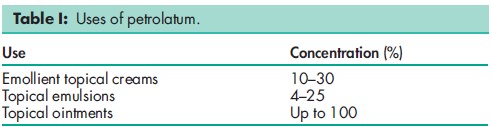
Petrolatum is mainly used in topical pharmaceutical formulations as an emollient-ointment base; it is poorly absorbed by the skin. Petrolatum is also used in creams and transdermal formulations and as an ingredient in lubricant formulations for medicated confectionery together with mineral oil. Therapeutically, sterile gauze dressings containing petrolatum may be used for nonadherent wound dressings or as a packing material.(1) Petrolatum is additionally widely used in cosmetics and in some food applications. See Table I.
Petrolatum is a pale yellow to yellow-colored, translucent, soft unctuous mass. It is odorless, tasteless, and not more than slightly fluorescent by daylight, even when melted.
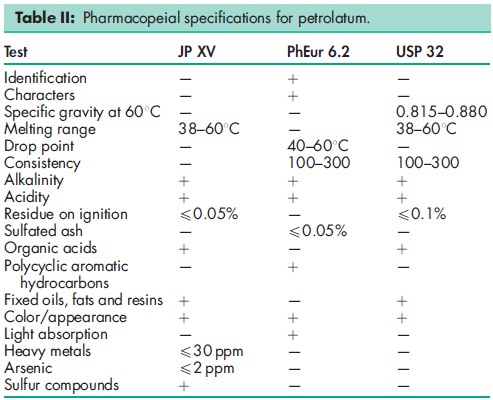
See Table II.
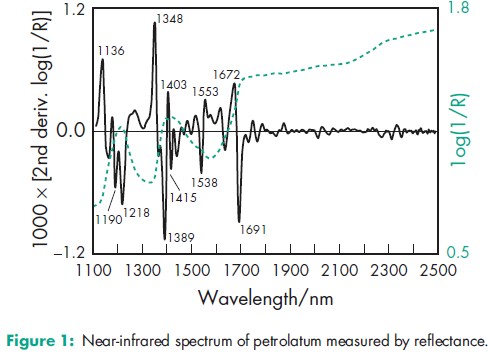
NIR spectra see Figure 1. Refractive index nD 60 = 1.460–1.474 Solubility Practically insoluble in acetone, ethanol, hot or cold ethanol (95%), glycerin, and water; soluble in benzene, carbon disulfide, chloroform, ether, hexane, and most fixed and volatile oils. Viscosity (dynamic) The rheological properties of petrolatum are determined by the ratio of the unbranched chains to the branched chains and cyclic components of the mixture. Petrolatum contains relatively high amounts of branched and cyclic hydrocarbons, in contrast to paraffin, which accounts for its softer character and makes it an ideal ointment base.(2–5)
Petrolatum is an inherently stable material owing to the unreactive nature of its hydrocarbon components; most stability problems occur because of the presence of small quantities of impurities. On exposure to light, these impurities may be oxidized to discolor the petrolatum and produce an undesirable odor. The extent of the oxidation varies depending upon the source of the petrolatum and the degree of refinement. Oxidation may be inhibited by the inclusion of a suitable antioxidant such as butylated hydroxyanisole, butylated hydroxytoluene, or alpha tocopherol. Petrolatum should not be heated for extended periods above the temperature necessary to achieve complete fluidity (approximately 708C). See also Section 18. Petrolatum may be sterilized by dry heat. Although petrolatum may also be sterilized by gamma irradiation, this process affects the physical properties of the petrolatum such as swelling, discoloration, odor, and rheological behavior.(6,7) Petrolatum should be stored in a well-closed container, protected from light, in a cool, dry place.
Petrolatum is an inert material with few incompatibilities.
Petrolatum is manufactured from the semisolid residue that remains after the steam or vacuum distillation of petroleum.(8) This residue is dewaxed and/or blended with stock from other sources, along with lighter fractions, to give a product with the desired consistency. Final purification is performed by a combination of high-pressure hydrogenation or sulfuric acid treatment followed by filtration through adsorbents. A suitable antioxidant may be added.
Petrolatum is mainly used in topical pharmaceutical formulations and is generally considered to be a nonirritant and nontoxic material. Animal studies, in mice, have shown petrolatum to be nontoxic and noncarcinogenic following administration of a single subcutaneous 100 mg dose. Similarly, no adverse effects were observed in a 2-year feeding study with rats fed a diet containing 5% of petrolatum blends.(9) Although petrolatum is generally nonirritant in humans following topical application, rare instances of allergic hypersensitivity reactions have been reported,(10–12) as have cases of acne, in susceptible individuals following repeated use on facial skin.(13) However, given the widespread use of petrolatum in topical products, there are few reports of irritant reactions. The allergic components of petrolatum appear to be polycyclic aromatic hydrocarbons present as impurities. The quantities of these materials found in petrolatum vary depending upon the source and degree of refining. Hypersensitivity appears to occur less with white petrolatum and it is therefore the preferred material for use in cosmetics and pharmaceuticals. Petrolatum has also been tentatively implicated in the formation of spherulosis of the upper respiratory tract following use of a petrolatum-based ointment packing after surgery,(14) and lipoid pneumonia following excessive use in the perinasal area.(15) Other adverse reactions to petrolatum include granulomas (paraffinomas) following injection into soft tissue.(16) Also, when taken orally, petrolatum acts as a mild laxative and may inhibit the absorption of lipids and lipid-soluble nutrients. Petrolatum is widely used in direct and indirect food applications. In the USA, the daily dietary exposure to petrolatum is estimated to be 0.404 mg/kg body-weight.(17) For further information see Mineral Oil and Paraffin.
Observe normal precautions appropriate to the circumstances and quantity of material handled. For recommended workplace exposure limits see Mineral Oil and Paraffin.
GRAS listed. Accepted for use in certain food applications in many countries worldwide. Included in the FDA Inactive Ingredients Database (ophthalmic preparations; oral capsules and tablets; otic, topical, and transdermal preparations). Included in nonparenteral medicines licensed in the UK. Included in the Canadian List of Acceptable Non-medicinal Ingredients.
Mineral oil; mineral oil light; paraffin; petrolatum and lanolin alcohols; white petrolatum. White petrolatum Synonyms Vaselinum album; white petroleum jelly; white soft paraffin. Appearance White petrolatum is a white to pale yellow-colored, translucent, soft unctuous mass. It is odorless and tasteless, and not more than slightly fluorescent by daylight, even when melted. Method of manufacture White petrolatum is petrolatum that has been highly refined so that it is wholly or nearly decolorized. It may contain a stabilizer. Comments White petrolatum is listed in the JP XV, PhEur 6.5, and USP 32. White petrolatum is one of the materials that have been selected for harmonization by the Pharmacopeial Discussion Group. For further information see the General Information Chapter <1196> in the USP32–NF27, the General Chapter 5.8 in PhEur 6.0, along with the ‘State of Work’ document on the PhEur EDQM website, and also the General Information Chapter 8 in the JP XV. White petrolatum is associated with fewer instances of hypersensitivity reactions and is the preferred petrolatum for use in cosmetics and pharmaceuticals, see Section 14.
Petrolatum is one of the materials that have been selected for harmonization by the Pharmacopeial Discussion Group. For further information see the General Information Chapter <1196> in the USP32–NF27, the General Chapter 5.8 in PhEur 6.0, along with the ‘State of Work’ document on the PhEur EDQM website, and also the General Information Chapter 8 in the JP XV. Various grades of petrolatum are commercially available, which vary in their physical properties depending upon their source and refining process. Petrolatum obtained from different sources may therefore behave differently in a formulation.(18) Care is required in heating petrolatum because of its large coefficient of thermal expansion. It has been shown by both rheological and spectrophotometric methods that petrolatum undergoes phase transition at temperatures between 30–408C. Additives, such as microcrystalline wax, may be used to add body to petrolatum. A specification for petrolatum is contained in the Food Chemicals Codex (FCC).(19) The EINECS number for petrolatum is 232-373-2.