
Name: Aluminum Monostearate
CAS No: Aluminum monostearate [7047-84-9]
JP: Aluminum Monostearate USP-NF: Aluminum Monostearate
Aluminum stearate; aluminum, dihydroxy (octadecanoate-O-); dihydroxyaluminum monostearate; HyQual; octadecanoic acid aluminum salt; stearic acid aluminum salt; stearic acid aluminum dihydroxide salt; Synpro.
Aluminum monostearate [7047-84-9]
C18H37AlO4 344.50
[CH3(CH2)16COO]Al(OH)2
Aluminum monostearate is mainly used in microencapsulation(1-3) and in the manufacture of ointments. Aluminum monostearate is used as a viscosity-increasing agent in nonaqueous cosmetic and pharmaceutical formulations. In addition, aluminum monostearate can be used as an emulsion stabilizer in cosmetic emulsions and is used in cosmetics such as mascara, moisturizers, and sunscreens.
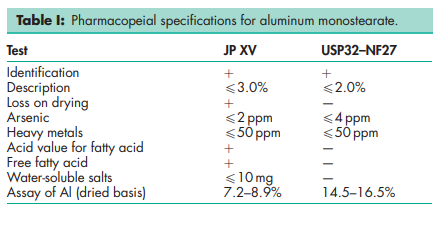
Aluminum monostearate is an aluminum compound of stearic acid and palmitic acid. The USP32–NF27 states that aluminum monostearate contains the equivalent of not less than 14.5% and not more than 16.5% of Al2O3, calculated on the dried basis. The JP XV states that it contains not less than 7.2% and not more than 8.9% of aluminium. Aluminum monostearate occurs as a white, fine, bulky powder with a slight odor of fatty acid. It is a solid material.
See Table I. See also Section 18.
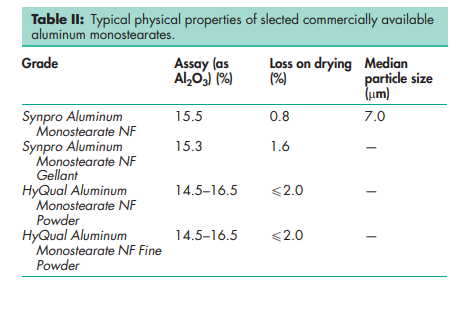
See Table II. Melting point 220–2258C Solubility Practically insoluble in water. Soluble in ethanol (95%) and benzene. Specific gravity 1.14
Aluminum monostearate should be stored in a well-closed container in a cool, dry, place. It is stable under ordinary conditions of use and storage.
—
Aluminum monostearate is prepared by reacting aluminum with stearic acid.
Aluminum monostearate is generally regarded as relatively nontoxic and nonirritant when used as an excipient.
Observe normal precautions appropriate to the circumstances and quantity of the material handled. When heated to decomposition, aluminum monostearate emits acrid smoke and irritating vapors.
Aluminum monostearate and aluminum stearate are included in the FDA Inactive Ingredients Database (oral capsules and tablets, topical creams and ointments). Included in nonparenteral medicines licensed in the UK.
Aluminum distearate; aluminum tristearate. Aluminum distearate Empirical formula C36H37AlO5 Molecular weight 877.39 CAS number [300-92-5] Synonyms Hydroxyaluminum distearate; aluminum stearate; aluminum monobasic stearate. Description Aluminum distearate occurs as a fine white to offwhite colored powder with a slight odor of fatty acid. Melting point 150–1658C Specific gravity 1.01 Solubility Soluble in benzene, and in ethanol (95%); practically insoluble in water. Comments The EINECS number for aluminum distearate is 206- 101-8. Aluminum tristearate Empirical formula C54H105AlO6 Molecular weight 610.9 CAS number [637-12-7] Synonyms Hydroxyaluminum tristearate; aluminum stearate. Description Aluminum tristearate occurs as a fine white to offwhite colored powder with a slight odor of fatty acid. Melting point 117–1208C Specific gravity 1.01 Solubility Practically insoluble in water. Soluble in ethanol (95%), benzene, turpentine oil, and mineral oils when freshly prepared. Comments The EINECS number for aluminum tristearate is 211- 279-5.
A specification for aluminum stearate, described as consisting mainly of the distearate, is included in the Japanese Pharmaceutical Excipients (JPE).(4) It should be noted that aluminum stearate can also refer to the distearate (CAS number 300-92-5) and the monostearate (CAS number 7047-84-9) in addition to the tristearate (CAS number 637- 12-7). The distearate exhibits the same excipient properties as the tristearate and is used in similar pharmaceutical applications. However, the monostearate is more widely used in both cosmetic and pharmaceutical preparations. The EINECS number for aluminum monostearate is 230-325-5.