
Name: Phenylmercuric Borate
CAS No: [Orthoborato(3-)-O]-phenylmercurate(2-)dihydrogen [102-98-7] The CAS Registry Number, chemical name and synonyms all refer to phenylmercuric borate alone, rather than the compound. The name phenylmercuric borate and the synonyms may, however, be applied to the PhEur 6.0 material, which is a compound or a mixture of compounds;. Unique CAS Registry Numbers for phenylmercuric borate and the compounds are as follows: C6H7BHgO3 [102-98-7] C12H13BHg2O4 [8017-88-7] C12H11BHg2O3 [6273-99-0]
BP: Phenylmercuric Borate PhEur: Phenylmercuric Borate
(Dihydrogen borato)phenylmercury; phenylhydrargyri boras; phenylmercuriborate; phenylmercury borate; PMB.
[Orthoborato(3-)-O]-phenylmercurate(2-)dihydrogen [102-98-7] The CAS Registry Number, chemical name and synonyms all refer to phenylmercuric borate alone, rather than the compound. The name phenylmercuric borate and the synonyms may, however, be applied to the PhEur 6.0 material, which is a compound or a mixture of compounds;. Unique CAS Registry Numbers for phenylmercuric borate and the compounds are as follows: C6H7BHgO3 [102-98-7] C12H13BHg2O4 [8017-88-7] C12H11BHg2O3 [6273-99-0]
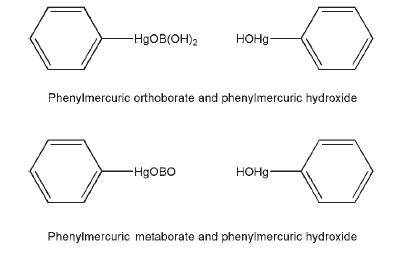
The PhEur 6.0 material is a compound consisting of equimolecular proportions of phenylmercuric hydroxide and phenylmercuric orthoborate (C12H13BHg2O4) or of the dehydrated form (metaborate, C12H11BHg2O3), or a mixture of the two compounds. Phenylmercuric hydroxide and phenylmercuric orthoborate: C12H13BHg2O4 633.2 Phenylmercuric hydroxide and phenylmercuric metaborate: C12H11BHg2O3 615.2
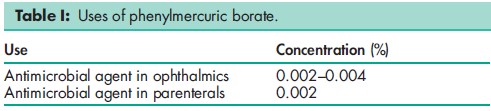
Phenylmercuric borate is used as an alternative antimicrobial preservative to phenylmercuric acetate or phenylmercuric nitrate. It is more soluble than phenylmercuric nitrate and has also been reported to be less irritant than either phenylmercuric acetate or phenylmercuric nitrate.(1) See Table I. See also Phenylmercuric Nitrate.
Phenylmercuric borate occurs as colorless, shiny flakes or as a white or slightly yellow, odorless, crystalline powder.
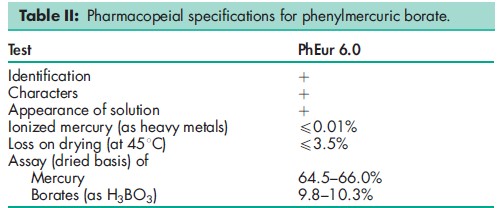
See Table II.
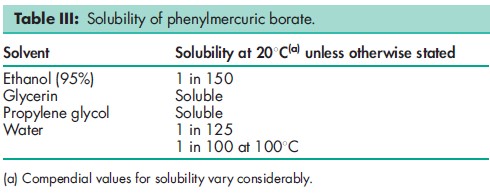
Acidity/alkalinity pH = 5.0–7.0 for 0.6% w/v aqueous solution at 208C. Antimicrobial activity Phenylmercuric borate is a broad-spectrum antimicrobial preservative with slow bactericidal and fungicidal activity similar to that of phenylmercuric nitrate; see Phenylmercuric Nitrate. Dissociation constant pKa = 3.3 Melting point 112–1138C Solubility see Table III.
As for other phenylmercuric salts; see Phenylmercuric Nitrate. Solutions may be sterilized by autoclaving. Phenylmercuric borate should be stored in a well-closed container, protected from light, in a cool, dry place.
As for other phenylmercuric salts; see Phenylmercuric Nitrate. Incompatible with: halides; anionic emulsifying agents and suspending agents; tragacanth; starch; talc; sodium metabisulfite; sodium thiosulfate; disodium edetate; silicates; aluminum and other metals; amino acids; ammonia and ammonium salts; sulfur compounds; rubber; and some plastics.
Phenylmercuric borate may be prepared by heating mercuric borate with benzene or by evaporating to dryness, under vacuum, an alcoholic solution containing equimolar proportions of phenylmercuric hydroxide and boric acid.
Phenylmercuric borate is mainly used as an antimicrobial preservative in topical pharmaceutical formulations. A number of adverse reactions to mercury-containing preservatives have been reported; see Phenylmercuric Nitrate. Although phenylmercuric borate is an irritant, it has been reported to be less so than either phenylmercuric acetate or phenylmercuric nitrate.(1) There is, however, some cross-sensitization potential with other mercurial preservatives. Systemic absorption has been reported following regular use of a hand disinfectant soap containing 0.04% phenylmercuric borate, resulting in an increase in the estimated total daily body load of mercury from 30–100 mg per 24 hours.(2)
Observe normal precautions appropriate to the circumstances and quantity of material handled. Phenylmercuric borate may be irritant to the skin, eyes, and mucous membranes. Eye protection, gloves, and a respirator are recommended.
Included in nonparenteral medicines licensed in Europe. Included in the Canadian List of Acceptable Non-medicinal Ingredients (ophthalmic, nasal and otic preparations up to 0.004%; there must be no other suitable alternative preservative). In Europe, use is limited to eye makeup and eye makeup remover at not more than 0.007% mercury alone or in combination with other permitted mercurial substances.(3) In France, a maximum concentration of up to 0.01% is permitted for use in pharmaceutical formulations. Prohibited from use in cosmetic products in Canada. Prohibited in antimicrobial diaper rash drug products in the USA. Limited use in Japan (see Phenylmercuric Nitrate).
Phenylmercuric acetate; phenylmercuric nitrate; thimerosal.
The EINECS number for phenylmercuric borate is 203-068-1.