
Name: Sugar, Confectioner’s
CAS No: See Section 4.
USP-NF: Confectioner’s Sugar
Icing sugar; powdered sugar.
See Section 4.
The USP32–NF27 describes confectioner’s sugar as a mixture of sucrose (C12H22O11) and corn starch that has been ground to a fine powder; it contains not less than 95.0% sucrose calculated on the dried basis.
See Section 4 and Sucrose.
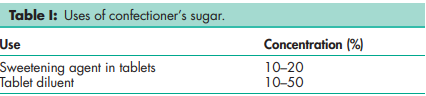
Confectioner’s sugar is used in pharmaceutical formulations when a rapidly dissolving form of sugar is required for flavoring or sweetening. It is used as a diluent in solid-dosage formulations when a small particle size is necessary to achieve content uniformity in blends with finely divided active ingredients. In solutions, at high concentrations (70% w/v), confectioner’s sugar provides increased viscosity along with some preservative effects. Confectioner’s sugar is also used in the preparation of sugar-coating solutions and in wet granulations as a binder/diluent.
Confectioner’s sugar occurs as a sweet-tasting, fine, white, odorless powder.
See Table II.
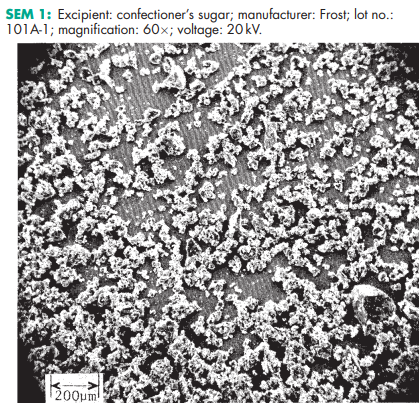
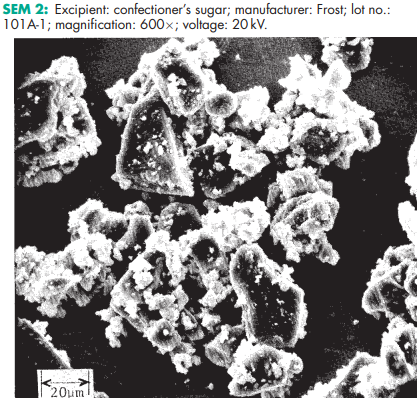
Density (bulk) 0.465 g/cm3 Density (tapped) 0.824 g/cm3 Moisture content 0.1–0.31% NIR spectra see Figure 1. Particle size distribution Various grades with different particle sizes are commercially available, e.g. 6X, 10X, and 12X grades of confectioner’s sugar from the Domino Sugar Corp. Mean particle size is 14.3 mm. For 6X, 94% through a #200 (75 mm) mesh. For 10X, 99.9% through a #100 (150 mm) mesh and 97.5% through a #200 (75 mm) mesh. For 12X, 99% through a #200 (75 mm) mesh and 96% through a #325 (45 mm) mesh. Solubility The sucrose portion is water-soluble while the starch portion is insoluble in water, although it forms a cloudy solution.
Confectioner’s sugar is stable in air at moderate temperatures but may caramelize and decompose above 1608C. It is more hygroscopic than granular sucrose. Microbial growth may occur on dry storage if adsorbed moisture is present or in dilute aqueous solutions. Confectioner’s sugar should be stored in a well-closed container in a cool, dry place.
Confectioner’s sugar is incompatible with dilute acids, which cause the hydrolysis of sucrose to invert sugar. It is also incompatible with alkaline earth hydroxides, which react with sucrose to form sucrates.
Confectioner’s sugar is usually manufactured by grinding refined granulated sucrose with corn starch to produce a fine powder. Other anticaking agents, such as tricalcium phosphate and various silicates, have also been used but are less common.
Confectioner’s sugar is used in confectionery and oral pharmaceutical formulations. It is generally regarded as a relatively nontoxic and nonirritant material
Observe normal precautions appropriate to the circumstances and quantity of material handled. See also Sucrose.
Included in the FDA Inactive Ingredients Database (capsules and tablets). Included in the Canadian List of Acceptable Non-medicinal Ingredients.
Compressible sugar; sucrose; sugar spheres.
Confectioner’s sugar is not widely used in pharmaceutical formulations because the poor-flow characteristics prevent its use in directcompression blends. However, confectioner’s sugar is used when a smooth mouth feel or a rapidly dissolving sweetener is required, and when a milled/micronized active ingredient must be blended with a diluent of similar particle size for powders or wet granulations. Low-starch grades of confectioner’s sugar containing 0.01% w/w starch are also commercially available.