
Name: Sulfur Dioxide
CAS No: Sulfur dioxide [7446-09-5]
USP-NF: Sulfur Dioxide
E220; sulfur(IV) oxide; sulfurous anhydride; sulfurous oxide.
Sulfur dioxide [7446-09-5]
SO2 64.06
See Section 4.
Sulfur dioxide is used as an antioxidant for pharmaceutical injections. It is also used as a preservative and antioxidant in the food and cosmetics industries.
Sulfur dioxide occurs as a colorless gas at room temperature and pressure, with a strong, suffocating, pungent odor. It is noncombustible and is a strong reducing agent.
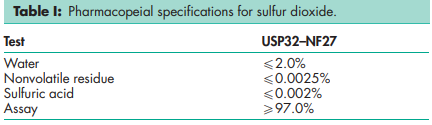
See Table I.
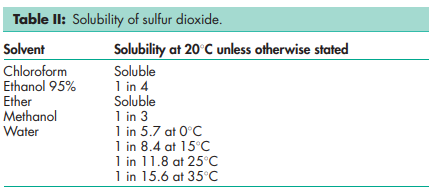
Boiling point 10.08C Density 2.927 g/cm3 (gas); 1.5 g/cm3 (liquid) Melting point 72.08C Solubility see Table II. Vapor pressure 338.4 kPa (2538 mmHg) at 218C
Sulfur dioxide is noncorrosive and stable when dry. It is usually stored under pressure in cylinders, and should be kept in a cool, dry, well-ventilated area, away from flammable materials.
Sulfur dioxide reacts vigorously with strong alkalis and oxidizing agents. The moist gas corrodes most metals. Sulfur dioxide is incompatible with chlorates, fluorine, interhalogens, powdered metals, metal oxides, metal acetylides, sodium hydroxide, and diethyl zinc. It is also incompatible with thiamine and gelatin.
Sulfur dioxide can be made by burning sulfur, or by roasting sulfide ores such as pyrites, sphalerite, and cinnabar.
Sulfur dioxide is used in food and pharmaceutical products. However, in large amounts, sulfur dioxide gas is highly irritant to the eyes, skin, and mucous membranes. Inhalation can lead to severe irritation of the respiratory tract. Direct contact with the liquid form may cause frostbite. Sulfur dioxide and sulfites may also cause allergic reactions and asthma.(1–3)
Observe normal precautions appropriate to the circumstances and quantity of the material handled. Sulfur dioxide forms sulfurous acid on contact with water. When heated to decomposition, it emits toxic fumes of sulfur oxide gases. Avoid inhalation and contact with eyes and skin.
GRAS listed. Accepted for use as a food additive in Europe. Included in the FDA Inactive Ingredients Database (IV infusions; injection solutions). Included in the Canadian List of Acceptable Non-medicinal Ingredients.
Potassium metabisulfite; sodium metabisulfite; sodium sulfite.
Sulfur dioxide is a byproduct of cement manufacture. A specification for sulfur dioxide is contained in the Food Chemicals Codex (FCC).(4 The EINECS number for sulfur dioxide is 231-195-2. The PubChem Compound ID (CID) for sulfur dioxide is 1119