
Name: Sunflower Oil
CAS No: Sunflower oil [8001-21-6]
BP: Refined Sunflower Oil PhEur: Sunflower Oil, Refined USP-NF: Sunflower Oil
Helianthi annui oleum raffinatum; huile de tournesol; oleum helianthi; sunflowerseed oil.
Sunflower oil [8001-21-6]
See Section 5.
Sunflower oil is classified as an oleic–linoleic acid oil. Its composition includes linoleic acid (66%), oleic acid (21.3%), palmitic acid (6.4%), arachidic acid (4.0%), stearic acid (1.3%), and behenic acid (0.8%). The USP32–NF-27 describes sunflower oil as a refined fixed oil obtained from the seeds of Helianthus annus Linne´ (Fam. Asteraceae alt. Compositae). The PhEur 6.2 describes sunflower oil as the refined fatty oil obtained from the seeds of Helianthus annus C. by mechanical expression or by extraction. A suitable antioxidant may be added
Sunflower oil is widely used as an edible oil, primarily in oleomargarine. It is also used extensively in cosmetics and pharmaceutical formulations. Therapeutically, sunflower oil is used to provide energy and essential fatty acids for parenteral nutrition. Studies have shown that sunflower oil may be used in intramuscular injections without inducing tissue damage.(1)
Sunflower oil occurs as a clear, light yellow-colored liquid with a bland, agreeable taste.
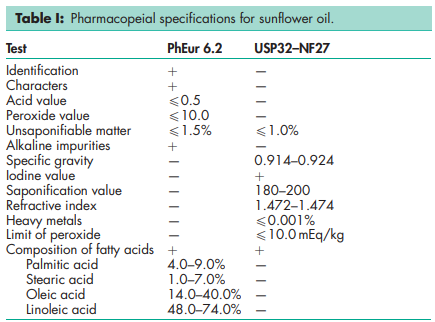
See Table I.
Boiling point 40–608C Density 0.915–0.919 g/cm3 Hydroxyl value 14–16 Iodine number 125–140 Melting point 188C Refractive index nD 25 = 1.472–1.474; nD 40 = 1.466–1.468. Solubility Miscible with benzene, chloroform, carbon tetrachloride, diethyl ether, and light petroleum; practically insoluble in ethanol (95%) and water.
Sunflower oil should be stored in an airtight, well-filled container, protected from light. Stability may be improved by the addition of an antioxidant such as butylated hydroxytoluene.
The oxidative stability of sunflower oil is reduced in the presence of iron oxides and zinc oxide.(2) Sunflower oil forms a ‘skin’ after being exposed to air for 2–3 weeks
Sunflower oil is obtained from the fruits and seeds (achenes) of the sunflower, Helianthus annus (Compositae), by mechanical means or by extraction.
Sunflower oil is widely used in food products and on its own as an edible oil. It is also used extensively in cosmetics and topical pharmaceutical formulations, and is generally regarded as a relatively nontoxic and nonirritant material.
Observe normal precautions appropriate to the circumstances and quantity of material handled. When heated to decomposition, sunflower oil emits acrid smoke and irritating fumes.
GRAS listed. Included in nonparenteral medicines licensed in the UK.
Corn oil; cottonseed oil; peanut oil; sesame oil; soybean oil.
High oleic acid content sunflower oil with good oxidative stability and emollient properties is commercially available for use in cosmetic formulations.(3) Sunflower oil with marked oxidative stability is particularly suitable for the manufacture of sunscreen agents.(4) Sunflower oil should be labeled to indicate the name and concentration of any antioxidant added, and also whether the oil was obtained by mechanical expression or extraction. A specification for sunflower oil is contained in the Food Chemicals Codex (FCC).(5) The EINECS number for sunflower oil is 232-273-9