
Name: Polyoxyethylene Sorbitan Fatty Acid Esters
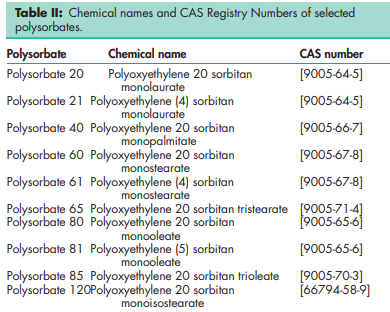
CAS No: See Table II.
BP: Polysorbate 20 Polysorbate 40 Polysorbate 60 Polysorbate 80 JP: Polysorbate 80 PhEur: Polysorbate 20 Polysorbate 40 Polysorbate 60 Polysorbate 80 USP-NF: Polysorbate 20 Polysorbate 40 Polysorbate 60 Polysorbate 80
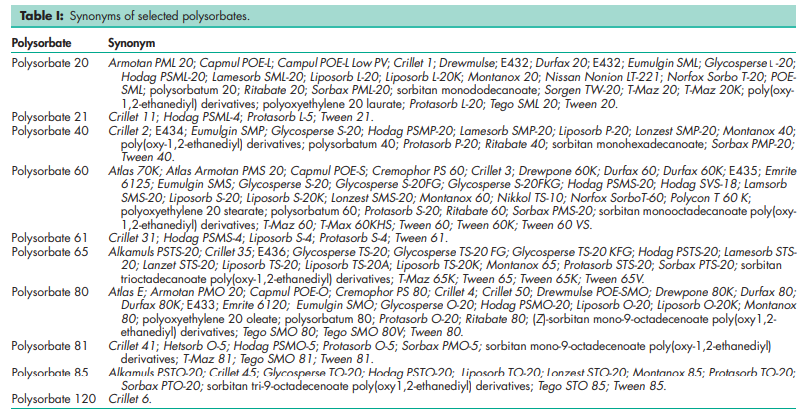
For synonyms of selected polysorbates,see Table I
See Table II.
Approximate molecular weights for selected polysorbates are shown in Table III.
w þ x þ y þ z = 20 (Polysorbates 20, 40, 60, 65, 80, and 85) w þ x þ y þ z = 5 (Polysorbates 81) w þ x þ y þ z = 4 (Polysorbates 21 and 61) R = fatty acid
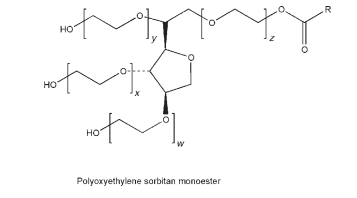
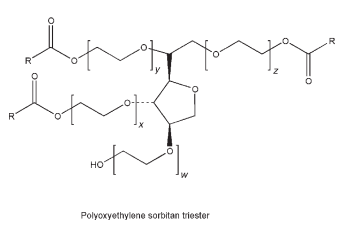
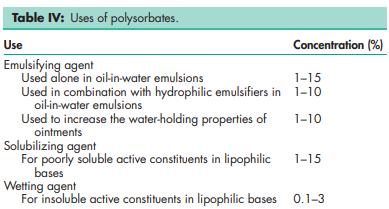
Polyoxyethylene sorbitan fatty acid esters (polysorbates) are a series of partial fatty acid esters of sorbitol and its anhydrides copolymerized with approximately 20, 5, or 4 moles of ethylene oxide for each mole of sorbitol and its anhydrides. The resulting product is therefore a mixture of molecules of varying sizes rather than a single uniform compound. Polysorbates containing 20 units of oxyethylene are hydrophilic nonionic surfactants that are used widely as emulsifying agents in the preparation of stable oil-in-water pharmaceutical emulsions. They may also be used as solubilizing agents for a variety of substances including essential oils and oil-soluble vitamins, and as wetting agents in the formulation of oral and parenteral suspensions. They have been found to be useful in improving the oral bioavailability of drug molecules that are substrates for Pglycoprotein.(1,2) Polysorbates are also widely used in cosmetics and food products.
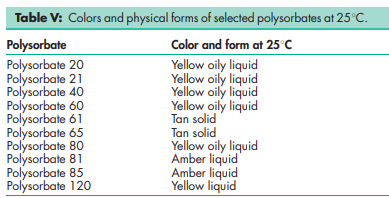
Polysorbates have a characteristic odor and a warm, somewhat bitter taste. Their colors and physical forms at 258C are shown in Table V, although it should be noted that the absolute color intensity of the products may vary from batch to batch and from manufacturer to manufacturer.
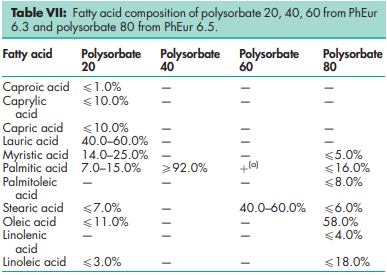
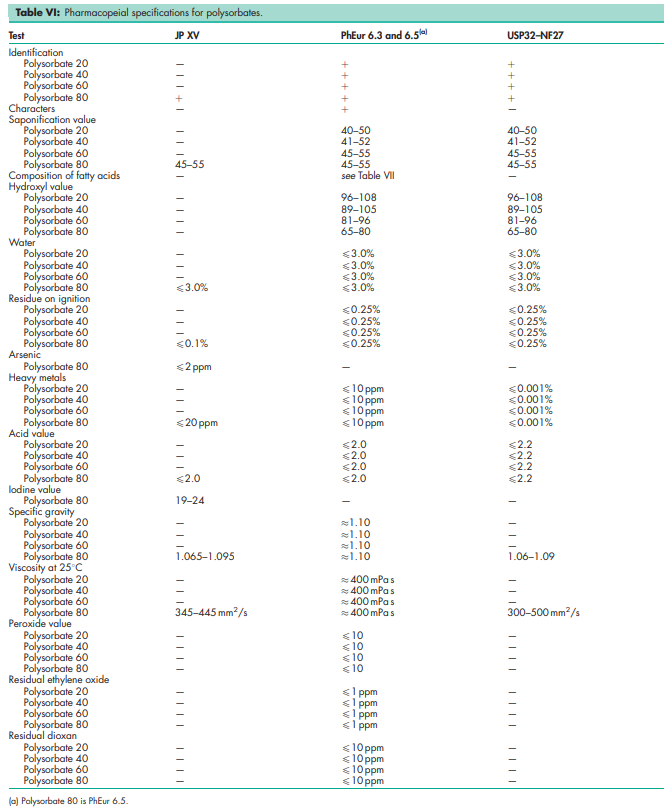
See Tables VI and VII
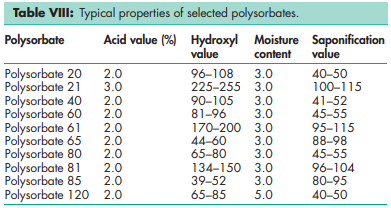
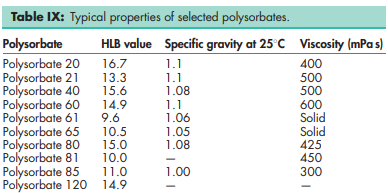
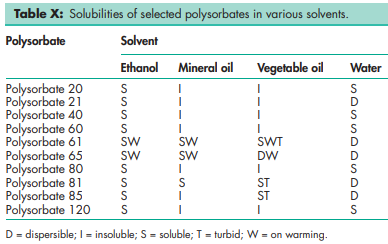
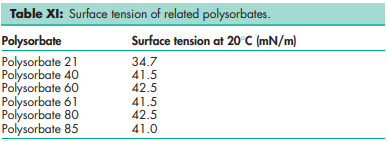
Acid value see Table VIII. Acidity/alkalinity pH = 6.0–8.0 for a 5% w/v aqueous solution. Flash point 1498C HLB value see Table IX. Hydroxyl value see Table VIII. Moisture content see Table VIII. Saponification value see Table VIII. Solubility see Table X. Specific gravity see Table IX. Surface tension For 0.1% w/v solutions, see Table XI. Viscosity (dynamic)
Polysorbates are stable to electrolytes and weak acids and bases; gradual saponification occurs with strong acids and bases. The oleic acid esters are sensitive to oxidation. Polysorbates are hygroscopic and should be examined for water content prior to use and dried if necessary. Also, in common with other polyoxyethylene surfactants, prolonged storage can lead to the formation of peroxides. Polysorbates should be stored in a well-closed container, protected from light, in a cool, dry place.
Discoloration and/or precipitation occur with various substances, especially phenols, tannins, tars, and tarlike materials. The antimicrobial activity of paraben preservatives is reduced in the presence of polysorbates.(3) See Methylparaben.
Polysorbates are prepared from sorbitol in a three-step process. Water is initially removed from the sorbitol to form a sorbitan (a cyclic sorbitol anhydride). The sorbitan is then partially esterified with a fatty acid, such as oleic or stearic acid, to yield a hexitan ester. Finally, ethylene oxide is chemica
Polysorbates are widely used in cosmetics, food products, and oral, parenteral and topical pharmaceutical formulations, and are generally regarded as nontoxic and nonirritant materials. There have, however, been occasional reports of hypersensitivity to polysorbates following their topical and intramuscular use.(4) Polysorbates have also been associated with serious adverse effects, including some deaths, in low-birthweight infants intravenously administered a vitamin E preparation containing a mixture of polysorbates 20 and 80.(5,6) When heated to decomposition, the polysorbates emit acrid smoke and irritating fumes. The WHO has set an estimated acceptable daily intake for polysorbates 20, 40, 60, 65, and 80, calculated as total polysorbate esters, at up to 25 mg/kg body-weight.(7) Polysorbate 20 Moderate toxicity by IP and IV routes. Moderately toxic by ingestion. Human skin irritant. LD50 (hamster, oral): 18 g/kg(8) LD50 (mouse, IV): 1.42 g/kg LD50 (rat, oral): 37 g/kg Polysorbate 21 Moderately toxic by IV route. Polysorbate 40 Moderately toxic by IV route. LD50 (rat, IV): 1.58 g/kg.(8) Polysorbate 60 Moderately toxic by IV route. Experimental tumorigen; reproductive effects. LD50 (rat, IV): 1.22 g/kg.(8) Polysorbate 61 Moderately toxic by IV route. Polysorbate 80 Moderately toxic by IV route. Mildly toxic by ingestion. Eye irritation. Experimental tumorigen, reproductive effects. Mutagenic data. LD50 (mouse, IP): 7.6 g/kg(8) LD50 (mouse, IV): 4.5 g/kg LD50 (mouse, oral): 25 g/kg LD50 (rat, IP): 6.8 g/kg LD50 (rat, IV): 1.8 g/kg Polysorbate 85 Skin irritant.
Observe normal precautions appropriate to the circumstances and quantity of material handled. Eye protection and gloves are recommended
Polysorbates 60, 65, and 80 are GRAS listed. Polysorbates 20, 40, 60, 65, and 80 are accepted as food additives in Europe. Polysorbates 20, 40, 60, and 80 are included in the FDA Inactive Ingredients Database (IM, IV, oral, rectal, topical, and vaginal preparations). Polysorbates are included in parenteral and nonparenteral medicines licensed in the UK. Polysorbates 20, 21, 40, 60, 61, 65, 80, 81, 85, and 120 are included in the Canadian List of Acceptable Non-medicinal Ingredients.
Polyethylene glycol; sorbitan esters (sorbitan fatty acid esters).
Polysorbate 80 is one of the materials that have been selected for harmonization by the Pharmacopeial Discussion Group. For further information see the General Information Chapter <1196> in the USP32–NF27, the General Chapter 5.8 in PhEur 6.0, along with the ‘State of Work’ document on the PhEur EDQM website, and also the General Information Chapter 8 in the JP XV. The PubChem Compound ID (CID) for polysorbates includes 443314 and 5281955.