
Name: Potassium Benzoate
CAS No: Potassium benzoate [582-25-2]
USP-NF: Potassium Benzoate
Benzoate of potash; benzoic acid potassium salt; E212; kalium benzoat; potassium salt trihydrate; ProBenz PG.
Potassium benzoate [582-25-2]
C7H5KO2 160.21
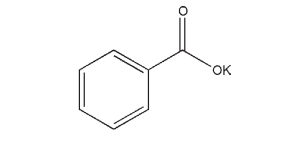
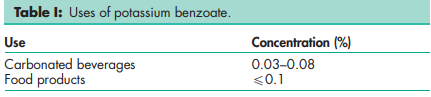
Potassium benzoate is predominantly used as an antimicrobial preservative in a wide range of beverages, foods and some pharmaceutical formulations. Preservative efficacy increases with decreasing pH; it is most effective at pH 4.5 or below. However, at low pH undissociated benzoic acid may produce a slight though discernible taste in food products. Increasingly, potassium benzoate is used as an alternative to sodium benzoate in applications where a low sodium content is desirable. Therapeutically, potassium benzoate has also been used in the management of hypokalemia.
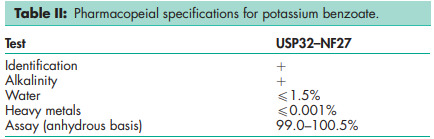
Potassium benzoate occurs as a slightly hygroscopic, white, odorless or nearly odorless crystalline powder or granules. Aqueous solutions are slightly alkaline and have a sweetish astringent taste.
See Table II.
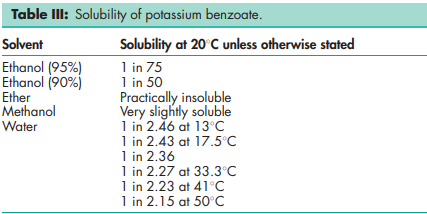
Acidity/alkalinity Aqueous solutions are slightly alkaline. Melting point >3008C Solubility see Table III. Specific gravity 1.5
Potassium benzoate is stable at room temperature under normal storage conditions. Since it is slightly hygroscopic, potassium benzoate should be stored in sealed containers. Exposure to conditions of high humidity and elevated temperatures should be avoided
Potassium benzoate is incompatible with strong acids and strong oxidizing agents.
Potassium benzoate is prepared from the acid–base reaction between benzoic acid and potassium hydroxide.
Potassium benzoate is widely used in food products and is generally regarded as a nontoxic and nonirritant material. However, people with a history of allergies may show allergic reactions when exposed to potassium benzoate. Ingestion is inadvisable for asthmatics. Higher concentrations of potassium benzoate have been reported to cause irritation to mucous membranes. The WHO acceptable daily intake of total benzoates including potassium benzoate, calculated as benzoic acid, has been estimated at up to 5 mg/kg of body-weight.(1,2)
Observe normal precautions appropriate to the circumstances and quantity of material handled. Potassium benzoate may be irritant to the eyes and skin. Eye protection and gloves are recommended. When exposed to heat, and when heated to decomposition, potassium benzoate emits acrid smoke and irritating fumes.
GRAS listed. Accepted as a food additive in Europe. Included in the Canadian List of Acceptable Non-medicinal Ingredients.
Benzoic acid; sodium benzoate.
The EINECS number for potassium benzoate is 209-481-3. The PubChem Compound ID (CID) for potassium benzoate is 23661960.