
Name: Potassium Hydroxide
CAS No: Potassium hydroxide [1310-58-3]
BP: Potassium Hydroxide JP: Potassium Hydroxide PhEur: Potassium Hydroxide USP-NF: Potassium Hydroxide
Caustic potash; E525; kalii hydroxidum; kalium hydroxydatum; potash lye; potassium hydrate
Potassium hydroxide [1310-58-3]
KOH 56.11
See Section 4.
Potassium hydroxide is widely used in pharmaceutical formulations to adjust the pH of solutions. It can also be used to react with weak acids to form salts. Therapeutically, potassium hydroxide is used in various dermatological applications.
Potassium hydroxide occurs as a white or nearly white fused mass. It is available in small pellets, flakes, sticks and other shapes or forms. It is hard and brittle and shows a crystalline fracture. Potassium hydroxide is hygroscopic and deliquescent; on exposure to air, it rapidly absorbs carbon dioxide and water with the formation of potassium carbonate.
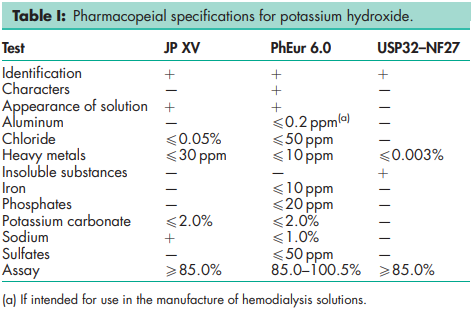
See Table I.
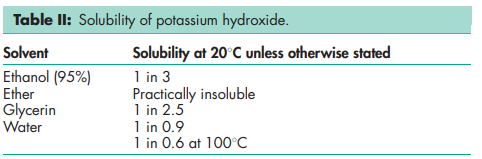
Acidity/alkalinity pH = 13.5 (0.1 M aqueous solution) Melting point 3608C; 3808C when anhydrous Solubility see Table II.
Potassium hydroxide should be stored in an airtight, nonmetallic container in a cool, dry place.
Potassium hydroxide is a strong base and is incompatible with any compound that readily undergoes hydrolysis or oxidation. It should not be stored in glass or aluminum containers, and will react with acids, esters, and ethers, especially in aqueous solution.
Potassium hydroxide is made by the electrolysis of potassium chloride. Commercial grades may contain chlorides as well as other impurities.
Potassium hydroxide is widely used in the pharmaceutical and food industries and is generally regarded as a nontoxic material at low concentrations. At high concentrations it is a corrosive irritant to the skin, eyes, and mucous membranes. LD50 (rat, oral): 0.273 g/kg(1)
Potassium hydroxide is a corrosive irritant to the skin, eyes, and mucous membranes. The solid and solutions cause burns, often with deep ulceration. It is very toxic on ingestion and harmful on inhalation. Observe normal handling precautions appropriate to the quantity and concentration of material handled. Gloves, eye protection, respirator, and other protective clothing should be worn. Potassium hydroxide is strongly exothermic when dissolved in ethanol (95%) or water, and considerable heat is generated. The reaction between potassium hydroxide solutions and acids is also strongly exothermic. In the UK, the workplace exposure limit for potassium hydroxide has been set at 2 mg/m3 short-term.(2)
GRAS listed. Accepted for use in Europe in certain food applications. Included in the FDA Inactive Ingredients Database (injections, infusions, and oral capsules and solutions). Included in nonparenteral and parenteral medicines licensed in the UK. Included in the Canadian List of Acceptable Non-medicinal Ingredients.
Sodium hydroxide.
A specification for potassium hydroxide is contained in the Food Chemicals Codex (FCC).(3) The EINECS number for potassium hydroxide is 215-181-3