
Name: Potassium Sorbate
CAS No: 2,4-Hexadienoic acid potassium salt [24634-61-5]
BP: Potassium Sorbate PhEur: Potassium Sorbate USP-NF: Potassium Sorbate
E202; 2,4-hexadienoic acid (E,E)-potassium salt; kalii sorbas; potassium (E,E)-hexa-2,4-dienoate; potassium (E,E)-sorbate; sorbic acid potassium salt.
2,4-Hexadienoic acid potassium salt [24634-61-5]
C6H7O2K 150.22
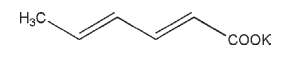
Potassium sorbate is an antimicrobial preservative, with antibacterial and antifungal properties used in pharmaceuticals, foods, enteral preparations, and cosmetics. Generally, it is used at concentrations of 0.1–0.2% in oral and topical formulations, especially those containing nonionic surfactants. Potassium sorbate has been used to enhance the ocular bioavailability of timolol.(1) Potassium sorbate is used in approximately twice as many pharmaceutical formulations as is sorbic acid owing to its greater solubility and stability in water. Like sorbic acid, potassium sorbate has minimal antibacterial properties in formulations above pH 6.
Potassium sorbate occurs as a white crystalline powder with a faint, characteristic odor.
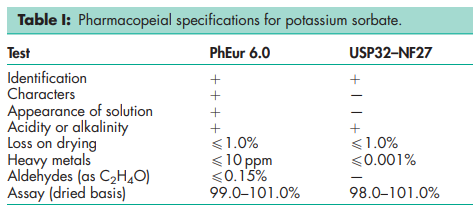
See Table I.
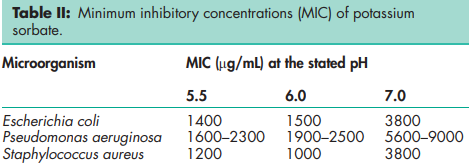
Antimicrobial activity Potassium sorbate is predominantly used as an antifungal preservative, although it also has antibacterial properties. Similarly to sorbic acid, the antimicrobial activity is dependent on the degree of dissociation; there is practically no antibacterial activity above pH 6. Preservative efficacy is increased with increasing temperature,(2) and increasing concentration of potassium sorbate.(2) The efficacy of potassium sorbate is also increased when used in combination with other antimicrobial preservatives or glycols since synergistic effects occur.(3) Reported minimum inhibitory concentrations (MICs) at the pH values indicated are shown in Table II.(3)
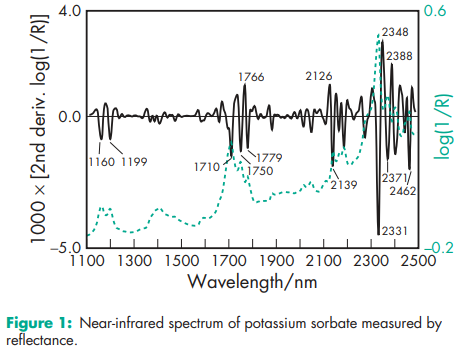
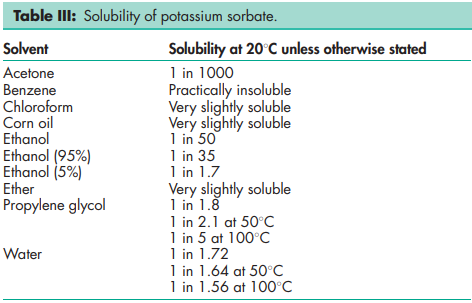
Potassium sorbate is more stable in aqueous solution than sorbic acid; aqueous solutions may be sterilized by autoclaving. The bulk material should be stored in a well-closed container, protected from light, at a temperature not exceeding 408C.
Some loss of antimicrobial activity occurs in the presence of nonionic surfactants and some plastics. See also Sorbic Acid.
Potassium sorbate is prepared from sorbic acid and potassium hydroxide.
Potassium sorbate is used as an antimicrobial preservative in oral and topical pharmaceutical formulations and is generally regarded as a relatively nontoxic material. However, some adverse reactions to potassium sorbate have been reported, including irritant skin reactions which may be of the allergic, hypersensitive type. There have been no reports of adverse systemic reactions following oral consumption of potassium sorbate. The WHO has set an estimated total acceptable daily intake for sorbic acid, calcium sorbate, potassium sorbate, and sodium sorbate expressed as sorbic acid at up to 25 mg/kg body-weight.(4,5) LD50 (mouse, IP): 1.3 g/kg(6) LD50 (rat, oral): 4.92 g/kg
Observe normal precautions appropriate to the circumstances and quantity of material handled. Potassium sorbate is irritant to the skin, eyes, and mucous membranes; eye protection and gloves are recommended. In areas of limited ventilation, a respirator is also recommended.
GRAS listed. Accepted for use as a food additive in Europe. Included in the FDA Inactive Ingredients Database (nasal sprays; oral capsules, solutions, suspensions, syrups, tablets; topical creams and lotions). Included in nonparenteral medicines licensed in the UK. Included in the Canadian List of Acceptable Non-medicinal Ingredients.
Sorbic acid.
Much of the information contained in the sorbic acid monograph on safety, incompatibilities, and references also applies to potassium, calcium, and sodium sorbates. See Sorbic Acid for further information. Potassium sorbate has less antimicrobial activity than sorbic acid, but is more water soluble. Most potassium sorbate compounds will contain sorbic acid. A specification for potassium sorbate is contained in the Food Chemicals Codex (FCC).(7) The EINECS number for potassium sorbate is 246-376-1. The PubChem Compound ID (CID) for potassium sorbate includes 23676745 and 24184641.