Name: Ammonium Alginate
CAS No: Ammonium alginate [9005-34-9]
None adopted.
Alginic acid, ammonium salt; ammonium polymannuronate; E404; Keltose.
Ammonium alginate [9005-34-9]
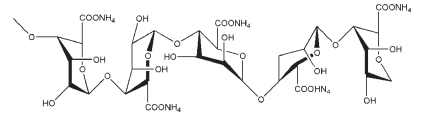
(C6H11NO6)n 193.16 (calculated) 217 (actual, average) Ammonium alginate is the ammonium salt of alginic acid.
The number and sequence of the mannuronate and glucuronate residues shown above vary in the naturally occurring alginate. The associated water molecules are not shown.
Ammonium alginate is widely used in foods as a stabilizer, thickener and emulsifier. It is also used in pharmaceutical preparations as a color-diluent, emulsifier, film-former, and humectant.
Ammonium alginate occurs as white to yellowish brown filamentous, grainy, granular, or powdered forms.
See Section 18.
Moisture content Not more than 15% at 1058C for 4 hours. Solubility Dissolves slowly in water to form a viscous solution; insoluble in ethanol and in ether.
Ammonium alginate is a hygroscopic material, although it is stable if stored at low relative humidities and cool temperatures.
Incompatible with oxidizing agents and strong acids and alkalis.
—
Ammonium alginate is widely used in cosmetics and food products, and also in pharmaceutical formulations such as tablets. It is generally regarded as a nontoxic and nonirritant material, although excessive oral consumption may be harmful.
Observe normal precautions appropriate to the circumstances and quantity of the material handled. Eye protection, gloves, and a dust respirator are recommended.
GRAS listed. Accepted in Europe for use as a food additive. Included in the FDA Inactive Ingredients Database (oral, tablets).
Alginic acid; calcium alginate; potassium alginate; propylene glycol alginate; sodium alginate.
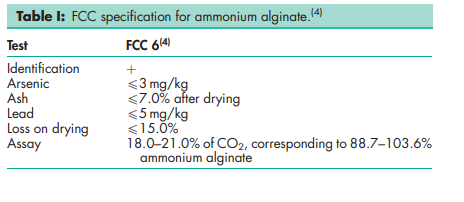
Alginates are commonly used in wound dressings.(1) Chitosan and alginates have been used together to produce sponges for use as wound dressings, or matrices for tissue engineering.(2) Alginate microspheres have been produced by internal gelation using emulsification methods.(3) Although not included in any pharmacopeias, a specification for ammonium alginate is contained in the Food Chemicals Codex (FCC), see Table I.