Name: Dibutyl Phthalate
CAS No: Dibutyl benzene-1,2-dicarboxylate [84-74-2]
BP: Dibutyl Phthalate PhEur: Dibutyl Phthalate USP-NF: Dibutyl Phthalate
Araldite 502; benzenedicarboxylic acid; benzene-o-dicarboxylic acid di-n-butyl ester; butyl phthalate; Celluflex DBP; DBP; dibutyl 1,2-benzenedicarboxylate; dibutyl benzene 1,2-dicarboxylate; dibutyl ester of 1,2-benzenedicarboxylic acid; dibutylis phthalas; dibutyl-o-phthalate; di-n-butyl phthalate; Elaol; Ergoplast FDB; Genoplast B; Hatcol DBP; Hexaplast M/B; Kodaflex DBP; Monocizer DBP; Palatinol C; phthalic acid dibutyl ester; Polycizer DBP; PX 104; RC Plasticizer DBP; Staflex DBP; Unimoll DB; Vestimol C; Witcizer 300.
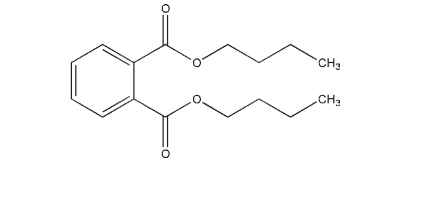
Dibutyl benzene-1,2-dicarboxylate [84-74-2]
C16H22O4 278.34
Dibutyl phthalate is used in pharmaceutical formulations as a plasticizer in film-coatings. It has been evaluated as a pore-forming agent in novel delivery systems.(3,4) It is also used extensively as a solvent, particularly in cosmetic formulations such as antiperspirants, hair shampoos, and hair sprays. In addition to a number of industrial applications, dibutyl phthalate is used as an insect repellent, although it is not as effective as dimethyl phthalate.
Dibutyl phthalate occurs as an odorless, oily, colorless, or very slightly yellow-colored, viscous liquid.
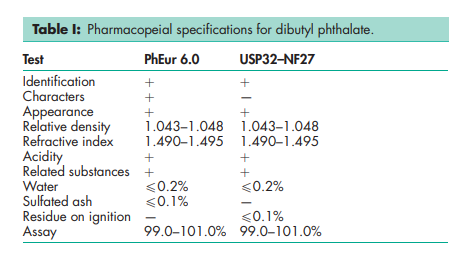
See Table I.
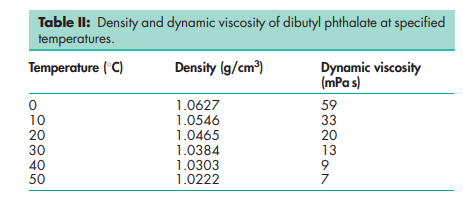
Boiling point 3408C Density see Table II. Flash point 1718C (open cup) Melting point 358C Partition coefficient Octanol: water log kow = 4.50 Refractive index n D 20 = 1.491–1.495 Solubility Very soluble in acetone, benzene, ethanol (95%), and ether; soluble 1 in 2500 of water at 208C. Viscosity (dynamic) see Table II.
Dibutyl phthalate should be stored in a well-closed container in a cool, dry, location. Containers may be hazardous when empty since they can contain product residues such as vapors and liquids.
Dibutyl phthalate reacts violently with chlorine. It also reacts with oxidizing agents, acids, bases, and nitrates.
Dibutyl phthalate is produced from n-butanol and phthalic anhydride in an ester formation reaction.
Dibutyl phthalate is generally regarded as a relatively nontoxic material, although it has occasionally been reported to cause hypersensitivity reactions. It is widely used in topical cosmetic and some oral pharmaceutical formulations. LD50 (mouse, IV): 0.72 g/kg(1) LD50 (mouse, oral): 5.3 g/kg LD50 (rat, oral): 8.0 g/kg LD50 (rat, IP): 3.05 mL/kg
Observe normal precautions appropriate to the circumstances and quantity of material handled. Contact with the skin and eyes should be avoided. Decomposition produces toxic fumes, carbon monoxide and carbon dioxide. In the USA, the permitted 8-hour exposure limit for dibutyl phthalate is 5 mg/m3 . In the UK, the long-term (8-hour TWA) workplace exposure limit for dibutyl phthalate is 5 mg/m3 . The short-term (15-minute) workplace exposure limit is 10 mg/m3
Diethyl phthalate; dimethyl phthalate; dioctyl phthalate. Dioctyl phthalate Empirical formula C24H38O4 Molecular weight 390.55 CAS number Dioctyl phthalate occurs commercially in two isomeric forms: di-n-octyl phthalate [117-84-0] and di(2- ethylhexyl) phthalate [117-81-7]. Synonyms 1,2-Benzenedicarboxylic acid bis(2-ethylhexyl) ester; bis(2-ethylhexyl) phthalate; di(2-ethyl-hexyl)phthalate; DEHP; DOP; Octoil. Description Clear, colorless, odorless, and anhydrous liquid. Boiling point 3848C Flash point 2068C (closed cup) Melting point 508C Refractive index n D 20 = 1.50 Solubility Soluble in conventional organic solvents; practically insoluble in water. Comments The EINECS number for dioctyl phthalate is 204-214-7.
The EINECS number for dibutyl phthalate is 201-557-4. The PubChem Compound ID (CID) for dibutyl phthalate is 3026.