
Name: Calcium Silicate
CAS No: Calcium silicate [1344-95-2]
USP-NF: Calcium Silicate
Calcium hydrosilicate; calcium metasilicate; calcium monosilicate; calcium polysilicate; Micro-Cel; okenite; silicic acid, calcium salt; tobermorite
Calcium silicate [1344-95-2]
CaSiO3 116.2
See Section 4.
Calcium silicate is used as a filler aid for oral pharmaceuticals. It has also been used in pharmaceutical preparations as an antacid. The main applications of calcium silicate relate to its anticaking properties, and it has therefore been used in dusting powders and a range of different cosmetic products (e.g. face powders, eye shadow).(1)
Calcium silicate occurs as a crystalline or amorphous white or offwhite material, and often exists in different hydrate forms.
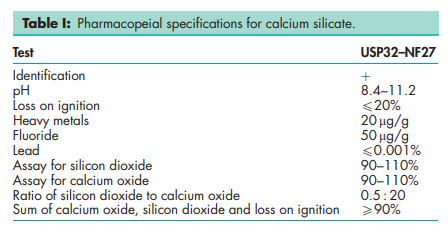
The USP32–NF27 describes the material as containing not less than 4% of calcium oxide and not less than 35% of silicon dioxide. See Table I.
Acidity/alkalinity pH = 8.4–10.2 (5% w/v aqueous solution) Density 2.10 g/cm3 Melting point 15408C Solubility Practically insoluble in water; forms a gel with mineral acids. It can absorb up to 2.5 times its weight of liquids and still remain a free-flowing powder.
Calcium silicate is chemically stable and nonflammable, but it should be protected from moisture. Store in airtight containers in a cool, dry place.
Calcium silicate is a naturally occurring mineral, but for commercial applications it is usually prepared from lime and diatomaceous earth under carefully controlled conditions
When used in oral formulations, calcium silicate is practically nontoxic. Inhalation of the dust particles may cause respiratory tract irritation.
Observe normal precautions appropriate to the circumstances and quantity of the material handled. In large quantities, calcium silicate is irritating to eyes, the respiratory system and skin. Gloves, eye protection, a respirator, and other protective clothing should be worn. In the UK, the long-term (8-hour TWA) workplace exposure standards for calcium silicate are 10 mg/m3 for total inhalable dust and 4 mg/m3 for respirable dust.(2)
GRAS listed. Included in the FDA Inactive Ingredients Database (oral dosage forms). Included in nonparenteral (oral, orodispersible, effervescent and enteric-coated tablets) formulations licensed in the UK.
Calcium diorthosilicate; calcium trisilicate Studies utilizing the porous properties of calcium silicate granules have shown their ability to form floating structures, giving rise to potentially gastroretentive formulations.(3,4) A specification for calcium silicate is contained in the Food Chemicals Codex (FCC).(5) The EINECS number for calcium silicate is 215-710-8. The PubChem Compound ID (CID) for calcium silicate is 518851.
Studies utilizing the porous properties of calcium silicate granules have shown their ability to form floating structures, giving rise to potentially gastroretentive formulations.(3,4) A specification for calcium silicate is contained in the Food Chemicals Codex (FCC).(5) The EINECS number for calcium silicate is 215-710-8. The PubChem Compound ID (CID) for calcium silicate is 518851.