
Name: Canola Oil
CAS No: Canola oil [120962-03-0]
PhEur: Rapeseed Oil, Refined USP-NF: Canola Oil
Canbra oil; Colzao CT; huile de colza; Lipex 108; Lipex 204; Lipovol CAN; low erucic acid colza oil; low erucic acid rapeseed oil; rapae oleum raffinatum; tower rapeseed oil.
Canola oil [120962-03-0]
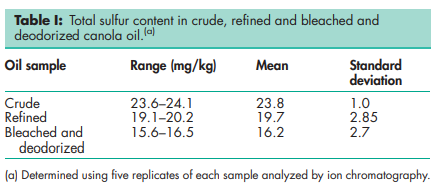
Canola oil contains approximately 6% saturated acids, 2% monounsaturated acids, and 32% polyunsaturated acids. Additionally, sulfur-containing fatty acids may also be present as minor constituents. The sulfur-containing compounds have been held responsible for the unpleasant odors from heated rapeseed oil. It has been suggested that the sulfur compounds in rapeseed oil are of three types: volatile, thermolabile, and nonvolatile.(1) Unrefined canola oil is said to contain low levels of sulfurcontaining fatty acids, resulting in the presence of sulfur in the oil in the stable form of triglycerides. These triglycerides resist refining procedures.(2) See Table I for the sulfur content of crude, refined, and deodorized canola oils.(3)
See Section 4.
Canola oil is a refined rapeseed oil obtained from particular species of rapeseed that have been genetically selected for their low erucic acid content.(4) In pharmaceutical formulations, canola oil is used mainly in topical preparations such as soft soaps and liniments. It is also used in cosmetics.
A clear, light yellow-colored oily liquid with a bland taste
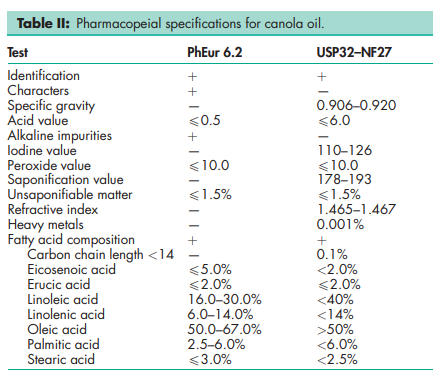
See Table II.
Density 0.913–0.917 g/cm3 Flash point 290–3308C Free fatty acid 40.05% as oleic acid Freezing point 10 to 28C Solubility Soluble in chloroform and ether; practically insoluble in ethanol (95%); miscible with fixed oils. Viscosity (dynamic) 77.3–78.3 mPa s (77.3–78.3 cP) at 208C
Canola oil is stable and should be stored in an airtight, lightresistant container in a cool, dry place. The USP32–NF27 specifies that contact between canola oil and metals should be avoided. Containers should be filled to the top, while partially filled containers should be flushed with nitrogen. During storage, grassy, paintlike, or rancid off-flavors can develop. Flavor deterioration has been attributed mainly to secondary oxidation products of linolenic acid, which normally makes up 6–14% of the fatty acids in canola oil. Storage tests of canola oil showed sensory changes after 2–4 days at 60–658C in comparison to 16 weeks at room temperature. Canola oil seems to be more stable to storage in light than cottonseed oil and soybean oils, but is less stable than sunflower oil.(5) In addition, the effects of various factors on sediment formation in canola oil have been reported.(6) It has been reported that oils stored at 28C showed the highest rate of sediment formation, followed by those stored at 68C.(5) All samples showed little sediment formation, as measured by turbidity, during storage at 128C. Removal of sediment from canola oil prior to storage by cold precipitation and filtration did not eliminate this phenomenon, which still developed rapidly at 28C. A study on the effect of heating on the oxidation of low linolenic acid canola oil at frying temperatures under nitrogen and air clearly showed that a significantly lower development of oxidation was evident for the low linolenic acid canola oil. Reduction in the linolenic acid content of canola oil reduced the development of room odor at frying temperatures. The thermal oxidation of canola oil studied during oven heating revealed an increase in peroxide values of pure and antioxidant treated oils. Peroxide values were shown to differ between pure and antioxidant-treated canola oil during the initial stages of microwave heating (6 minutes). Formation of secondary products of oxidation, which contribute to off-flavors, were also observed.(7)
Canola oil is obtained by mechanical expression or n-hexane extraction from the seeds of Brassica napus (Brassica campestris) var. oleifera and certain other species of Brassica (Cruciferae). The crude oil thus obtained is refined, bleached, and deodorized to substantially remove free fatty acids, phospholipids, color, odor and flavor components, and miscellaneous nonoil materials.
Canola oil is generally regarded as an essentially nontoxic and nonirritant material, and has been accepted by the FDA for use in cosmetics, foods, and pharmaceuticals. Rapeseed oil has been used for a number of years in food applications as a cheap alternative to olive oil. However, there are large amounts of erucic acid and glucosinolates in conventional rapeseed oil, both substances being toxic to humans and animals.(7) Canola oil derived from genetically selected rapeseed plants that are low in erucic acid content has been developed to overcome this problem. The FDA specifies 165.55 mg as the maximum amount for each route or dosage form containing the ingredient. Feeding studies in rats have suggested that canola oil is nontoxic to the heart, although it has also been suggested that the toxicological data may be unclear.(8
Observe normal precautions appropriate to the circumstances and quantity of material handled. Spillages of this material are very slippery and should be covered with an inert absorbent material prior to disposal. Canola oil poses a slight fire hazard.
Accepted for use by the FDA in cosmetics and foods. Included in the FDA Inactive Ingredients Database (oral capsules). Included in the Canadian List of Acceptable Non-medicinal Ingredients.
Almond oil; corn oil; cottonseed oil; peanut oil; rapeseed oil; sesame oil; soybean oil. Rapeseed oil CAS number [8002-13-9] Synonyms Calchem H-102; colza oil; rape oil. Appearance A clear, yellow to dark yellow-colored oily liquid. Iodine number 94–120 Peroxide value <5 Saponification value 168–181 Comments Rapeseed oil contains 40–55% erucic acid. It is an edible oil and has been primarily used as an alternative, in foods and some pharmaceutical applications, to the more expensive olive oil. However, the safety of rapeseed oil as part of the diet has been questioned; see Section 14.
Canola oil has the lowest level of saturated fat compared to all other oils on the market at present and it is now second only to soybean as the most important source of vegetable oil in the world. It has both a high protein (28%) and a high oil content (40%). When the oil is extracted, a high-quality and highly palatable feed concentrate of 37% protein remains. Canola oil is also high in the monounsaturated fatty acid oleic acid; see Table III. The content of tocopherol, a natural antioxidant in canola, is comparable to those of peanut and palm oil. This is an important factor for oils with high linolenic acid content, which can reduce the shelf-life of the product, while the natural antioxidant, if present, can prevent oxidation during storage and processing. A specification for canola oil is contained in the Food Chemicals Codex (FCC).(10) The EINECS number for canola oil is 232-313-5