
Name: Carboxymethylcellulose Calcium
CAS No: Cellulose, carboxymethyl ether, calcium salt [9050-04-8
BP: Carmellose Calcium JP: Carmellose Calcium PhEur: Carmellose Calcium USP-NF: Carboxymethylcellulose Calcium
Calcium carboxymethylcellulose; calcium cellulose glycolate; carmellosum calcium; CMC calcium; ECG 505; Nymcel ZSC.
Cellulose, carboxymethyl ether, calcium salt [9050-04-8
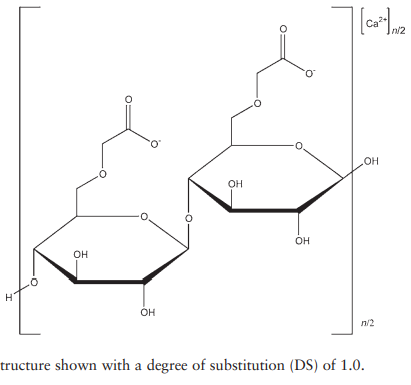
The USP32–NF27 describes carboxymethylcellulose calcium as the calcium salt of a polycarboxymethyl ether of cellulose
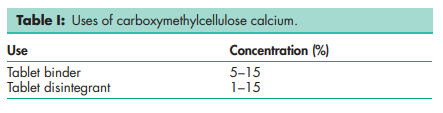
The main use of carboxymethylcellulose calcium is in tablet formulations (see Table I), where it is used as a binder, diluent, and disintegrant.(1–4) Although carboxymethylcellulose calcium is insoluble in water, it is an effective tablet disintegrant as it swells to several times its original bulk on contact with water. Concentrations up to 15% w/w may be used in tablet formulations; above this concentration, tablet hardness is reduced. Carboxymethylcellulose calcium is also used in other applications similarly to carboxymethylcellulose sodium; for example, as a suspending or viscosity-increasing agent in oral and topical pharmaceutical formulations. Carboxymethylcellulose calcium is also used in modern wound dressings for its water absorption, retention and hemostatic properties.
Carboxymethylcellulose calcium occurs as a white to yellowishwhite, hygroscopic, odorless powder.
See Table II. See also Section 18.
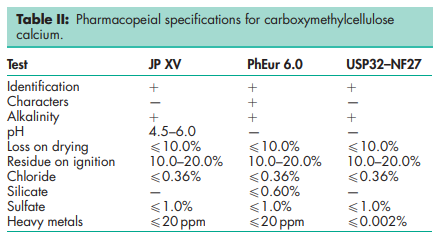
Acidity/alkalinity pH = 4.5–6.0 for a 1% w/v aqueous dispersion. Solubility Practically insoluble in acetone, chloroform, ethanol (95%), toluene, and ether. Insoluble in water, but swells to form a suspension.
Carboxymethylcellulose calcium is a stable, though hygroscopic material. It should be stored in a well-closed container in a cool, dry place. See also Carboxymethylcellulose Sodium.
See Carboxymethylcellulose Sodium.
Cellulose, obtained from wood pulp or cotton fibers, is carboxymethylated, followed by conversion to the calcium salt. It is then graded on the basis of its degree of carboxymethylation and pulverized.
Carboxymethylcellulose calcium is used in oral and topical pharmaceutical formulations, similarly to carboxymethylcellulose sodium, and is generally regarded as a nontoxic and nonirritant material. However, as with other cellulose derivatives, oral consumption of large amounts of carboxymethylcellulose calcium may have a laxative effect. See also Carboxymethylcellulose Sodium.
Observe normal precautions appropriate to the circumstances and quantity of material handled. Carboxymethylcellulose calcium may be irritant to the eyes; eye protection is recommended.
Included in the FDA Inactive Ingredients Database (oral, capsules and tablets). Included in nonparenteral medicines licensed in the UK. Included in the Canadian List of Acceptable Non-medicinal Ingredients.
Carboxymethylcellulose sodium; croscarmellose sodium
Carboxymethylcellulose calcium is one of the materials that have been selected for harmonization by the Pharmacopeial Discussion Group. For further information see the General Information Chapter <1196> in the USP32–NF27, the General Chapter 5.8 in PhEur 6.0, along with the ‘State of Work’ document on the PhEur EDQM website, and also the General Information Chapter 8 in the JP XV.