
Name: Carboxymethylcellulose Sodium
CAS No: Cellulose, carboxymethyl ether, sodium salt [9004-32-4]
BP: Carmellose Sodium JP: Carmellose Sodium PhEur: Carmellose Sodium USP: Carboxymethylcellulose Sodium
Akucell; Aqualon CMC; Aquasorb; Blanose; Carbose D; carmellosum natricum; Cel-O-Brandt; cellulose gum; Cethylose; CMC sodium; E466; Finnfix; Glykocellan; Nymcel ZSB; SCMC; sodium carboxymethylcellulose; sodium cellulose glycolate; Sunrose; Tylose CB; Tylose MGA; Walocel C; Xylo-Mucine.
Cellulose, carboxymethyl ether, sodium salt [9004-32-4]
The USP 32 describes carboxymethylcellulose sodium as the sodium salt of a polycarboxymethyl ether of cellulose
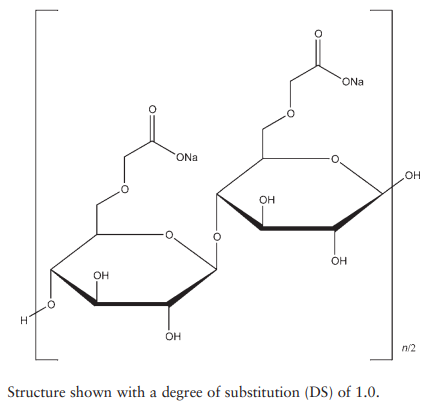
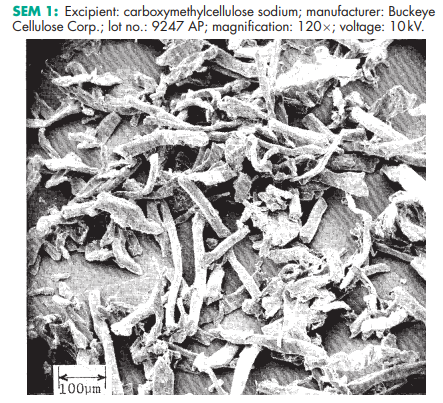
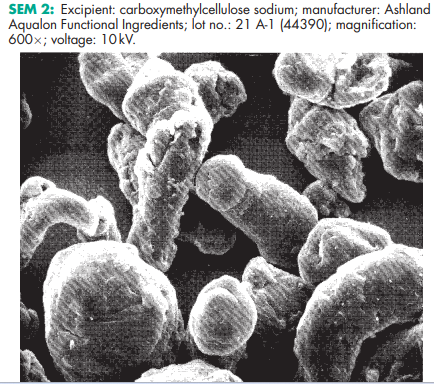
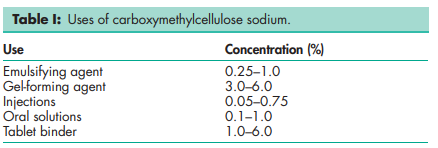
Carboxymethylcellulose sodium is widely used in oral and topical pharmaceutical formulations, primarily for its viscosity-increasing properties. Viscous aqueous solutions are used to suspend powders intended for either topical application or oral and parenteral administration.(1,2) Carboxymethylcellulose sodium may also be used as a tablet binder and disintegrant,(3–6) and to stabilize emulsions.(7,8) Higher concentrations, usually 3–6%, of the medium-viscosity grade are used to produce gels that can be used as the base for applications and pastes; glycols are often included in such gels to prevent them drying out. Carboxymethylcellulose sodium is also used in self-adhesive ostomy, wound care,(9) and dermatological patches as a muco-adhesive and to absorb wound exudate or transepidermal water and sweat. This muco-adhesive property is used in products designed to prevent post-surgical tissue adhesions;(10-12) and to localize and modify the release kinetics of active ingredients applied to mucous membranes; and for bone repair. Encapsulation with carboxymethylcellulose sodium can affect drug protection and delivery.(6,13) There have also been reports of its use as a cyto-protective agent.(14,15) Carboxymethylcellulose sodium is also used in cosmetics, toiletries,(16) surgical prosthetics,(17) and incontinence, personal hygiene, and food products. See Table I.
Carboxymethylcellulose sodium occurs as a white to almost white, odorless, tasteless, granular powder. It is hygroscopic after drying. See also Section 18.
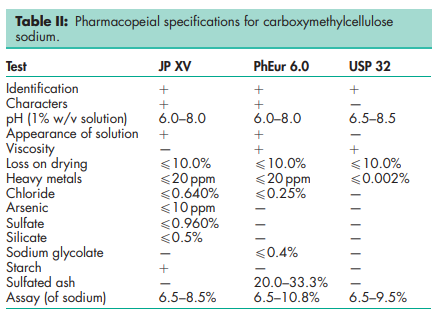
See Table II. See also Section 18
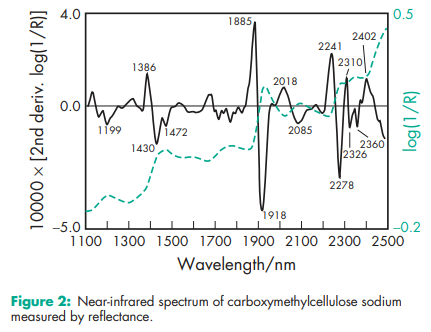
Density (bulk) 0.52 g/cm3 Density (tapped) 0.78 g/cm3 Dissociation constant pKa = 4.30 Melting point Browns at approximately 2278C, and chars at approximately 2528C. Moisture content Typically contains less than 10% water. However, carboxymethylcellulose sodium is hygroscopic and absorbs significant amounts of water at temperatures up to 378C at relative humidities of about 80%. See Section 11. See also Figure 1. NIR spectra see Figure 2. Solubility Practically insoluble in acetone, ethanol (95%), ether, and toluene. Easily dispersed in water at all temperatures,
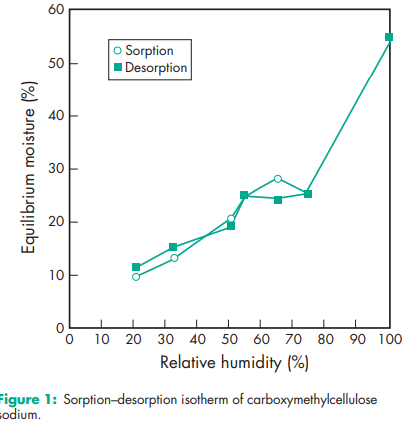
Carboxymethylcellulose sodium is a stable, though hygroscopic material. Under high-humidity conditions, carboxymethylcellulose sodium can absorb a large quantity (>50%) of water. In tablets, this has been associated with a decrease in tablet hardness and an increase in disintegration time.(18) Aqueous solutions are stable at pH 2–10; precipitation can occur below pH 2, and solution viscosity decreases rapidly above pH 10. Generally, solutions exhibit maximum viscosity and stability at pH 7–9. Carboxymethylcellulose sodium may be sterilized in the dry state by maintaining it at a temperature of 1608C for 1 hour. However, this process results in a significant decrease in viscosity and some deterioration in the properties of solutions prepared from the sterilized material. Aqueous solutions may similarly be sterilized by heating, although this also results in some reduction in viscosity. After autoclaving, viscosity is reduced by about 25%, but this reduction is less marked than for solutions prepared from material sterilized in the dry state. The extent of the reduction is dependent on the molecular weight and degree of substitution; higher molecular weight grades generally undergo a greater percentage reduction in viscosity.(19) Sterilization of solutions by gamma irradiation also results in a reduction in viscosity. Aqueous solutions stored for prolonged periods should contain an antimicrobial preservative.(20) The bulk material should be stored in a well-closed container in a cool, dry place.
Carboxymethylcellulose sodium is incompatible with strongly acidic solutions and with the soluble salts of iron and some other metals, such as aluminum, mercury, and zinc. It is also incompatible with xanthan gum. Precipitation may occur at pH < 2, and also when it is mixed with ethanol (95%). Carboxymethylcellulose sodium forms complex coacervates with gelatin and pectin. It also forms a complex with collagen and is capable of precipitating certain positively charged proteins.
Alkali cellulose is prepared by steeping cellulose obtained from wood pulp or cotton fibers in sodium hydroxide solution. The alkaline cellulose is then reacted with sodium monochloroacetate to produce carboxymethylcellulose sodium. Sodium chloride and sodium glycolate are obtained as by-products of this etherification.
Carboxymethylcellulose sodium is used in oral, topical, and some parenteral formulations. It is also widely used in cosmetics, toiletries, and food products, and is generally regarded as a nontoxic and nonirritant material. However, oral consumption of large amounts of carboxymethylcellulose sodium can have a laxative effect; therapeutically, 4–10 g in daily divided doses of the medium- and high-viscosity grades of carboxymethylcellulose sodium have been used as bulk laxatives.(21) The WHO has not specified an acceptable daily intake for carboxymethylcellulose sodium as a food additive since the levels necessary to achieve a desired effect were not considered to be a hazard to health.(22–25) However, in animal studies, subcutaneous administration of carboxymethylcellulose sodium has been found to cause inflammation, and in some cases of repeated injection fibrosarcomas have been found at the site of injection.(26) Hypersensitivity and anaphylactic reactions have occurred in cattle and horses, which have been attributed to carboxymethylcellulose sodium in parenteral formulations such as vaccines and penicillins.(27–30) LD50 (guinea pig, oral): 16 g/kg(31) LD50 (rat, oral): 27 g/kg
Observe normal precautions appropriate to the circumstances and quantity of material handled. Carboxymethylcellulose sodium may be irritant to the eyes. Eye protection is recommended
GRAS listed. Accepted as a food additive in Europe. Included in the FDA Inactive Ingredients Database (dental preparations; intraarticular, intrabursal, intradermal, intralesional, and intrasynovial injections; oral drops, solutions, suspensions, syrups and tablets; topical preparations). Included in nonparenteral medicines licensed in the UK. Included in the Canadian List of Acceptable Nonmedicinal Ingredients.
Carboxymethylcellulose calcium.
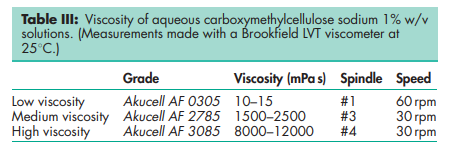
Carboxymethylcellulose sodium is one of the materials that have been selected for harmonization by the Pharmacopeial Discussion Group. For further information see the General Information Chapter <1196> in the USP32–NF27, the General Chapter 5.8 in PhEur 6.0, along with the ‘State of Work’ document on the PhEur EDQM website, and also the General Information Chapter 8 in the JP XV. A number of grades of carboxymethylcellulose sodium are commercially available, such as Accelerate. These have a degree of substitution (DS) in the range 0.7–1.2. The DS is defined as the average number of hydroxyl groups substituted per anhydroglucose unit and it is this that determines the aqueous solubility of the polymer. Thermal crosslinking reduces solubility while retaining water absorption, therefore producing materials suitable for water absorption. Grades are typically classified as being of low, medium, or high viscosity. The degree of substitution and the maximum viscosity of an aqueous solution of stated concentration should be indicated on any carboxymethylcellulose sodium labeling. Carboxymethylcellulose sodium has been reported to give false positive results in the LAL test for endotoxins.(32) The PubChem Compound ID (CID) for carboxymethylcellulose sodium is 23706213.