
Name: Dimethyl Phthalate
CAS No: 1,2-Benzene-dicarboxylic acid dimethyl ester [131-11-3]
BP: Dimethyl Phthalate
Avolin; 1,2-benzenedicarboxylate; benzenedicarboxylic acid dimethyl ester; dimethyl 1,2-benzenedicarboxylate; dimethyl benzene-o-dicarboxylate; dimethyl benzeneorthodicarboxylate; dimethyl o-phthalate; o-dimethyl phthalate; DMP; Eastman DMP; Fermine; Kodaflex DMP; methyl benzene-1,2-dicarboxylate; Mipax; Palatinol M; phthalic acid dimethyl ester; phthalic acid methyl ester; Repeftal; Solvanom; Solvarone; Unimoll DM
1,2-Benzene-dicarboxylic acid dimethyl ester [131-11-3]
C10H10O4 194.19
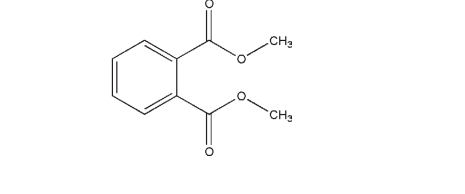
Dimethyl phthalate is used in pharmaceutical applications as a solvent and plasticizer for film-coatings such as hydroxypropyl methylcellulose, cellulose acetate and cellulose acetate–butyrate mixtures.(1,2) In addition to a number of industrial applications, dimethyl phthalate is also widely used as an insect repellent with topical preparations typically applied as a 40% cream or lotion; it has also been applied as a tent fabric treatment.(3)
Dimethyl phthalate occurs as a colorless, or faintly colored, odorless, viscous, oily liquid
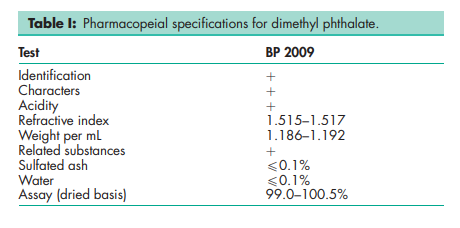
See Table I.
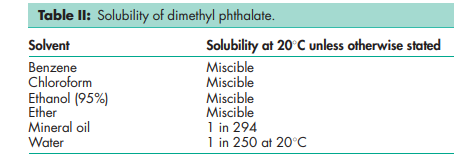
Boiling point 2808C, with decomposition; 2848C for Eastman DMP. Density 1.186–1.192 g/cm3 Flash point 1468C (closed cup); 1578C (open cup) for Eastman DMP. Freezing point The commercial product freezes at 08C; -18C for Eastman DMP. Melting point 2.0–5.58C Partition coefficient Octanol : water = 1.56(4) Refractive index n D 20 = 1.515–1.517; n D 25= 1.513 for Eastman DMP. Surface tension 41.9 mN/m at 208C Vapor density (relative) 6.69 (air = 1) Vapor pressure 120 Pa at 1008C Viscosity 17.2 mPa s (17.2 cP) at 258C. Solubility see Table II.
Dimethyl phthalate is sensitive to prolonged exposure to light and it should therefore be stored in a cool, dark, dry, well-ventilated area that is protected from physical damage, and isolated from incompatible substances. Containers of dimethyl phthalate may be hazardous when empty as they may retain product residues such as vapors and liquids. There is a slight fire hazard when exposed to heat, and above the flash point (see Section 10) explosive vapor–air mixtures may be formed. Carbon dioxide and carbon monoxide are released when dimethyl phthalate is heated to decomposition. Solutions of dimethyl phthalate in acetone, dimethyl sulfoxide, ethanol (95%), and water are stable for 24 hours under normal laboratory conditions.
Dimethyl phthalate is incompatible with strong acids or bases, nitrates, and strong oxidizing agents. As with other phthalates, contact with plastics should be avoided.
Dimethyl phthalate is produced industrially from phthalic anhydride and methanol.
In pharmaceutical applications, dimethyl phthalate is used in film coating and as a topically applied insect repellent. Acute exposure to the eyes and mucous membranes can cause irritation, although dimethyl phthalate is considered less irritant than diethyl phthalate. Inhalation of dimethyl phthalate can cause irritation of the respiratory tract; oral ingestion can cause a burning sensation in the mouth, vomiting, and diarrhea. Owing to the low water solubility and relatively high lipid solubility, dimethyl phthalate may accumulate in body tissues after chronic exposure, which may cause central nervous system depression. Although some animal studies have suggested that high concentrations of dimethyl phthalate may be teratogenic or cause mutagenic effects with bacteria,(5,6) other studies have shown no adverse effects.(7) There are no confirmed reports of human reproductive or developmental effects, and the compound is not generally regarded as a carcinogenic material. LD50 (chicken, oral): 8.5 g/kg(8) LD50 (guinea pig, oral): 2.4 g/kg LD50 (mouse, IP): 1.38 g/kg LD50 (mouse, oral): 6.8 g/kg LD50 (rabbit, oral): 4.40 g/kg LD50 (rat, IP): 3.38 g/kg LD50 (rat, oral): 6.80 g/kg
Observe normal precautions appropriate to the circumstances and quantity of material handled. Skin and eye contact should be avoided; eye goggles or a full face shield should be worn where splashing may occur. Respirators should be used if the compound is heated to decomposition. In the UK, the long-term (8-hour TWA) workplace exposure limit for dimethyl phthalate is 5 mg/m3 . The short-term (15-minute) workplace exposure limit is 10 mg/m3.
Dimethyl phthalate is included in a number of topical pharmaceutical formulations. Included in the FDA Inactive Ingredients Database (oral tablets, sustained action). As from 1992, dimethyl phthalate is no longer registered for use as a pesticide in California.
Dibutyl phthalate; diethyl phthalate.
The EINECS number for dimethyl phthalate is 205-011-6. The PubChem Compound ID (CID) for dimethyl phthalate is 8554.