Name: Dimethylacetamide
CAS No: N,N-Dimethylacetamide [127-19-5]
BP: Dimethylacetamide PhEur: Dimethylacetamide
Acetdimethylamide; acetic acid dimethylamide; acetyldimethylamine; dimethylacetamidum; dimethylacetone amide; dimethylamide acetate; DMA; DMAC.
N,N-Dimethylacetamide [127-19-5]
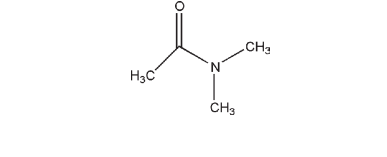
C4H9NO 87.12
Dimethylacetamide is used as a solvent in oral and injectable pharmaceutical formulations.(1) It has been used as a cosolvent to solubilize poorly soluble drugs.(2–4) The use of dimethylacetamide has also been investigated as a vehicle for the parenteral delivery of relatively small peptides.(5) The use of solvents such as dimethylacetamide has been shown to influence the size and rate of release of norfloxacin from nanoparticles.(6) Dimethylacetamide has also been used in topical formulations and has been evaluated as a permeation enhancer for transdermal drug delivery.(1)
Dimethylacetamide occurs as a clear, colorless, slightly hygroscopic liquid. It has a weak ammonia-like or fish-like odor.
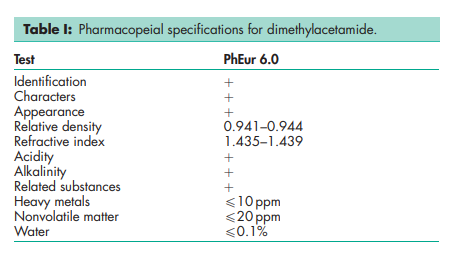
See Table I. See also Section 18.
Autoignition temperature 4908C Boiling point 1658C Dielectric constant D20 = 37.8 Flash point 708C Refractive index nD 22.5 = 1.4371 Solubility Miscible with ethanol (95%), water, and most common solvents. Specific gravity 0.943 Surface tension 35.7 mN/m (35.7 dyne/cm) Vapor pressure 0.33 kPa at 208C Viscosity (dynamic) 1.02 mPa s (1.02 cP) at 258C
Dimethylacetamide should be stored in an airtight container, protected from light, in a cool, dry place. Dimethylacetamide has an almost unlimited shelf-life when kept in closed containers and under nitrogen. It is combustible.
Dimethylacetamide is incompatible with carbon tetrachloride, oxidizing agents, halogenated compounds, and iron. It attacks plastic and rubber. Contact with strong oxidizers may cause fire
Dimethylacetamide is manufactured from acetic acid and dimethylamine in a closed system.
Dimethylacetamide is used in pharmaceutical preparations as a solvent in parenteral formulations and is generally regarded as a nontoxic material when used as an excipient. Animal toxicity studies indicate that dimethylacetamide is readily absorbed into the bloodstream following inhalation or topical application. Repeated exposure to dimethylacetamide may be harmful and can result in liver damage. High intravenous doses (>400 mg/kg/day for 3 days) may be hallucinogenic.(7–10) LD50 (rabbit, SC): 9.6 g/kg(11) LD50 (rat, IP): 2.75 g/kg LD50 (rat, IV): 2.64 g/kg LD50 (rat, oral): 4.93 g/kg LD50 (mouse, inhalation): 7.2 g/kg LD50 (mouse, IP): 2.8 g/kg LD50 (mouse, IV): 3.02 g/kg LD50 (mouse, SC): 9.6 g/kg
Observe normal precautions appropriate to the circumstances and quantity of the material handled. Dimethylacetamide can be absorbed into the bloodstream by inhalation and through the skin; it is irritating to the skin and eyes
Included in the FDA Inactive Ingredients Database (IM injections, IV injections and infusions). Included in parenteral medicines licensed in the UK.
—
A specification for dimethylacetamide is included in the Japanese Pharmaceutical Excipients (JPE).(12) The EINECS number for dimethylacetamide is 204-826-4. The PubChem Compound ID (CID) for dimethylacetamide is 31374.