
Name: Docusate Sodium
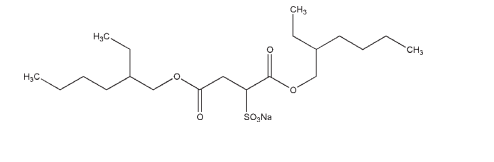
CAS No: Sodium 1,4-bis(2-ethylhexyl) sulfosuccinate [577-11-7]
BP: Docusate Sodium PhEur: Docusate Sodium USP: Docusate Sodium
Bis(2-ethylhexyl) sodium sulfosuccinate; dioctyl sodium sulfosuccinate; DSS; natrii docusas; sodium 1,4-bis(2-ethylhexyl) sulfosuccinate; sodium 1,4-bis[(2-ethylhexyl)oxy]-1,4-dioxobutane-2- sulfonate; sodium dioctyl sulfosuccinate; sulfo-butanedioic acid 1,4-bis(2-ethylhexyl) ester, sodium salt; sulfosuccinic acid 1,4-bis(2- ethylhexyl) ester S-sodium salt.
Sodium 1,4-bis(2-ethylhexyl) sulfosuccinate [577-11-7]
C20H37NaO7S 444.56
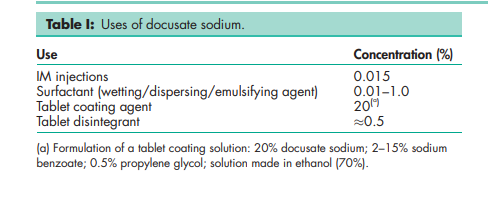
Docusate sodium and docusate salts are widely used as anionic surfactants in pharmaceutical formulations. Docusate sodium is mainly used in capsule and direct-compression tablet formulations to assist in wetting and dissolution.(1) Docusate salts are also used in oral formulations as laxatives and fecal softeners; see Table I
Docusate sodium is a white or almost white, waxlike, bitter tasting, plastic solid with a characteristic octanol-like odor. It is hygroscopic and usually available in the form of pellets, flakes, or rolls of tissuethin material.
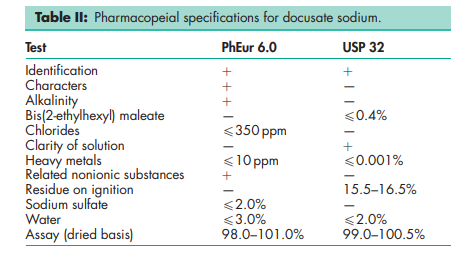
See Table II
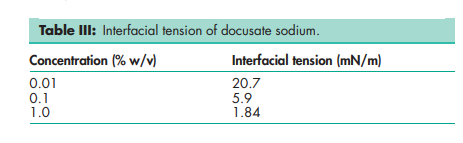
Acidity/alkalinity pH = 5.8–6.9 (1% w/v aqueous solution). Acid value 42.5 Critical micelle concentration 0.11% w/v aqueous solution at 258C. Density 1.16 g/cm3 Hydroxyl value 6.0–8.0 Interfacial tension In water versus mineral oil at 258C, Iodine number 40.25 Melting point 153–1578C Moisture content 1.51%
Docusate sodium is stable in the solid state when stored at room temperature. Dilute aqueous solutions of docusate sodium between pH 1–10 are stable at room temperature. However, at very low pH (<1) and very high pH (>10) docusate sodium solutions are subject to hydrolysis. The solid material is hygroscopic and should be stored in an airtight container in a cool, dry place.
Electrolytes, e.g. 3% sodium chloride, added to aqueous solutions of docusate sodium can cause turbidity.(2,3) However, docusate sodium possesses greater tolerance to calcium, magnesium, and other polyvalent ions than do some other surfactants. Docusate sodium is incompatible with acids at pH < 1 and with alkalis at pH > 10.
Maleic anhydride is treated with 2-ethylhexanol to produce dioctyl maleate, which is then reacted with sodium bisulfite.
Docusate salts are used in oral formulations as therapeutic agents for their fecal softening and laxative properties. As a laxative in adults, up to 500 mg of docusate sodium is administered daily in divided doses; in children over 6 months old, up to 75 mg in divided doses is used. The quantity of docusate sodium used as an excipient in oral formulations should therefore be controlled to avoid unintended laxative effects.(4) Adverse effects associated with docusate sodium include diarrhea, nausea, vomiting, abdominal cramps, and skin rashes. As with the chronic use of laxatives, the excessive use of docusate sodium may produce hypomagnesemia.(5) Docusate salts are absorbed from the gastrointestinal tract and excreted in bile; they may cause alteration of the gastrointestinal epithelium.(6,7) The gastrointestinal or hepatic absorption of other drugs may also be affected by docusate salts, enhancing activity and possibly toxicity. Docusate sodium should not be administered with mineral oil as it may increase the absorption of the oil. LD50 (mouse, IV): 0.06 g/kg(8) LD50 (mouse, oral): 2.64 g/kg LD50 (rat, IP): 0.59 g/kg LD50 (rat, oral): 1.9 g/kg
Observe normal precautions appropriate to the circumstances and quantity of material handled. Docusate sodium may be irritant to the eyes and skin, and when inhaled. Eye protection, gloves, and a dust mask or respirator are recommended. When heated to decomposition, docusate sodium emits toxic fumes
GRAS listed. Included in the FDA Inactive Ingredients Database (IM injections; oral capsules, suspensions, and tablets; also topical formulations). Included in nonparenteral medicines licensed in the UK. Included in the Canadian List of Acceptable Non-medicinal Ingredients.
Docusate calcium; docusate potassium. Docusate calcium Empirical formula C40H74CaO14S2 Molecular weight 883.23 CAS number [128-49-4] Synonyms 1,4-Bis(2-ethylhexyl) sulfosuccinate, calcium salt; dioctyl calcium sulfosuccinate. Appearance White amorphous solid with a characteristic octanollike odor. Solubility Soluble 1 in less than 1 of ethanol (95%), chloroform, and ether, and 1 in 3300 of water; very soluble in corn oil and polyethylene glycol 400. Docusate potassium Empirical formula C20H37KO7S Molecular weight 460.67 CAS number [7491-09-0] Synonyms Dioctyl potassium sulfosuccinate; potassium 1,4-bis(2- ethylhexyl) sulfosuccinate. Appearance White amorphous solid with a characteristic octanollike odor. Solubility Soluble in ethanol (95%) and glycerin; sparingly soluble in water.
A convenient way of making a 1% w/v aqueous solution of docusate sodium is to add 1 g of solid to about 50 mL of water and to apply gentle heat. The docusate sodium dissolves in a short time and the resulting solution can be made up to 100 mL with water. Alternatively, 1 g may be soaked overnight in 50 mL of water and the additional water may then be added with gentle heating and stirring. Docusate sodium may alter the dissolution characteristics of certain dosage forms and the bioavailability of some drugs. A specification for docusate sodium is contained in the Food Chemicals Codex (FCC).(9) The EINECS number for docusate sodium is 209-406-4. The PubChem Compound ID (CID) for docusate sodium is 23673837.