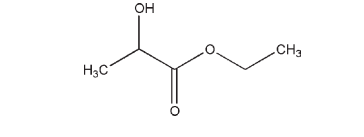
Name: Ethyl Lactate
CAS No: 2-Hydroxy-propanoic acid ethyl ester [97-64-3]
None adopted.
Actylol; Acytol; ethyl a-hydroxypropionate; ethyl-2-hydroxypropanoate; ethyl-2-hydroxypropionate; ethyl-S-(–)-2-hydroxypropionate; 2-hydroxypropanoic acid ethyl ester; lactic acid ethyl ester; propanoic acid 2-hydroxy-ethyl ester; Purasolv EL; Solactol.
2-Hydroxy-propanoic acid ethyl ester [97-64-3]
C5H10O3 & 118.13
Ethyl lactate is used as a solvent or co-solvent in liquid formulations(1,2) and recently as a co-solvent in emulsions and microemulsion technologies. It has also been used as a solvent for nitrocellulose, cellulose acetate, cellulose ethers, polyvinyl and other resins.(3) It has been applied topically in the treatment of acne vulgaris,(4,5) where it accumulates in the sebaceous glands and is hydrolyzed to ethanol and lactic acid, lowering the skin pH and exerting a bactericidal effect.
Ethyl lactate occurs as a clear colorless liquid with a sharp characteristic odor.
—
Acidity/alkalinity pH = 7 (10% w/v aqueous solution) Boiling point 154–1558C Density 1.0328 at 208C Explosion limits 1.5–11.4% Flash point 468C Heat of combustion 6.5 kcal/g Melting point –26.08C Refractive index n D 20 = 1.412–1.414 Solubility Miscible with water (with partial decomposition), ethanol (95%), ether, chloroform, ketones, esters, and hydrocarbons. Viscosity (dynamic) 0.0261 mPa s ( 0.0261 cP) at 208C Vapor density 4.07 (air = 1) Vapor pressure 0.732 kPa at 308C
Stable at normal temperature and pressure. Ethyl lactate is a flammable liquid and vapor. Store in a cool, dry, and well-ventilated location away from any fire hazard area, in a tightly closed container
Incompatible with bases or strong alkalis and may cause fire or explosion with strong oxidizing agents
Ethyl lactate is produced by the esterification of lactic acid with ethanol in the presence of a little mineral oil, or by combination of acetaldehyde with hydrocyanic acid to form acetaldehyde cyanhydrin. This is followed by treatment with ethanol (95%) and hydrochloric or sulfuric acid. Purification is achieved using fractional distillation. The commercial product is a racemic mixture.
Ethyl lactate is used as a flavoring agent in pharmaceutical preparations, and is found in food products. The estimated acceptable daily intake for lactic acid is 12.5 mg/kg body-weight. In general, lactate esters have an oral LD50 > 2000 mg/kg; and the inhalation LC50 is generally above 5000 mg/m3 . They have the potential of causing eye and skin irritation (on prolonged contact), but not sensitization.(6) Ethyl lactate is moderately toxic by intraperitoneal, subcutaneous, and intravenous routes. There is low oral and skin contact toxicity; although ingestion may cause nausea, stomach and throat pain, and narcosis. Inhalation of concentrated vapor of ethyl lactate may cause irritation of the mucous membranes, drowsiness, and narcosis. LD50 (rat, oral): >5.0 g/kg(7) LD50 (mouse, oral): 2.5 g/kg LD50 (mouse, SC): 2.5 g/kg LD50 (mouse, IV): 0.6 g/kg LD50 (rabbit, skin): >5.0 g/kg
Observe normal precautions appropriate to the circumstances and quantity of material handled. Avoid skin and eye contact; eye goggles should be worn, or a full face shield where splashing may occur. There is a slight explosion hazard in the form of vapor when it is exposed to flame. Avoid ignition sources and use adequate ventilation to keep vapor and mist as low as possible. When heated to decomposition, it emits acrid smoke and irritating fumes. Facial respirators are recommended when dealing with excessive amounts or with prolonged exposure to the compound.
GRAS listed. Reported in the EPA TSCA Inventory.
n-Butyl lactate; methyl lactate. n-Butyl lactate Empirical formula C7H14O3 Molecular weight 146.2 CAS number [138-22-7] Synonyms Butyl a-hydroxypropionate; propanoic acid 2-hydroxy butyl ester; lactic acid butyl ester; Purasolv BL. Boiling point 1888C Melting point –438C Solubility Partially miscible with water and most organic solvents. Comments n-Butyl lactate is used as a flavoring agent in pharmaceutical preparations. The EINECS number for n-butyl lactate is 205-316-4. Methyl lactate Empirical formula C4H8O3 Molecular weight 104 CAS number [547-64-8] Synonyms Methyl hydroxy propionate; Purasolv ML. Appearance Methyl lactate occurs as a clear, colorless liquid. Boiling point 143.98C Comments Methyl lactate is used as a cellulose acetate solvent.
Ethyl lactate is found in food products as a flavoring agent; owing to its biodegradability, ethyl lactate is replacing many solvents in many household products, including packaging, plastics, paints, paint strippers, grease removers, cleansers, aerosols, adhesives, and varnishes. Ethyl lactate is specified as a flavor chemical in the Food Chemicals Codex (FCC).