
Name: Ethylene Glycol Stearates
CAS No: Ethylene glycol palmitostearate
BP: Ethylene Glycol Monopalmitostearate PhEur: Ethylene Glycol Monopalmitostearate USP-NF: Ethylene Glycol Stearates
Ethyleneglycoli monopalmitostearas.
Ethylene glycol palmitostearate
Ethylene glycol stearates are used as stabilizers for water-in-oil emulsions, although they have poor emulsifying properties. They have emollient properties and are also used as opacifying, thickening, and dispersing agents. In cosmetics, ethylene glycol stearates are used as a ‘fatty body’ for lipsticks, as pearling agents in opalescent and cream shampoos, and as additives for tanning lubricants.
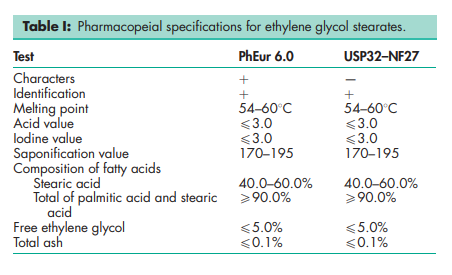
The USP32–NF27 and PhEur 6.0 describe ethylene glycol stearates as a mixture of ethylene glycol monoesters and diesters of stearic and palmitic acids, containing not less than 50% of monoesters produced from the condensation of ethylene glycol and stearic acid, of vegetable or animal origin. Ethylene glycol stearates occur as a white or almost white waxy solid.
See Table I.
Melting point 54–608C Solubility Soluble in acetone and hot ethanol (95%); practically insoluble in water
Ethylene glycol stearates should be stored in a cool, dark place, protected from light.
—
Ethylene glycol stearates are produced from the condensation of ethylene glycol with stearic acid 50 of vegetable or animal origin
Ethylene glycol stearates are mainly used in cosmetics and topical pharmaceutical formulations, where they are generally regarded as relatively nontoxic and nonirritant materials.
Observe normal precautions appropriate to the circumstances and quantity of material handled.
Included in nonparenteral medicines licensed in Europe.
Diethylene glycol monopalmitostearate; ethylene glycol monopalmitate; ethylene glycol monostearate; glyceryl monostearate; glyceryl palmitostearate. Diethylene glycol monopalmitostearate Synonyms Diethyleneglycoli monopalmitostearas; diethylene glycol palmitostearate. Description The PhEur 6.0 describes diethylene glycol monopalmitostearate as a mixture of diethylene glycol monoesters and diesters of stearic and palmitic acids. It contains not less than 45.0% of monoesters produced from the condensation of diethylene glycol and stearic acid 50 of vegetable or animal origin. Diethylene glycol monopalmitostearate occurs as a white or almost white waxy solid. Acid value 44.0 Iodine value 43.0 Melting point 43–508C Saponification value 150–170 Solubility Soluble in acetone and hot ethanol (95%); practically insoluble in water. Ethylene glycol monopalmitate CAS number [4219-49-2] Ethylene glycol monostearate Synonyms Ethylene glycol stearate; ethylene glycoli monostearas; ethyleni glycoli stearas; 2-hydroxyethyl ester stearic acid; Monestriol EN-A; Monthyle. CAS number [111-60-4] Empirical formula C20H40O3 Molecular weight 328.60 Description Occurs as pale yellow flakes. Melting point 57–638C Safety LD50 (mouse, IP): 0.20 g/kg(1)
—